


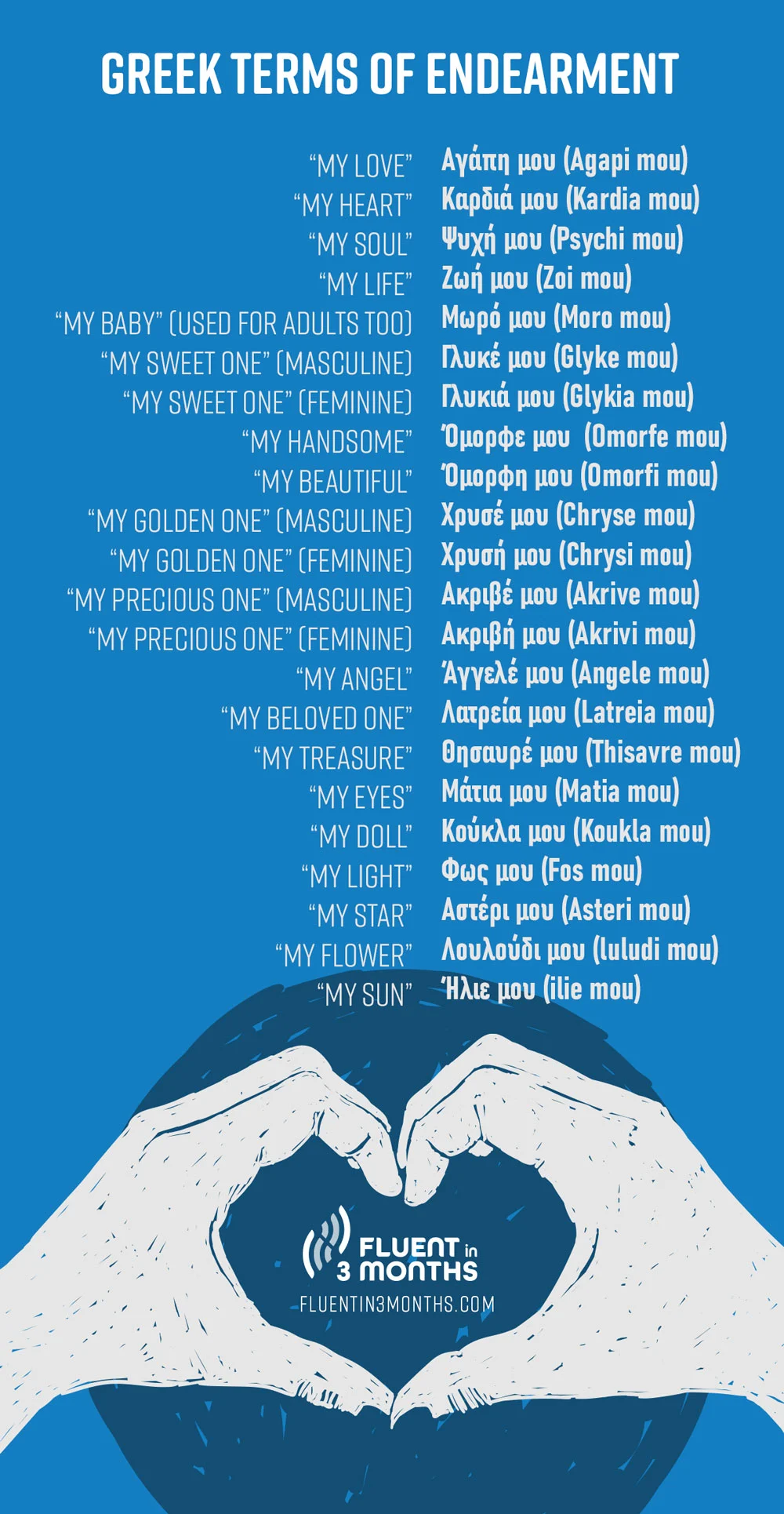
The Greek language, a cornerstone of Western civilization with a documented history spanning over 3,400 years, possesses a sophisticated lexicon for expressing human emotion and interpersonal connection. Central to this linguistic framework is the use of endearment terms, or ypokoristika, which serve as vital tools for navigating social hierarchies, reinforcing familial bonds, and articulating romantic devotion. For modern speakers and language learners alike, mastering these terms is not merely an exercise in vocabulary but an essential step toward achieving cultural fluency within the Hellenic world. The strategic combination of the fundamental phrase S’agapo (I love you) with specific nouns of affection like agapi mou (my love) or kardia mou (my heart) forms the bedrock of Greek emotional communication.
The Syntactic Foundation of Greek Endearment
To understand the mechanics of Greek affection, one must first analyze the role of the possessive pronoun mou (my). In the Greek language, this enclitic pronoun is almost invariably placed after the noun to denote a personal connection. This syntactic structure creates a sense of intimacy and "ownership" of the affection being expressed. For instance, the transition from the general noun agapi (love) to the endearing agapi mou (my love) transforms a conceptual abstract into a direct interpersonal address.
Linguists note that the Greek language is highly inflected, meaning that terms of endearment must often agree with the gender of the recipient, particularly when adjectives are involved. This is evidenced in terms such as glyke mou (my sweet one, masculine) versus glykia mou (my sweet one, feminine). Furthermore, the phonetic construction of these words often involves soft vowels and liquid consonants, which are cognitively associated with warmth and approachability.
A Taxonomy of Common Affectionate Terms
Greek endearment terms can be categorized based on their metaphorical origins, ranging from biological vital organs to celestial bodies. This variety allows speakers to calibrate the intensity of their expression based on the nature of the relationship.
Anatomical and Vital Metaphors
The Greek culture places significant emphasis on the "vital center" of a person. Consequently, terms involving the heart, soul, and life are among the most frequently utilized:
- Kardia mou (My heart): Used broadly across romantic and familial lines to indicate that the person is central to the speaker’s existence.
- Psychi mou (My soul): A deeper, more spiritual term often reserved for profound connections.
- Zoi mou (My life): An intensive declaration of the recipient’s importance.
- Matia mou (My eyes): Derived from the cultural importance of sight and the "evil eye" (mati) tradition, calling someone "my eyes" suggests they are the lens through which the speaker views the world.
Celestial and Natural Imagery
Nature provides a rich source for endearing nicknames, often highlighting the recipient’s role as a source of light or beauty:
- Fos mou (My light): Signifying guidance and clarity.
- Asteri mou (My star): Often used for children or romantic partners to denote brilliance.
- Ilie mou (My sun): Representing warmth and the sustaining force of life.
- Luludi mou (My flower): A term primarily used for children or young women, emphasizing delicacy and growth.
Value-Based and Aesthetic Terms
Terms that reference precious materials or aesthetic beauty serve to elevate the recipient’s status:
- Chryse/Chrysi mou (My golden one): Used to denote someone of high moral or personal value.
- Akrive/Akrivi mou (My precious/expensive one): Highlighting the irreplaceable nature of the individual.
- Thisavre mou (My treasure): A common term for children, suggesting they are a prized possession.
- Omorfe/Omorfi mou (My handsome/beautiful): Direct aesthetic compliments that double as nicknames.
The Diminutive System and Morphological Evolution
A unique feature of the Greek language is its robust system of diminutives. By adding specific suffixes to names or common nouns, speakers can "shrink" the word, which in Greek culture serves to increase its level of affection and cuteness. This morphological process is a cornerstone of Greek social interaction.
The most common suffixes include:
- -aki: A gender-neutral suffix used for both names and objects (e.g., paidaki for a small child, or Yiorgaki for a little George).
- -itsa: Primarily used for female names (e.g., Elenitsa for Helen).
- -oulis / -oula: Masculine and feminine versions that imply a sense of "dearness" (e.g., manoula for mommy, pateroulis for daddy).
- -akis: A common masculine diminutive for names (e.g., Kostakis).
According to sociolinguistic studies, the use of diminutives in Greece is not restricted to children. Adults frequently use them with one another to soften requests, express solidarity, or signal a close platonic bond.
Historical Context: From Ancient Philosophy to Modern Vernacular
The modern usage of endearment terms is deeply rooted in Ancient Greek philosophical distinctions regarding love. In antiquity, the Greeks identified eight distinct types of love, a framework that still informs the nuances of modern endearment:
- Eros: Romantic, passionate love.
- Philia: Deep friendship or brotherly love.
- Storge: Familial love, particularly between parents and children.
- Agape: Unconditional, selfless love.
- Ludus: Playful, flirtatious love.
- Pragma: Long-standing, enduring love.
- Philautia: Self-love.
- Mania: Obsessive love.
While modern Greek has evolved, the distinction between agapi (the noun for love) and erotas (passionate love) remains sharp. When a Greek speaker says agapi mou, they are often tapping into the concept of Agape or Storge, whereas erota mou would be strictly reserved for a romantic partner.
Data and Trends in Greek Language Acquisition
Recent data from global language learning platforms indicates a steady interest in the Greek language, particularly among the Greek diaspora and travelers. According to 2023-2024 metrics, Greek remains a top-tier "heritage language," with millions of learners in the United States, Australia, and Germany seeking to reconnect with their ancestral roots.
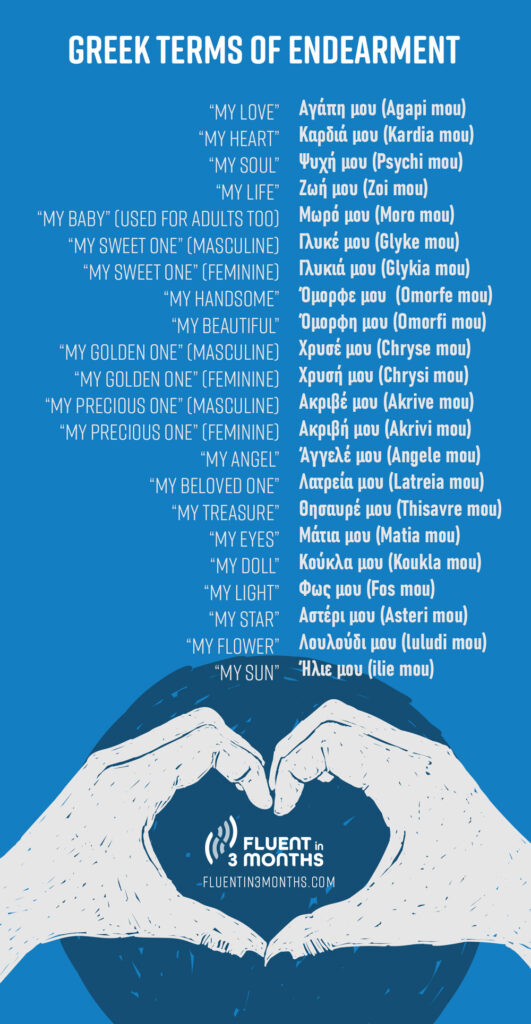
Market research suggests that "terms of endearment" are among the most searched linguistic categories for new learners. This trend is attributed to the "high-context" nature of Greek society, where emotional expression is prioritized over literal translation. For non-native speakers, the ability to correctly apply a term like moro mou (my baby) in a social setting is often viewed as a marker of high-level social integration.
Official Responses and Cultural Implications
Cultural attaches and educators from the Hellenic Foundation for Culture have frequently emphasized that language is the primary vehicle for philoxenia (hospitality). In official statements regarding the promotion of the Greek language abroad, experts argue that the emotive power of the Greek vocabulary is one of its greatest assets.
"The Greek language does not just describe reality; it colors it with emotion," states a report on Hellenic linguistic influence. The widespread use of endearment terms is seen as a psychological buffer that fosters strong community ties. In a professional analysis of Mediterranean social structures, researchers found that the frequent use of terms like koukla mou (my doll) or agori mou (my boy) among friends reduces social distance and facilitates faster conflict resolution compared to more formal linguistic cultures.
Chronology of Linguistic Integration for Learners
For those seeking to master these terms, educators suggest a chronological approach to integration:
- Phase One (Foundational): Learning the possessive mou and basic nouns like agapi and kardia.
- Phase Two (Gender Agreement): Distinguishing between masculine and feminine adjectives (glyke vs. glykia).
- Phase Three (Diminutives): Understanding the application of suffixes like -aki to personal names.
- Phase Four (Contextual Fluency): Recognizing when to use platonic terms (like file mou – my friend) versus romantic ones.
Conclusion: The Broader Impact of Hellenic Affection
The richness of Greek endearment terms reflects a culture that values emotional transparency and the preservation of close-knit social units. By utilizing these terms, speakers participate in a tradition that dates back millennia, bridging the gap between the philosophical heights of Ancient Greece and the vibrant, lived reality of the modern Mediterranean.
As globalization continues to influence language, the persistence of these unique Greek expressions serves as a testament to the enduring power of cultural identity. For the listener, being called psychi mou or matia mou is more than a greeting; it is an invitation into the heart of the Greek experience, where every individual is recognized through a lens of affection, value, and shared humanity. Through the strategic use of these terms, the Greek language continues to offer the world a profound vocabulary for the many faces of love.