


Microsoft has officially unveiled a comprehensive suite of AI-powered tools and a new academic pricing structure for Microsoft 365 Copilot, signaling a major shift in how generative artificial intelligence is integrated into global education systems. The announcement includes the introduction of "Teach," a platform designed for educators, and "Study and Learn," an adaptive agent for students, alongside a significant reduction in the cost of Copilot for academic institutions. These developments come as the education sector grapples with the rapid adoption of AI, with Microsoft’s own 2025 AI in Education Report indicating that over 80% of stakeholders are already utilizing some form of AI in school environments.
The tech giant’s strategy focuses on two primary objectives: reducing the administrative burden on teachers and providing students with personalized, science-based learning supports. By offering several of these high-level tools at no additional cost to existing education customers, Microsoft aims to broaden access to cutting-edge technology while positioning its ecosystem as the central hub for the future of digital pedagogy.
A New Framework for Instructional Design: Introducing Teach
At the heart of Microsoft’s new educator-focused initiative is "Teach," an AI-powered experience built specifically to streamline the complexities of classroom preparation. Historically, educators have faced a mounting "balancing act," tasked with shaping curriculum, innovating on the frontlines, and managing administrative overhead simultaneously. Teach is designed to alleviate these pressures by providing a centralized hub within the Microsoft 365 Copilot app.
The tool allows educators to leverage AI to generate comprehensive lesson plans, draft rubrics, and create quizzes with minimal manual input. Unlike general-purpose AI, Teach includes intuitive features that allow for the modification of materials based on specific criteria such as reading level, language, length, and difficulty. Crucially, the platform enables educators to align their content with relevant academic standards, ensuring that AI-generated materials meet district or national requirements.
The rollout of Teach begins immediately for Microsoft 365 education customers at no additional cost. Microsoft has also confirmed that future updates will include direct integration with Learning Management Systems (LMS), allowing teachers to export AI-generated materials directly into the platforms they use to manage their classrooms. Many of these features are currently being integrated into the daily workflows of Microsoft Teams and OneNote, further embedding AI into the existing software infrastructure of schools.
Pedagogy-First AI: The Study and Learn Agent for Students
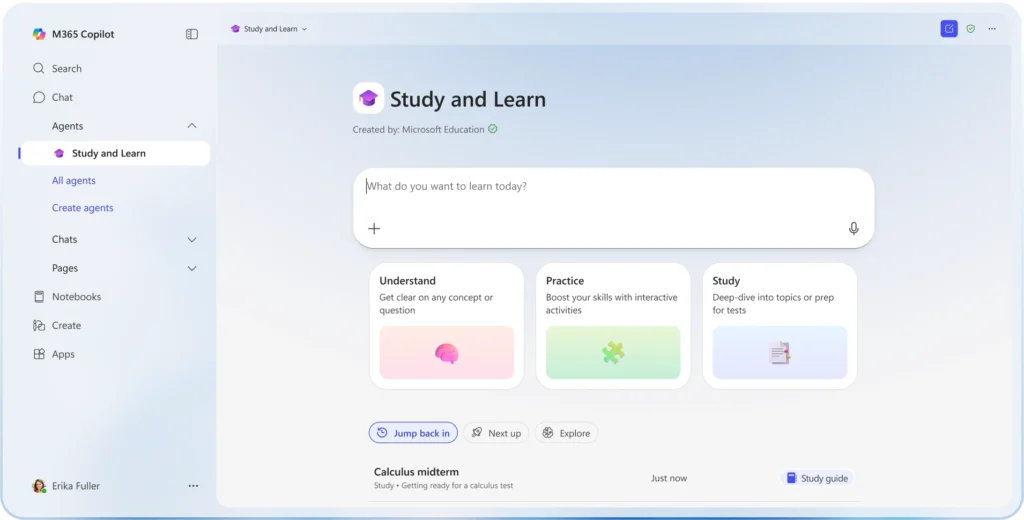
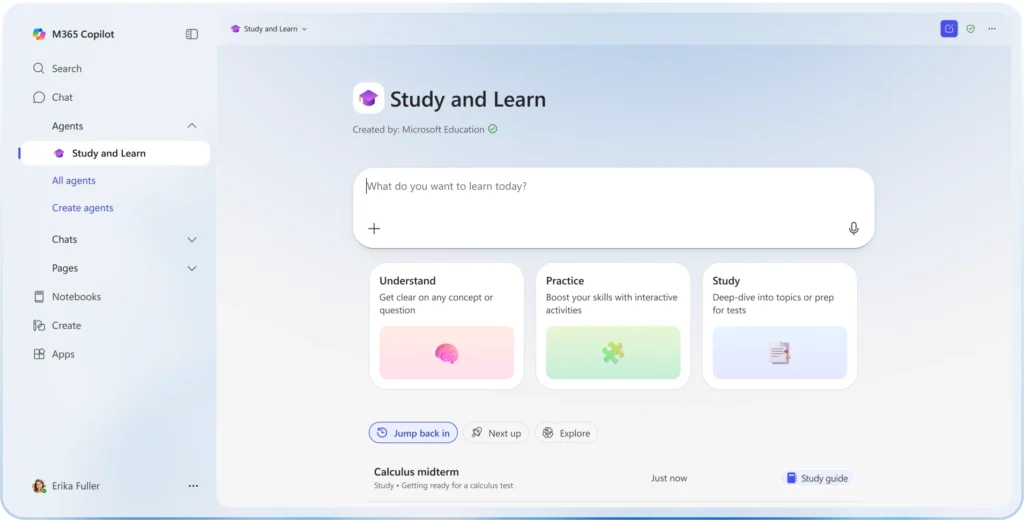
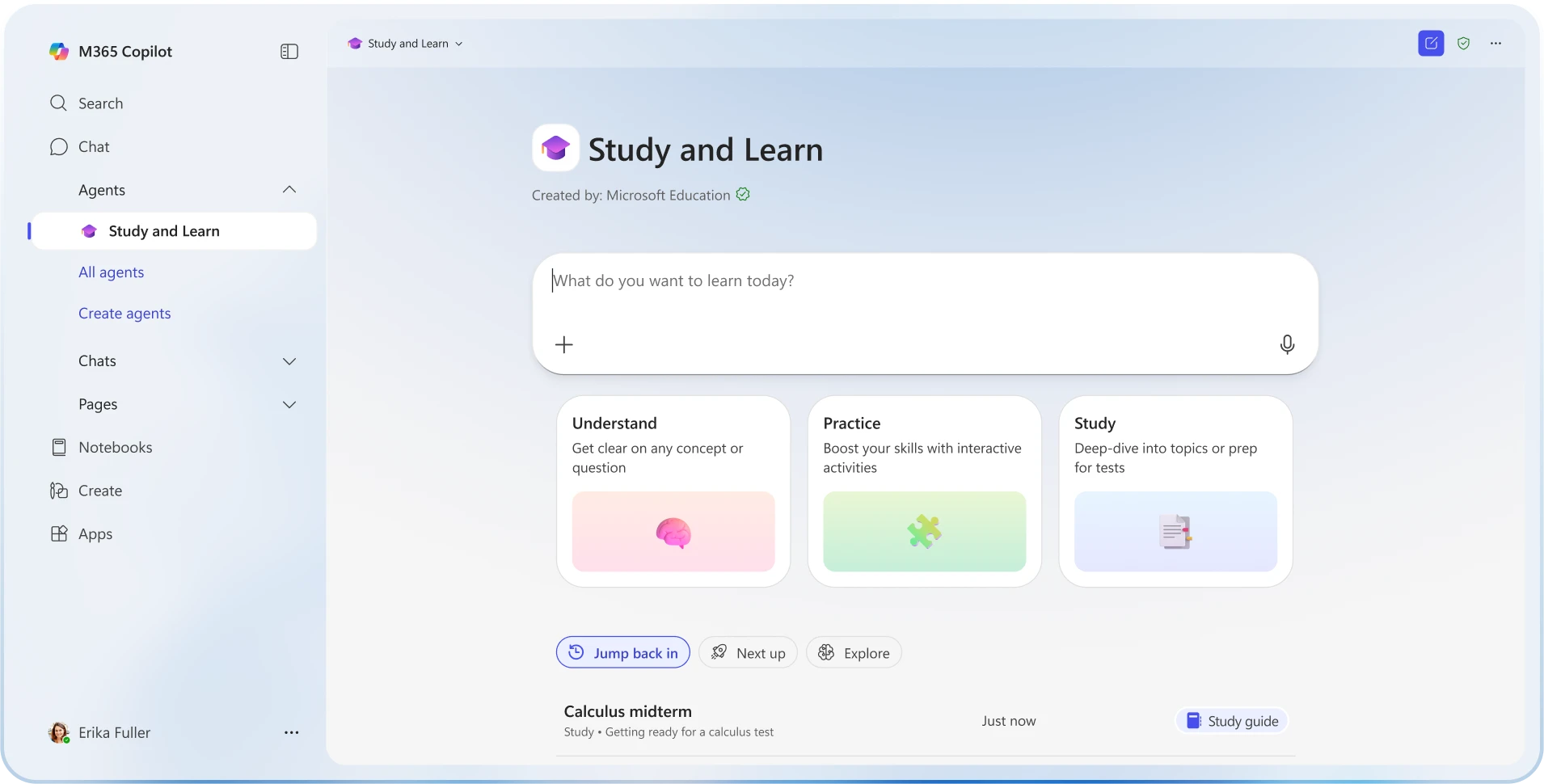
While the "Teach" platform addresses the supply side of education, the "Study and Learn" agent focuses on the demand side—the students. Scheduled for a preview release in November 2025, Study and Learn is described as an advanced agent grounded in learning science. The goal is to move beyond simple content generation—often a concern for academic integrity—and toward the development of critical thinking and skill mastery.

Study and Learn provides an adaptive environment where students can engage with material through various modalities. The agent offers specific activities such as digital flashcards, matching games, fill-in-the-blank exercises, and practice quizzes. By facilitating a "chat-to-learn" interface, the tool encourages reflective thinking rather than rote memorization. This approach reflects a growing trend in EdTech to use generative AI as a "tutor" rather than a "writer," helping students find their voice and build confidence in their subject matter expertise.
The Economic Shift: Microsoft 365 Copilot Academic Offering
In a move that addresses the budget constraints of the public and private education sectors, Microsoft has announced a specialized academic offering for Microsoft 365 Copilot. Starting in December 2025, the service will be available for $18 per user per month for educators, staff, and students aged 13 and older. This pricing represents a significant entry point for institutions looking to deploy enterprise-grade AI across their entire populations.
This academic version of Copilot is not merely a chatbot; it is deeply integrated into the full Microsoft 365 stack, including Word, Excel, PowerPoint, Outlook, and Teams. It utilizes institutional data—such as emails, meeting transcripts, and internal documents—to provide contextually relevant responses while maintaining enterprise-level data protection. The offering includes advanced features such as:
- Researcher and Analyst: Tools designed to help users synthesize large volumes of data and conduct academic inquiries more efficiently.
- Copilot Tuning: A feature that allows institutions to customize the AI’s behavior and responses to better fit their specific pedagogical or operational needs.
- Copilot Control System: A robust administrative framework designed to protect institutional data and ensure that AI usage complies with privacy regulations.
The announcement also highlighted the inclusion of GPT-5 capabilities within the secure chat environment, providing students and faculty with access to the most advanced large language models currently available, backed by IT controls that prevent data leakage.
Integration with Global Learning Ecosystems
Recognizing that many schools operate within a fragmented software environment, Microsoft is expanding its reach into third-party Learning Management Systems. By December 2025, Microsoft 365 Copilot Chat will be accessible via Microsoft 365 LTI (Learning Tools Interoperability) within major platforms including Canvas, Schoology, Brightspace, Blackboard, and Moodle.
This interoperability is a strategic move to ensure that AI tools are available within the "daily flow" of student and teacher activity. Early adopters, such as Fulton County Schools and Babson College, have already reported that such integrations are helping to increase student agency and accelerate the time-to-market for student-led entrepreneurial projects.
Institutional Impacts: Case Studies and Performance Data
Microsoft’s rollout is backed by early-stage data from several pilot programs across the globe. These case studies suggest that the primary benefit of AI integration in education is the recovery of time—a commodity in short supply for both faculty and students.
At Brisbane Catholic Education, the Chief Information Officer, Leigh Williams, reported that participating educators saved an average of over nine hours per week on administrative and planning tasks. "This empowers them to focus on the reason they came into education—supporting student learning and personalizing education in ways that weren’t possible before," Williams stated.
Similarly, the University of South Carolina conducted a study of its Copilot users, finding that 84% of respondents—including students—saved between one and five hours per week. Professors at the university noted that the time savings directly translated into higher-quality academic output, as they were able to shift their focus from routine administrative work to high-value research and student mentoring.
The University of South Florida (USF) has taken a more systemic approach by developing custom agents. Their IT department has built specialized AI agents to handle travel policies, IT help desk inquiries, and event management for commencement. USF is also collaborating with its College of Medicine to create an advanced accreditation system and interactive student handbooks, demonstrating the potential for AI to transform not just the classroom, but the entire operational backbone of a university.
Broader Implications and the Future of AI in Education
The expansion of AI in education carries significant implications for the future of work and literacy. By integrating tools like GitHub Copilot Pro—which is now available for free to educators and students—Microsoft is effectively training the next generation of developers and professionals to be "AI-native."
The inclusion of Minecraft AI Foundations and Khanmigo (a collaboration with Khan Academy) further suggests that Microsoft is targeting AI literacy at a foundational level, starting with K-12 students. For older students, the company is offering a 50% discount on Microsoft 365 Personal and a 12-month free trial to ensure that AI tools remain accessible for life tasks such as job hunting, meal planning, and "side hustles."
However, the rapid deployment of these tools also raises questions regarding the digital divide. While the $18 price point is lower than commercial rates, it still represents a substantial investment for underfunded school districts. Microsoft’s decision to offer "Teach" and "Study and Learn" at no additional cost appears to be a direct response to these concerns, ensuring that even institutions that cannot afford the full Copilot suite can still benefit from AI-driven efficiency.
As we move toward the 2025-2026 academic year, the focus will likely shift from the novelty of generative AI to its efficacy. With the introduction of autonomous agents—which the University of South Florida is already piloting for IT automation—the role of AI in education is evolving from a passive assistant to an active participant in the educational ecosystem. Microsoft’s latest announcements provide the infrastructure for this transition, setting a new standard for how technology companies interact with the world’s learning institutions.