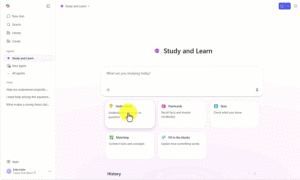




Microsoft has officially announced the general availability of the Study and Learn agent within Microsoft 365 Copilot, signaling a significant shift in how artificial intelligence is integrated into the academic environment. This new specialized AI tool is designed to move beyond the traditional "chatbot" model, which often prioritizes providing immediate answers, toward a pedagogical framework that emphasizes student comprehension and independent problem-solving. Available to all education customers at no additional cost, the Study and Learn agent is now accessible for students aged 13 and older, provided that institutional IT administrators enable the service for K-12 accounts.
The release comes at a critical juncture for global education. Since the public debut of large language models in late 2022, educational institutions have struggled to balance the innovative potential of generative AI with the risks of academic dishonesty and the erosion of critical thinking skills. By introducing a "learning-first" agent, Microsoft aims to provide a structured, safe, and educationally sound alternative to general-purpose AI tools that students are already using in their private study sessions.
The Evolution of AI in the Classroom: A Two-Year Chronology
The journey toward the Study and Learn agent began shortly after the launch of OpenAI’s ChatGPT in November 2022. The initial reaction from the education sector was one of caution. By early 2023, several of the largest school districts in the United States, including New York City Public Schools, had implemented temporary bans on AI tools, citing concerns over cheating and the accuracy of generated content.
However, by mid-2023, the narrative began to shift from prohibition to "AI literacy." In May 2023, Microsoft announced its early vision for Copilot in Education, emphasizing data privacy and the need for tools that support teachers rather than replace them. Throughout late 2023 and early 2024, Microsoft conducted pilot programs and gathered feedback from educators who noted that while AI could summarize text, it rarely helped students understand the "why" behind a concept.
The culmination of this feedback led to the development of specialized agents. In early 2024, Microsoft introduced the "Teach" agent for educators to assist with lesson planning and administrative tasks. The general availability of the "Study and Learn" agent in May 2024 completes this ecosystem, providing a student-facing counterpart designed specifically for the rigors of academic study.

Shifting the Paradigm: From Answer Bot to Socratic Tutor
The central philosophy of the Study and Learn agent is that "the learner does the thinking." Unlike standard versions of Copilot or other AI models that might simply solve a math equation or write a history paragraph upon request, the Study and Learn agent is programmed to act as a coach.
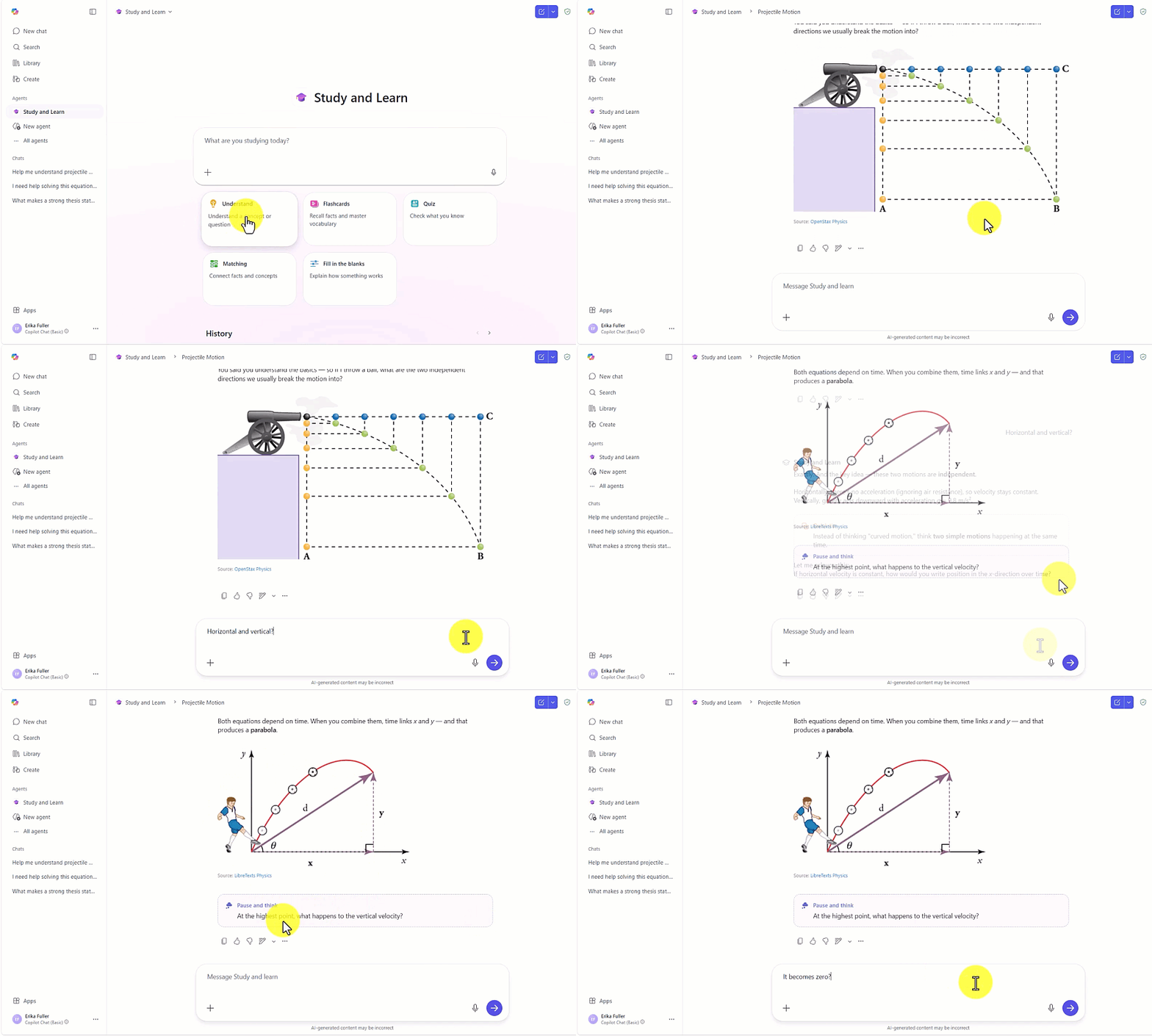
When a student interacts with the agent, the AI employs a scaffolding technique—a method in which the tool provides temporary support that is gradually removed as the student develops autonomous skills. For instance, if a student presents a complex calculus problem, the agent does not provide the final numerical answer. Instead, it asks the student to identify the first step or explains the underlying theorem required to solve the problem.
This interactive learning environment includes several key functionalities:
- Step-by-Step Coaching: The AI walks students through logic-based problems, offering hints and clarifying concepts without bypassing the work of the student.
- Dynamic Study Aids: Students can request the generation of flashcard sets or matching activities based on their specific course materials, facilitating active recall.
- Writing Refinement: Rather than drafting essays, the agent engages in a dialogue with the student about their arguments, asking probing questions to help the student sharpen their thesis and structure.
- Visual Integration: The tool can generate or search for illustrations of complex biological or physical concepts to aid visual learners.
The Science of Learning: Four Pillars of Design
Microsoft has stated that the Study and Learn agent is built on established learning science rather than just raw computational power. The experience is grounded in four specific research-based principles that have been proven to improve long-term retention and mastery.
First is the principle of Retrieval Practice. By generating quizzes and matching activities, the agent forces the brain to retrieve information, which strengthens neural pathways more effectively than passive reading. Second is Scaffolding, where the AI provides just enough information to help a student move to the next level of understanding, ensuring the "Zone of Proximal Development" is maintained.
Third is Active Engagement. The tool is designed to be conversational, requiring the student to input their own ideas and responses frequently. Finally, the agent utilizes Feedback Loops. Immediate, specific feedback on why a particular answer was incorrect helps students correct misconceptions in real-time, preventing the reinforcement of errors.

Implementation, Safety, and Institutional Control
Recognizing the security concerns of school boards and IT departments, Microsoft has integrated the Study and Learn agent into the existing Microsoft 365 Education framework. This ensures that the tool adheres to enterprise-grade data and privacy protections, including compliance with the Family Educational Rights and Privacy Act (FERPA) and other regional data protection regulations.
For K-12 institutions, the Copilot Chat functionality—and by extension, the Study and Learn agent—is turned off by default. IT administrators must proactively enable the service. Once enabled, students access the agent using their school-issued Microsoft Entra ID credentials. This ensures that all data remains within the school’s "tenant," meaning student prompts and AI responses are not used to train the underlying public AI models, a major concern for privacy advocates.
Microsoft has also implemented age-gating, restricting the tool to students aged 13 and older, aligning with the Children’s Online Privacy Protection Act (COPPA) guidelines. To assist with the rollout, Microsoft has provided video walkthroughs and configuration guides for IT staff to ensure a smooth transition.
Supporting Data and Market Context
The move to release a specialized education agent is supported by emerging data regarding student AI usage. According to a 2023 survey by the Center for Democracy & Technology, approximately 63% of students reported using generative AI for school-related tasks, yet only 24% of teachers reported receiving guidance on how to use it effectively.
Furthermore, data from the Tyton Partners "Time for Class" report indicates that while student adoption of AI is high, there is a significant "trust gap" among faculty, with many fearing that AI promotes academic "shortcuts." By branding the Study and Learn agent as a tool where "the learner does the thinking," Microsoft is directly addressing this trust gap to encourage institutional adoption.
Microsoft’s primary competitors in this space, including Google with its "Gemini for Google Workspace Education" and Khan Academy with its "Khanmigo" tutor, are also vying for dominance in the EdTech sector. However, Microsoft’s advantage lies in the deep integration of Copilot across the entire M365 suite, including Word, PowerPoint, and Teams, where students already perform the majority of their academic work.
Official Responses and Industry Implications
While official statements from individual school districts are still forthcoming following the general availability announcement, educational technology consultants have noted the significance of the "no additional cost" model. "By bundling these sophisticated agents into existing licenses, Microsoft is removing the financial barrier that often prevents underfunded districts from accessing high-quality AI tools," said one industry analyst.
The implications of this launch extend beyond the classroom. As the workforce increasingly demands AI proficiency, providing students with a tool that teaches them how to collaborate with AI—rather than just use it for output—is seen as a vital step in career preparation.
The Study and Learn agent is currently optimized for English (United States), but Microsoft has confirmed plans to expand language support in the coming weeks. This expansion is expected to include major global languages, further broadening the tool’s reach to international education markets.
Conclusion: A Credible Path Forward
The introduction of the Study and Learn agent represents a maturing of the AI industry. It acknowledges that while AI can be a powerful engine for efficiency, its role in education must be handled with nuance and a commitment to pedagogical integrity. By shifting the focus from "giving the answer" to "guiding the process," Microsoft provides a credible, learning-first path for schools to enable AI at scale.
As institutions continue to navigate the complexities of the digital age, tools like the Study and Learn agent will likely become the benchmark for how technology can support, rather than undermine, the fundamental goal of education: the development of independent, critical thinkers. For now, the responsibility shifts to IT administrators and educators to implement these tools and guide students in their responsible use.