
For the past two years, the discourse surrounding artificial intelligence (AI) in corporate learning has been largely dominated by a singular metric: efficiency. The prevailing narrative has focused on the speed at which AI can generate content, accelerate course production, and streamline administrative tasks. This emphasis on velocity has, for many organizations, become the default measure of success in leveraging AI for employee development. However, this singular focus on speed risks becoming a double-edged sword, accelerating the wrong initiatives and ultimately hindering genuine learning outcomes. The emerging consensus among learning and development (L&D) professionals suggests that the true transformative power of AI lies not in its ability to produce more, but in its capacity to personalize and optimize the learning journey for individual employees, addressing their unique skills, contextual needs, confidence levels, and career trajectories.
The Peril of Abundant, Yet Inaccessible, Content
The current landscape of digital workplace learning is often likened to an overflowing library, where the sheer volume of available content can be overwhelming rather than empowering. Imagine a scenario where an employee is tasked with acquiring a new skill. They are presented with a vast digital repository, akin to the British Library, which adds approximately three miles of new shelving for books annually. Without a sophisticated system to guide them, they would likely be paralyzed by choice, struggling to navigate the sheer abundance of information. This mirrors the reality for many employees in today’s digital workplaces; the challenge is not a scarcity of learning materials, but an overwhelming surplus of information, often referred to as "noise."
For years, L&D departments have diligently curated extensive catalogs of courses and resources. However, a well-stocked pantry, while containing the ingredients for a nutritious meal, does not guarantee its preparation or consumption. Today’s overloaded employees lack the time and luxury to leisurely browse through extensive libraries in search of what they need. The pursuit of efficiency through faster content creation, while seemingly beneficial, merely exacerbates this problem by filling these digital shelves even more rapidly. When learners cannot quickly identify the specific content that will address their individual skill gaps, they often disengage from the learning process altogether or waste valuable hours on tangential or irrelevant materials. This ultimately translates into a triple cost for organizations: the initial investment in content creation, the lost productivity of learners spending time on ineffective learning, and the ongoing costs associated with maintaining unused or underutilized assets. The critical realization is that the existing libraries of learning content are not the problem; rather, the interface through which employees access and engage with this content is.
Evolving Learning Paradigms: From Static Consumption to Adaptive Experiences
The future of workplace learning is poised to move beyond static content consumption models, which rely on employees passively absorbing pre-defined information. Instead, the next era will be characterized by the ability of AI to foster adaptive learning experiences. This evolution can be broadly categorized into three distinct modes, working in concert to create a more effective and engaging learning ecosystem:
1. Static Content: The Foundational Repository
This mode represents the traditional and enduring element of corporate learning. It encompasses polished, thoroughly reviewed assets such as high-quality videos, comprehensive guides, and official documentation. These materials are essential for conveying topics that require a high degree of oversight, consistent messaging across the organization, or specialized production values. In essence, this static content forms the bedrock of the learning library, serving as the authoritative source of truth. Organizations have invested significant resources over many years in building these repositories, and their value remains undeniable.
2. Adaptive Navigation: Intelligent Recommendations
Building upon the static foundation, adaptive navigation employs AI to help employees cut through the noise and discover the most relevant learning resources. This mode functions much like personalized recommendation engines found on streaming platforms, such as Spotify’s "Discover Weekly." By analyzing an employee’s skills data, role context, and learning history, AI can intelligently curate and suggest content that aligns with their current needs and immediate work requirements. This is akin to having an intelligent catalog that proactively queues up the right resources based on what an employee is actively working on, thereby minimizing search time and maximizing relevance.
3. Adaptive Experiences: Real-Time Responsiveness
This represents the most significant leap forward in AI-driven learning. It moves beyond simply recommending content to creating dynamic, interactive learning moments that adjust in real time based on the learner’s engagement and performance. This is the difference between a pre-made playlist and a personal trainer or a skilled mentor. Adaptive AI can generate personalized learning scenarios that dynamically adjust difficulty, provide targeted feedback, and offer corrective guidance mid-activity. For instance, a simulation might increase complexity as a learner demonstrates mastery, or a virtual coach could detect misconceptions during practice and immediately offer clarification and technique correction. These adaptive experiences do not merely point learners toward information; they actively teach, assess, and serve as dynamic sparring partners, fostering deeper understanding and skill acquisition.
The Interface Revolution: Connecting Static Assets to Dynamic Learning
While generative AI is undeniably transforming the nature and creation of content itself, the more profound opportunity lies in revolutionizing the interface through which employees access and interact with learning. The shift is from static collections of resources to dynamic, intelligent connections that cater to individual needs.
In an adaptive learning system, the organization’s existing curated assets—proprietary frameworks, licensed courses, and best-practice guides—serve as crucial "grounding" material. The AI leverages this approved content as its source of truth, ensuring that AI-driven coaching chatbots, personalized simulations, and adaptive learning pathways are delivered safely, accurately, and in alignment with organizational standards. This integration ensures that the power of AI is harnessed responsibly, building upon established knowledge rather than generating unverified information.
Evidence of this paradigm shift is already emerging. A global technology company, for example, significantly reduced the time-to-competency for its new product specialists by moving away from generic onboarding tracks. Their adaptive system was able to recognize if a specialist possessed advanced technical skills from previous roles or training. Instead of forcing them through introductory modules, the AI immediately engaged them in complex, scenario-based simulations that mirrored real-world challenges, accelerating their proficiency and integration into the team.
Similarly, a financial services organization implemented an AI-powered system to assess the prior knowledge of long-tenured employees during mandatory compliance training. Rather than requiring them to sit through basic definitions and foundational principles they had long mastered, the AI identified their existing understanding and directed them to a targeted module specifically covering recent regulatory changes. This approach not only saved valuable employee time but also ensured that the learning was relevant and impactful. These examples illustrate how adaptive AI moves beyond merely pointing employees to relevant content; it actively responds to their engagement, identifies areas of struggle, and guides them through meaningful, contextually relevant practice.
The Architectural Blueprint for Adaptive Learning Systems
Transitioning from static content delivery to truly adaptive learning requires a fundamental shift in architectural approach. This new architecture is built upon four interconnected layers, each playing a critical role in enabling personalized and dynamic learning experiences:
Foundation Layer: Unified Skills Data
At the base of any effective adaptive learning system lies a unified approach to skills data. Without a common, standardized "skills language" that spans across various platforms and systems, AI is severely limited in its ability to personalize learning. It can only resort to guesswork rather than informed guidance. This foundational layer establishes a shared vocabulary for skills that follows employees throughout their tenure and across different digital tools, creating a consistent and actionable data set for AI. This data can include explicit skills, proficiencies, and areas for development.
Interaction Layer: Open Dialogue and Dynamic Experiences
The interaction layer is designed to facilitate seamless and intuitive engagement between the learner and the AI. This includes enabling natural language interactions, whether through voice commands or chat interfaces, allowing employees to articulate their learning needs and preferences effectively. However, this layer goes beyond simple navigation. It is responsible for generating dynamic, adaptive experiences. This can manifest as coaching chatbots that not only answer questions but also actively detect when a learner is struggling with a particular concept and pivot to explain it using a different methodology or analogy. It enables simulations that respond to user actions and provide real-time feedback.
Adaptation Layer: Continuous Calibration
This is the core engine of adaptivity, responsible for shaping the learning journey in real time. The adaptation layer continuously calibrates the learning experience based on the learner’s performance, engagement, and demonstrated capabilities. It dynamically adjusts factors such as the difficulty of tasks, the pace of instruction, and the modality of delivery. Each learner follows a unique path that evolves as their understanding and proficiency grow. This means that no two learning journeys are identical, ensuring that each employee receives the precise support they need, precisely when they need it.
Intelligence Layer: Organizational Adaptation
The intelligence layer focuses on deriving insights from the aggregated data of thousands of individual learning journeys. As patterns emerge, organizations gain unprecedented visibility into the human element of transformation and change initiatives. This layer can immediately highlight where confidence is building within the workforce and where confusion or skill gaps are concentrated. This allows for proactive intervention in change initiatives while they are still in progress, rather than months later, after failures have already occurred. It provides a strategic overview of workforce capabilities and development trends.
Context: The Indispensable Starting Point for Learning
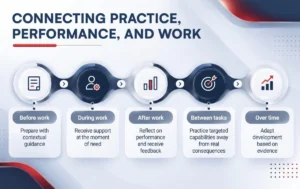
While these four layers enable adaptive learning, their effectiveness hinges on a critical, often overlooked, element: context. Learning fundamentally begins with context, not merely with content. AI’s true power in this domain is its ability to connect learning directly to real-time goals and pressing business needs, thereby fostering a sense of urgency and relevance. Efficiency, in this redefined landscape, is not an external metric but an intrinsic component of this continuous loop: understanding an employee’s needs, delivering precisely tailored experiences, and enabling the immediate application of newly acquired skills.
Recent research underscores the importance of this contextual application. A study found that a significant majority of professionals (78 percent) lack confidence in effectively using new capabilities, even when they have access to ample learning content. This gap is not a deficit in knowledge but a deficiency in the ability to practice and apply that knowledge within a relevant, real-world context. Adaptive learning systems, by providing this contextual practice environment, aim to bridge this critical divide.
A Phased Approach: Roadmap for Small Teams
Embarking on a journey towards adaptive learning does not necessitate an immediate, enterprise-wide transformation. A practical and effective approach can be adopted even by smaller teams, focusing on iterative implementation and demonstrable results:
-
Start with Frustration: Identify a specific business unit or team where existing learning gaps are creating tangible problems or significant frustration. Use this identified pain point as the mandate and pilot program for your initial adaptive learning initiative.
-
Audit a Focused Use Case: Concentrate on a narrowly defined use case. Select the three to five most critical skills that are essential for the success of your pilot team. Deeply tag existing relevant content to demonstrate the proof of concept, without requiring a massive, organization-wide metadata overhaul.
-
Test Navigation and Experience: Go beyond simply implementing smarter search functionalities. Experiment with the interactive elements of adaptive learning. This could involve piloting a coaching chatbot for a critical skill or a practice simulation that mimics real-world scenarios. The goal is to learn how active, adaptive experiences influence behavior differently than passive content consumption.
-
Expand Based on Proof: Utilize the insights and success metrics derived from your pilot program to build a compelling case for securing the necessary resources and buy-in for broader implementation across the organization.
Building for a Future of Continuous Transformation
For leaders in talent development, the opportunity is to redefine learning as a continuous, personalized, and integrated flow within the employee lifecycle. While existing learning libraries remain vital repositories of organizational knowledge, adaptive AI is the key to activating that knowledge in ways that are relevant and impactful for each individual.
Static libraries served an era characterized by predictable career paths and a slower pace of change. Adaptive systems, however, are purpose-built for a world defined by rapid technological advancements and evolving skill demands. The next wave of innovation in learning is not about producing more content; it is about precision, flexibility, and empowering employees with the right knowledge at the right time. The ultimate rescue from information overload lies in having a knowledgeable guide—sometimes a map, sometimes a coach—that understands precisely what each employee needs to learn and grow, today and into the future.
As a next step, consider your organization’s most critical current training initiative. Ask: Are we simply helping employees find content faster, or are we providing them with a safe, adaptive environment to practice and develop their capabilities? If the answer leans towards just finding content, the focus is likely on efficiency. If, however, the initiative enables meaningful practice and skill development, then the organization is truly solving for capability.