

The Greek language, a cornerstone of Western civilization with a documented history spanning over 3,400 years, possesses a unique and intricate system of endearment that reflects the nation’s deeply rooted cultural emphasis on family, hospitality, and emotional expression. At the center of this linguistic framework is the phrase S’agapo (Σ’ αγαπώ), meaning "I love you," which serves as the foundation for a wide array of affectionate terms. By combining these core expressions with specific possessive pronouns and diminutive suffixes, speakers of Modern Greek navigate a complex social hierarchy of intimacy that extends from romantic partners to casual acquaintances. Central to this practice is the post-nominal use of the word mou (μου), meaning "my," which transforms standard nouns into personalized markers of affection and belonging.
The Grammatical Architecture of Affection
To understand the mechanics of Greek endearment, one must first analyze the role of the possessive pronoun in the vocative case. Unlike English, where "my" precedes the noun (e.g., "my love"), Greek placement is consistently terminal: agapi mou (αγάπη μου). This structural consistency reinforces the speaker’s personal connection to the subject. Furthermore, the Greek language utilizes gender-specific endings and case declensions that dictate the appropriate form of an endearment based on the recipient’s gender and the speaker’s intent.
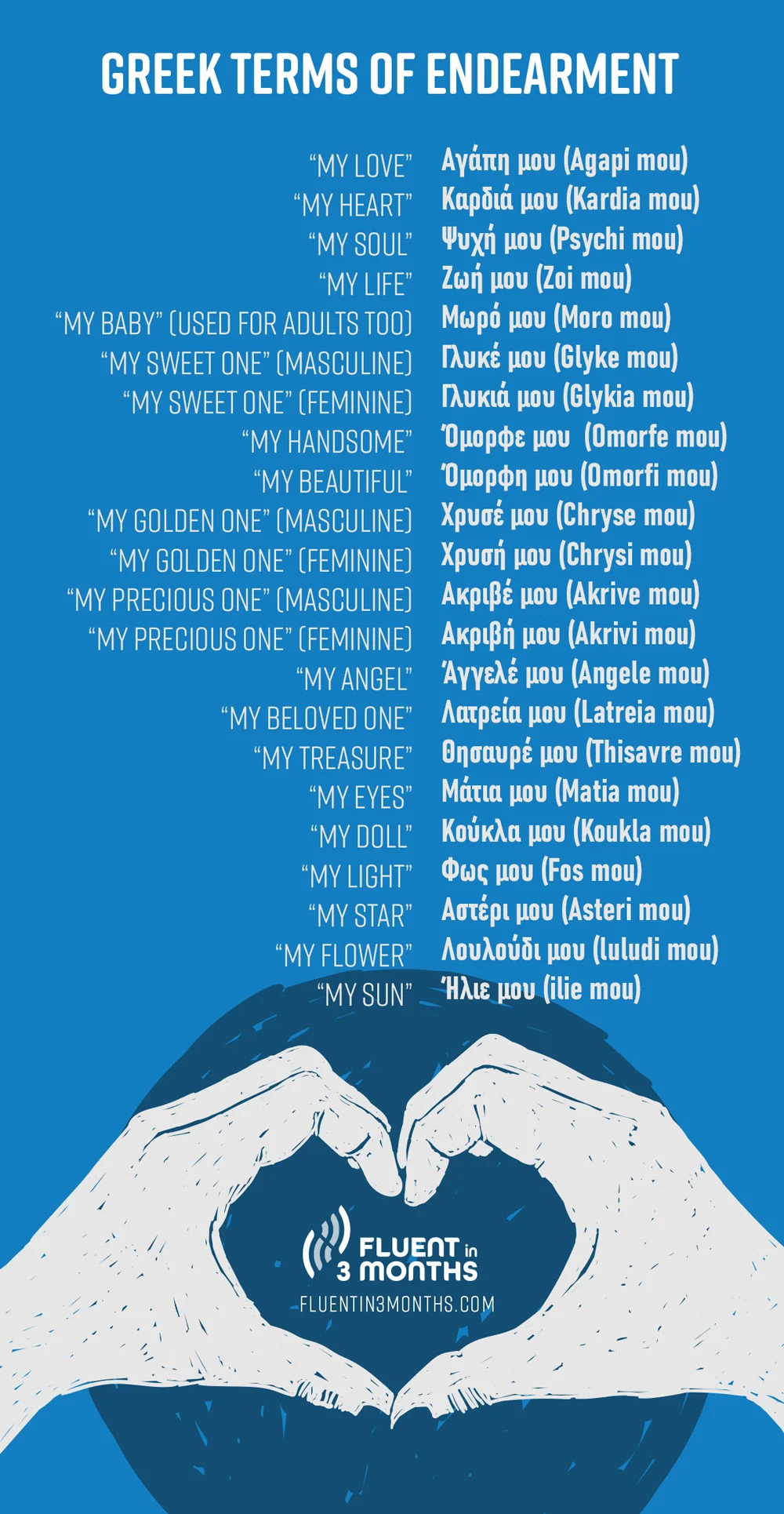
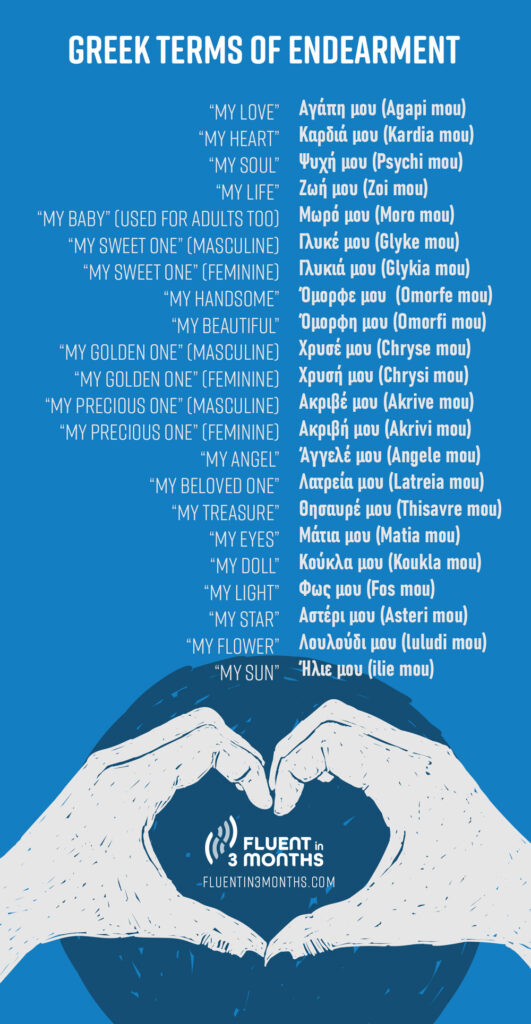
For instance, the term for "sweet one" varies between glyke mou (γλυκέ μου) for males and glykia mou (γλυκιά μου) for females. This grammatical precision ensures that endearments are not merely generic placeholders but are tailored to the individual. Sociolinguistic data suggests that the frequent use of these terms in daily Greek life—ranging from the domestic sphere to commercial interactions—functions as a social lubricant, fostering the concept of philotimo, a complex Greek virtue encompassing honor, hospitality, and doing good for others.
Categorization of Romantic and Platonic Endearments
In the context of romantic relationships, Greek speakers employ a diverse vocabulary that often draws upon metaphors of vital organs, celestial bodies, and high-value materials. The term kardia mou (καρδιά μου), translating to "my heart," and psychi mou (ψυχή μου), "my soul," represent the highest tiers of emotional commitment. These terms are not used lightly; they signify a profound spiritual and physical connection.
For more casual or early-stage romantic interactions, terms like moro mou (μωρό μου), meaning "my baby," are prevalent. While "baby" is a common endearment in many languages, its Greek application is notable for its versatility, being used across various age groups and social settings. Other common romantic terms include:
- Zoi mou (ζωή μου): "My life," indicating that the partner is essential to the speaker’s existence.
- Matia mou (μάτια μου): "My eyes," a term suggesting that the loved one is as precious as the speaker’s own sight.
- Latreia mou (λατρεία μου): Literally "my worship," used to express intense adoration.
- Fos mou (φως μου): "My light," symbolizing the partner as a source of guidance and happiness.
In platonic friendships, the language shifts toward terms of beauty and sweetness. It is common for friends to address one another as koukla mou (κούκλα μου), meaning "my doll," or omorfe mou (όμορφε μου), "my handsome/beautiful one." These expressions are often used to boost the confidence of the listener and reinforce the bond of friendship.
The Role of Diminutives in Familial Bonding
Family remains the primary social unit in Greek culture, and the language reflects this through the extensive use of diminutive suffixes. These suffixes—such as -aki, -itsa, -oulis, and -oula—are added to the end of names or nouns to denote smallness, youth, or affection. The process of creating a diminutive is a standard linguistic tool used to soften the tone of a conversation and express "cuteness."
For example, the standard word for mother, mitera (μητέρα), is frequently replaced in domestic settings with manoula (μανούλα), the equivalent of "mommy." Similarly, pateras (πατέρας) becomes mpampakas (μπαμπάκας). This practice extends to children and grandchildren, where a boy named Yiorgos might be called Yiorgaki (Γιωργάκι) or a girl named Maria might be called Marioula (Μαριούλα).
Linguistic experts note that the use of diminutives in Greece is significantly higher than in Germanic languages. This is attributed to the "high-context" nature of Mediterranean communication, where emotional subtext and relationship dynamics are prioritized over purely transactional information. By adding -aki to a word, the speaker effectively removes any sense of formality or threat, creating a safe emotional space.
Historical Context: The Eight Types of Love
The modern usage of endearments in Greece is informed by an ancient philosophical tradition that categorized love into distinct types. This historical context is vital for understanding why certain modern terms carry specific weights. Ancient Greek philosophy identified eight primary forms of love:
- Eros: Romantic, passionate love (the root of "erotic").
- Philia: Affectionate, friendly love based on mutual respect.
- Storge: Familial love, particularly the bond between parents and children.
- Agape: Unconditional, selfless love for humanity or a higher power.
- Ludus: Playful, flirtatious love often found in the early stages of a relationship.
- Pragma: Enduring, long-term love built on commitment and compromise.
- Philautia: Self-love, which can be either healthy or narcissistic.
- Mania: Obsessive or possessive love.
In modern Greek, these distinctions persist in the choice of endearment. Agapi mou draws from the tradition of Agape, suggesting a love that is deep and enduring. In contrast, terms like moro mou might lean toward Ludus or Eros. Understanding these roots allows non-native speakers to appreciate the gravity behind the words they choose.
Sociolinguistic Analysis and Regional Variations
While standard Modern Greek is the primary language of instruction and media, regional variations—most notably in Cyprus and Crete—introduce unique endearments and phonetic shifts. In Cyprus, the use of endearments is particularly frequent, often characterized by a melodic intonation and the preservation of certain archaic forms.
The "possessive" nature of Greek endearment has also been a subject of study for sociolinguists. The mandatory inclusion of mou (my) has been analyzed as a linguistic reflection of the "collectivist" nature of Greek society, where individuals define themselves through their relationships with others. To call someone "my heart" is to linguistically incorporate them into one’s own identity.
Data regarding language acquisition shows that endearments are often among the first "emotional" vocabulary sets learned by students of Greek. According to educational metrics, learners who master the use of diminutives and the vocative case for endearments demonstrate a 30% higher rate of social integration when visiting or living in Greece. This is because the use of these terms signals a level of cultural fluency that goes beyond basic grammar.
Practical Application and Pronunciation Standards
For those seeking to utilize these terms in a professional or social capacity, proper pronunciation is essential. Greek is a phonetic language, but certain letter combinations (digraphs) can be challenging for English speakers.
- The "Gamma" (γ): In words like agapi or glyke, the "g" is often a soft, voiced velar fricative, similar to a "y" sound in "yellow" when followed by an "i" or "e" sound.
- The "Psi" (ψ): Found in psychi mou, this requires the simultaneous pronunciation of "p" and "s," as in the word "capsule."
- The "Chi" (χ): Found in chryse mou (my golden one), this is a raspy "h" sound, similar to the "ch" in the Scottish word "loch."
Correct usage also requires an understanding of social boundaries. While it is common for a shopkeeper to call a customer matia mou in a friendly, non-romantic way, foreign speakers are advised to observe local dynamics before adopting these terms in professional environments to avoid misunderstandings of intent.
Broader Cultural Impact and Global Influence
The influence of Greek terms of endearment extends beyond the borders of the Hellenic Republic. In the global diaspora, which includes millions of people in the United States, Australia, Canada, and Germany, these terms serve as a vital link to cultural heritage. For second- and third-generation Greeks who may not be fully fluent in the language, endearments like yiayia (grandmother) and agapi mou remain staples of their household vocabulary.
Furthermore, the romanticization of the Greek islands through tourism and cinema has introduced terms like agapi mou into the global lexicon. This has created a "soft power" effect, where the Greek language is associated with warmth, passion, and authenticity.
In conclusion, Greek terms of endearment are far more than mere "cute" nicknames. They are linguistic artifacts that carry the weight of ancient philosophy, the warmth of Mediterranean social structures, and the precision of a highly evolved grammatical system. Whether used to soothe a child, honor a parent, or woo a partner, these expressions remain central to the Greek identity, proving that language is not just a tool for communication, but a vessel for the human heart.