

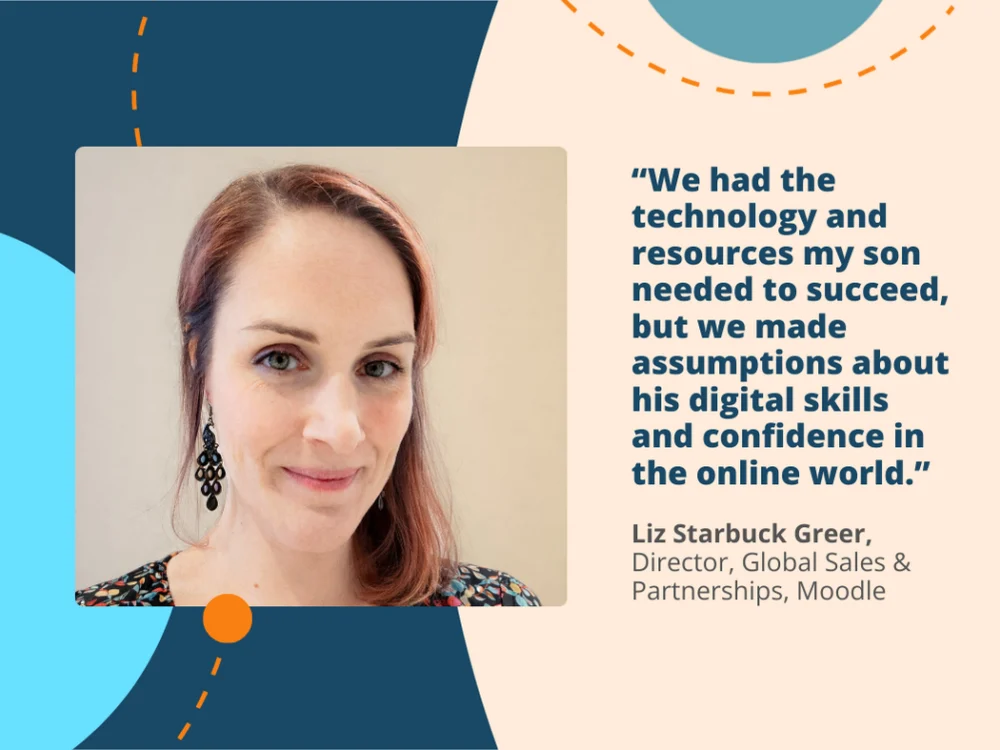
The seismic shift to online learning, accelerated by the COVID-19 pandemic, has illuminated a critical, yet often overlooked, distinction in the digital landscape: the chasm between digital confidence and digital competence. Liz Starbuck Greer, a prominent figure in educational technology, shared a deeply personal account that underscores this vital difference, offering profound lessons for educators, institutions, and parents alike. Her experience, detailed in a recent presentation and podcast, highlights how assumptions about a learner’s digital fluency can inadvertently create barriers to academic success, even in environments seemingly rich with technological resources.
Greer’s narrative centers on her own son’s struggle during the initial months of emergency online learning in the United Kingdom. Having just transitioned to high school, he was abruptly thrust into a remote educational setting as the nation entered lockdown. While Greer, a professional in business education, juggled the demands of her university students and faculty, her son began to disengage from his studies. This disengagement was particularly perplexing given the family’s apparent high level of "digital capital"—a term Greer defines as the synergistic combination of access, skills, experience, and social support that dictates an individual’s efficacy in utilizing digital tools and participating in online environments.
A Family Rich in Digital Capital, Yet Facing a Learning Crisis
The Greer household was, by many standards, well-equipped for the digital demands of remote learning. They possessed a robust internet connection, multiple devices, and a collective technical proficiency honed by professional careers that necessitated daily digital interaction. Both Greer and her husband had undertaken online learning themselves, and Greer had even been instrumental in developing and transitioning an entire MBA program to an online format. Furthermore, their children, having grown up overseas, were accustomed to leveraging technology for social connections, and her son was an avid and skilled gamer. By all outward appearances, they represented a household with substantial digital capital.
Despite this advantageous position, the first indication of a problem emerged not from within the family, but from an external source: a concerned teacher alerted Greer that her son was falling behind academically and had been absent from scheduled online classes. This revelation was met with initial disappointment and self-recrimination, as the parents realized they had underestimated their son’s capacity to self-regulate and make effective choices when the structured environment of in-person schooling was removed.
The Unveiling of a "Hidden Learning Gap"
The true extent of the issue became starkly apparent when Greer asked her son to retrieve his schoolwork. He opened his cloud storage drive to reveal hundreds of files, all inexplicably named "Untitled Document." His explanation, "It’s in one of these. Or maybe the questions are in the chat. Or they might be on email," painted a clear picture of his confusion and lack of organizational strategy.
Further probing revealed a critical deficit in foundational digital skills essential for academic pursuits. Her son lacked the ability to consistently name documents or create organized folders. His typing skills were rudimentary, significantly slowing down his ability to complete tasks. He was unsure how to locate his assignments, navigate different communication channels for clarification (such as email), and understand the varied submission requirements set by different teachers. Each inconsistent process and expectation from the school amplified his confusion and diminished his motivation, leading him to ultimately "give up."
This experience highlighted a profound misunderstanding: Greer and her husband had conflated their son’s proficiency in social and recreational technology use—specifically, his gaming prowess—with the distinct skill set required for effective online learning. While he could navigate complex virtual worlds and engage in sophisticated social interactions within games, the practical, organizational, and academic demands of a digital learning environment were entirely foreign to him. The skills and norms of using technology for educational purposes were not intuitively grasped, much like the intricate mechanics of a game like Fortnite might be opaque to an adult unfamiliar with it.
The Broader Implications for Educational Design
Greer’s personal narrative serves as a powerful case study for the broader implications of digital capital in education. While access to technology is a fundamental prerequisite, it is insufficient on its own to ensure equitable outcomes. The way technology is used, the purposes for which it is employed, and the benefits derived from that usage are all critical components of the larger picture. By failing to consider the diverse digital advantages and disadvantages that learners bring to virtual learning environments, educational institutions risk inadvertently creating obstacles that hinder academic progress for a significant portion of their student body.
The inconsistent approaches adopted by her son’s teachers, while perhaps understandable given the unprecedented circumstances of the pandemic, created a fragmented and confusing experience. Each teacher’s unique method of delivering coursework and receiving submissions, without clear guidance or standardization, compounded the learner’s disorientation. Greer candidly admits to assuming the school’s online infrastructure and pedagogy would be more robust, a sentiment that likely resonates with many educators and administrators grappling with similar challenges.
Rethinking Digital Fluency: Competence Over Confidence
The core lesson from Greer’s experience is the vital distinction between digital confidence and digital competence. Confidence, often fostered through familiarity and social engagement with technology, can create an illusion of preparedness. However, competence—the actual ability to perform specific tasks effectively and efficiently—is what truly underpins success in a structured environment like online learning. A learner may feel confident clicking around a website, but lack the competence to organize files, adhere to submission protocols, or effectively communicate with instructors via digital channels.
This realization has profound implications for the design and delivery of online courses. While educators often value the autonomy to design their courses according to their pedagogical preferences, this freedom can inadvertently complicate the learning journey for students who are not digitally adept.
Strategies for Designing Inclusive Online Learning Environments
To foster greater inclusivity and support learners with varying levels of digital capital, Greer advocates for several key strategies:
- Clarity and Consistency: Implementing standardized structures and clear signposting across all aspects of the online learning experience can significantly benefit all learners, particularly those with lower levels of digital capital. This includes consistent naming conventions for assignments, uniform submission procedures, and predictable communication channels.
- Explicit Instruction and Modeling: Educators should provide clear, step-by-step instructions for all tasks, especially those involving technology. Modeling expectations for learner interactions and demonstrating how to use specific digital tools can demystify the learning process.
- Proactive Support and Intervention: Regular check-ins with students, particularly those who appear to be struggling or disengaging, are crucial. Identifying learners who are falling behind early on allows for targeted interventions and support before academic deficits become insurmountable.
- Acknowledging the "Unknown Unknowns": Educators must recognize that learners may not be aware of the digital skills they lack until they encounter them in an academic context. The assumption that social digital fluency translates directly to academic digital competence is a dangerous oversimplification.
The Path Forward: A Community of Support
Fortunately, Greer’s son was able to navigate the challenges and ultimately move forward academically. His experience, however, serves as a potent reminder for educators designing online learning experiences. The "superpower" of platforms like Moodle, Greer suggests, lies not only in their technological capabilities but also in their vibrant communities of supportive colleagues who are ready to share best practices and offer assistance.
The implications of this distinction extend far beyond the pandemic. As online and blended learning models become increasingly integrated into mainstream education, understanding and addressing the nuances of digital capital is paramount. Educational institutions must invest in professional development for faculty to equip them with the knowledge and skills to design for diverse learners, and to move beyond assumptions about digital fluency. By fostering environments where digital competence is explicitly taught and supported, rather than simply assumed, educators can create truly equitable learning opportunities, ensuring that no learner is left behind in the digital age.
The ongoing evolution of digital education necessitates a continuous dialogue about how to best support all learners. Greer’s personal journey, while rooted in a specific moment of crisis, offers enduring insights into the critical need to bridge the gap between digital confidence and digital competence, thereby unlocking the full potential of online learning for everyone. The call to action is clear: design with the digital reality of learners in mind, and build learning environments where every student has the opportunity to thrive.