



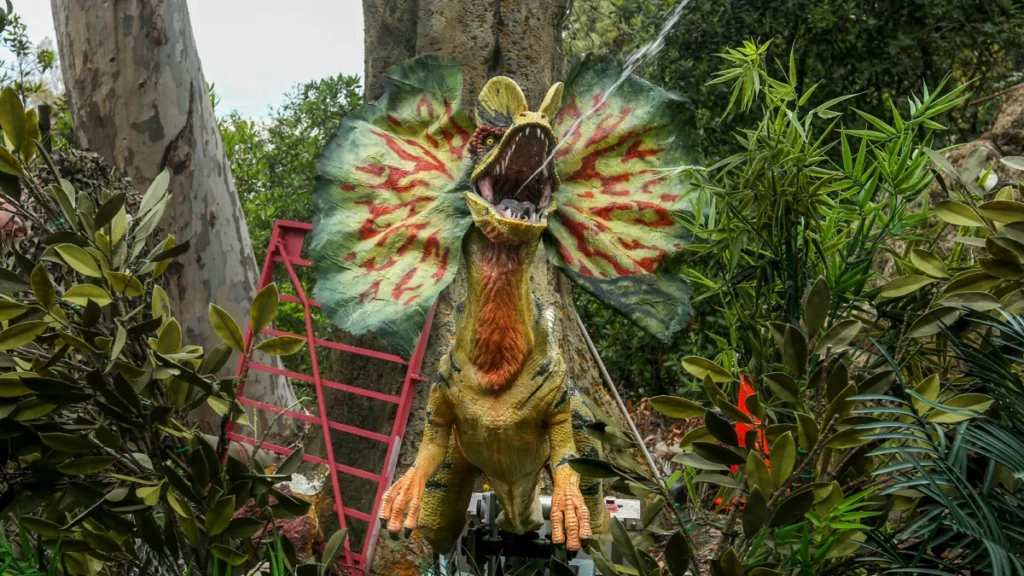
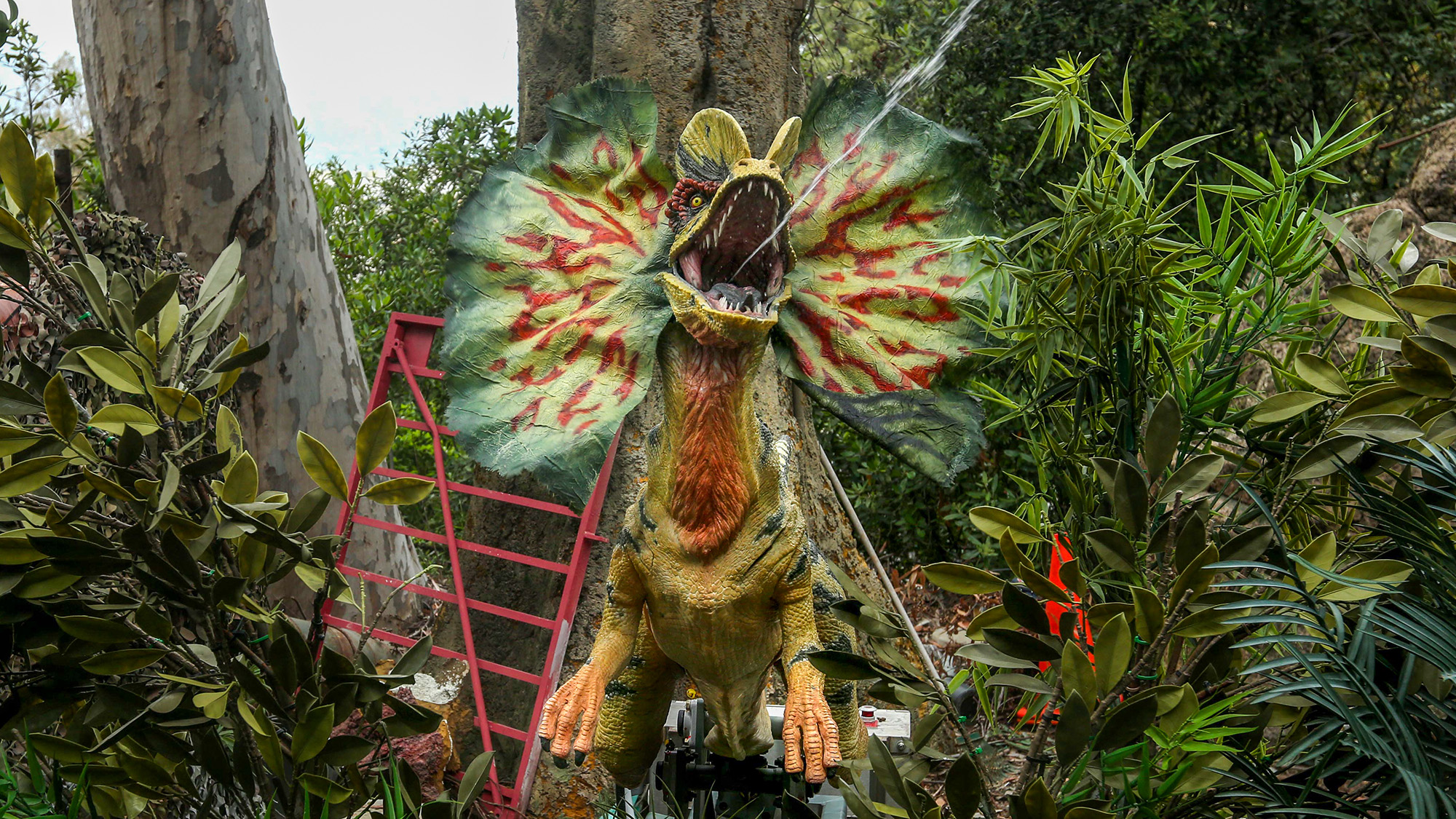
The image of the Dilophosaurus is etched into the collective consciousness of the public as a small, chirping predator with a vibrant neck frill and the ability to spit paralyzing venom. This depiction, popularized by the 1993 blockbuster Jurassic Park, has defined the species for decades. However, modern paleontological research suggests that this portrayal is almost entirely a product of cinematic imagination. While the Mesozoic Era was populated by some of the most formidable predators in Earth’s history, the question of whether any true dinosaur utilized venom as a hunting tool remains one of the most persistent mysteries in evolutionary biology. Recent findings in the fossil record, combined with advanced imaging technology, are finally providing a clearer picture of how toxins evolved in the shadow of the dinosaurs.
The Disconnect Between Cinema and Science
In the narrative of Michael Crichton’s Jurassic Park and Steven Spielberg’s film adaptation, the Dilophosaurus is presented as a diminutive threat that uses biological chemical warfare to incapacitate its victims, most notably the character Dennis Nedry. In reality, Dilophosaurus wetherilli was a far more imposing creature. Fossil evidence indicates that an adult Dilophosaurus could reach lengths of 20 feet and weigh approximately 880 pounds—roughly the size of a modern polar bear.
The "venom-spitting" theory originally gained traction in the 1980s when some paleontologists noted a "subnarial gap" or a perceived weakness in the dinosaur’s upper jaw. This led to speculation that the animal might have relied on chemical assistance because its bite force appeared insufficient to tackle large prey. However, a comprehensive 2020 study led by Adam Marsh, a paleontologist at Petrified Forest National Park, debunked this notion. Using advanced scans of Dilophosaurus fossils, Marsh and his team discovered that the jaws were actually reinforced with powerful musculature, suggesting the dinosaur was a high-powered apex predator that had no biological need for venom. The "venom glands" hypothesized by earlier researchers were revealed to be misidentified anatomical features of the jawbone.
A Chronology of Venom Evolution
While dinosaurs themselves may have lacked venom, the biological adaptation of producing toxins is ancient, predating the rise of the "terrible lizards" by millions of years. To understand the likelihood of venomous dinosaurs, researchers look to the broader timeline of vertebrate evolution.
- The Permian Precursor (250 Million Years Ago): The earliest confirmed venomous vertebrate was not a dinosaur or even a true reptile in the modern sense. Euchambersia, a small, dog-sized therapsid (a group of "mammal-like reptiles"), lived roughly 250 million years ago. CT scans of Euchambersia skulls have revealed deep fossae (hollows) behind the canine teeth, which likely housed venom glands, and a network of canals designed to deliver toxins into the mouth.
- The Triassic Transition (220 Million Years Ago): During the Triassic period, as the first dinosaurs began to emerge, other reptiles were already perfecting venomous strikes. Uatchitodon, a non-dinosaurian archosauromorph, possessed teeth with fully enclosed venom canals, similar to those found in modern cobras. Because only the teeth of Uatchitodon have been found, its exact place in the evolutionary tree remains a subject of debate, though it confirms that venomous delivery systems were active in the Mesozoic environment.
- The Cretaceous Controversy (125 Million Years Ago): In 2009, a team of researchers published a paper in the Proceedings of the National Academy of Sciences suggesting that Sinornithosaurus, a feathered dromaeosaur from China, possessed a venomous bite. They pointed to long, grooved teeth and a possible gland space in the skull. However, this theory was met with significant skepticism. Critics argued that the "grooves" were common features seen in many non-venomous species and that the "gland space" was likely a standard sinus cavity.
Biological Data: Venom vs. Poison
In discussing the potential for toxic dinosaurs, scientists emphasize the critical distinction between venomous and poisonous organisms. Venom is a toxin that is actively injected—usually through a bite, sting, or spine—to submerge prey or deter predators. Poison, conversely, is a passive defense mechanism; it is harmful only when touched or ingested.
The search for poisonous dinosaurs is even more challenging than the search for venomous ones. Modern birds, the only living descendants of dinosaurs, provide a fascinating parallel. In New Guinea, the Hooded Pitohui (Pitohui dichrous) sequesters batrachotoxin—the same neurotoxin found in poison dart frogs—within its feathers and skin. The bird acquires this toxin through its diet of Choresine beetles.
Theoretically, a dinosaur could have evolved a similar defense by consuming toxic plants or insects. However, because toxins and the soft tissues that contain them (such as skin and feathers) rarely survive the fossilization process, proving the existence of a "poisonous dinosaur" is nearly impossible with current technology. The chemical signatures of these toxins degrade over millions of years, leaving paleontologists with no "smoking gun."
The Challenges of the Fossil Record
The primary obstacle in identifying venomous dinosaurs is the nature of taphonomy—the study of how organisms decay and become fossilized. Venom delivery systems are comprised mostly of soft tissues:
- Venom Glands: These are modified salivary glands that rot away quickly after death.
- Ducts: The tubes connecting the gland to the teeth are equally fragile.
- Grooved Teeth: While teeth fossilize well, grooved teeth are not exclusive to venomous animals. Many modern fruit bats and primates have grooved teeth for non-toxic purposes, such as grooming or social signaling.
Furthermore, many modern venomous predators do not leave obvious skeletal markers. The Komodo dragon (Varanus komodoensis), for instance, was long thought to kill via bacteria in its mouth. It was only in 2009 that researchers discovered it possesses complex venom glands. These glands are tucked under the jaw and do not leave a distinct impression on the bone, meaning that if a Komodo dragon were fossilized, future paleontologists might never realize it was venomous.
Supporting Data: Apex Predators and Evolutionary Necessity
From an ecological standpoint, the absence of venom in large dinosaurs like Tyrannosaurus rex or Giganotosaurus makes sense. Venom is an "expensive" biological commodity; it requires significant metabolic energy to produce and maintain. For an apex predator that already possesses massive physical strength, serrated teeth, and a multi-ton bite force, the evolutionary pressure to develop venom is low.
Venom is most commonly found in animals that need to quickly incapacitate prey that might otherwise escape or in smaller animals that need to "punch above their weight class." This is why researchers continue to look at smaller dromaeosaurs and bird-like dinosaurs as the most likely candidates for venom, despite the lack of conclusive evidence.
Broader Impact and Paleontological Implications
The ongoing investigation into dinosaur toxins has broader implications for our understanding of Mesozoic ecosystems. If venomous dinosaurs did exist, it would suggest a much more complex "arms race" between predators and prey than previously imagined.
The study of Spinosaurus, as highlighted by experts like Garrett Kruger of the I Know Dino podcast, further illustrates the mysteries of dinosaur specialization. The Spinosaurus, with its crocodile-like snout and massive dorsal sail, represents a highly specialized aquatic hunter. Some hypotheses suggest its sail could have been used for thermoregulation, display, or even as a hunting tool to shade the water and reduce glare, allowing it to see fish more clearly. These unique physical adaptations show that dinosaurs were constantly evolving specialized niches. While venom has not yet been proven to be one of those niches, the diversity of the dinosauria suggests that the possibility cannot be entirely ruled out.
Official Responses and Scientific Consensus
The current consensus among the global paleontological community is one of "cautious absence." While no specimen has provided undeniable proof of venom, the discovery of venomous contemporaries like Euchambersia and Uatchitodon proves that the "evolutionary toolkit" for venom was available during the Mesozoic.
"The fossil record is a filtered view of the past," notes the scientific community’s general sentiment. "We are limited by what turns into stone." As technology improves—particularly the use of synchrotron micro-tomography to look inside fossilized teeth for microscopic canals—scientists may one day find a specimen that settles the debate.
Until then, the venomous Dilophosaurus remains a resident of Hollywood rather than the natural history museum. The reality of the Mesozoic was likely even more terrifying: a world where predators didn’t need toxins to be deadly, relying instead on millions of years of refined physical prowess to dominate the planet. The search for the first truly venomous dinosaur continues, driven by the hope that the next discovery in the badlands of Montana or the deserts of Mongolia might finally reveal a hidden chemical weapon in the teeth of a prehistoric giant.