



Most large organizations have diligently navigated the initial stages of artificial intelligence adoption. Enterprise AI tools have been procured, configured, and licensed. Robust governance frameworks and essential guardrails are now established, and critical legal and compliance considerations have been thoroughly addressed. Many companies have even made public announcements regarding their AI initiatives, often accompanied by supplementary resources, dedicated office hours, or introductory training sessions. For Chief Learning Officers (CLOs) and other learning and development leaders, this phase is likely to be all too familiar, representing the current reality for a significant portion of the corporate world.
However, a discernible and persistent pattern is now emerging across these organizations, highlighting a critical disconnect between technological enablement and human capability. While a select group of early adopters is actively experimenting, exploring, and integrating AI into their daily workflows, a substantially larger segment of the workforce remains hesitant or uncertain. These employees grapple with understanding how AI fits into their specific roles, when its application is appropriate, and how to deploy it responsibly and effectively in real-world scenarios. Consequently, AI utilization is proving to be uneven, with varying levels of employee confidence, leaving a significant portion of the workforce in a state of cautious hesitation.
This disparity is precisely where the industry’s central tension becomes most apparent. The promise of AI is frequently articulated, often characterized by the potential for monumental leaps in productivity, creativity, and speed – frequently described as 10x or even 100x improvements. Yet, the tangible reality within many organizations paints a far more subdued picture. Despite the widespread availability of AI tools, the transformative impact initially envisioned has yet to materialize at scale across the enterprise. At this juncture, the primary challenge is no longer about granting access to AI technology; it has definitively shifted to ensuring workforce readiness. This is not a technical hurdle, but a profoundly human one.
The Documented Readiness Gap: Data Reveals a Growing Chasm
The firsthand experiences of learning leaders are increasingly being corroborated by industry-wide research, underscoring the growing divide between AI adoption and its realized impact. A landmark report, McKinsey’s 2025 State of AI, revealed that an impressive 88 percent of organizations are now leveraging AI in at least one business function. However, a significantly smaller proportion has successfully translated this adoption into meaningful gains in enterprise performance. This sentiment is echoed by the Forbes Technology Council, which recently noted that most organizations report less than 5 percent of their earnings are currently attributable to AI, a stark indicator of the persistent difficulty in moving from initial experimentation to measurable business impact.
Workforce data provides a parallel narrative. A comprehensive 2026 Gallup workforce survey, which polled over 22,000 employees, found that only approximately 12 percent of workers report using AI on a daily basis in their jobs, despite the widespread deployment of AI tools across enterprises. This data suggests that while organizations are rapidly providing access to AI technologies, the majority of employees are still in the nascent stages of learning how to effectively integrate these tools into their established workflows. The core challenge, therefore, is no longer the availability of the technology itself, but rather the cultivation of the confidence, capability, and sound judgment required to utilize it proficiently in practical work settings. In essence, organizations possess the AI tools, but they currently lack a reliable and scalable methodology to empower their people to perform optimally with these tools – consistently, responsibly, and at a broad enterprise level.
Defining Workforce Readiness: Beyond Proxies to Demonstrated Competence
Workforce readiness in the context of AI manifests as demonstrable competence and confidence in performing actual job tasks. This is not about inferred competence derived from mere course completion, nor is it about confidence assumed solely from survey responses. True readiness is characterized by demonstrated confidence, cultivated through preparation, action, consistent feedback, diligent reflection, and continuous improvement over time.
Historically, learning organizations have relied on indirect indicators to gauge readiness. Metrics such as course completion rates, certifications, employee tenure, or scores on standardized tests have served as proxies. However, the advent of AI, when approached with intentionality, fundamentally alters this paradigm. Readiness becomes observable, trackable over a longitudinal period, and scalable across the entire workforce.
This fundamental shift carries profound implications for both individual employees and the organizations they serve. For employees, enhanced readiness translates into more rewarding work experiences, characterized by reduced guesswork, increased confidence, and greater fluency in navigating complex challenges. For organizations, workforce readiness directly correlates with improved performance, better decision-making in the face of uncertainty, and a mitigated risk profile as new capabilities are introduced and integrated. This dual value proposition – benefits for the individual and the enterprise – stands as the defining hallmark of workforce readiness in an AI-augmented world.
The Overlooked Shift: From a Single Step to a Multi-Step Workflow
A significant factor contributing to the lag in workforce readiness stems from the prevalent adoption of a simplistic, one-step mental model for AI usage. This model, which mirrors basic search engine behavior, involves posing a question, receiving an answer, and moving on. While transactional and seemingly efficient, this approach is fundamentally limiting.
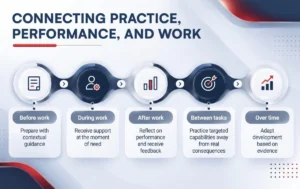
True collaboration with AI, on the other hand, necessitates a multi-step approach. This iterative process involves phases of planning, drafting, testing, refining, and revisiting decisions, allowing clarity to emerge organically. In this model, human judgment becomes central, and learning extends beyond the pre-action phase to encompass the post-action period. This distinction is crucial because reflection and the ability to pivot are only possible within multi-step workflows.
When AI is framed solely as a tool to "find me the answer," employees are less likely to pause and reflect on the outcomes or adjust their approach. However, when AI is conceptualized as a collaborator, a natural and powerful feedback loop emerges. This loop comprises planning the task, executing it with AI’s assistance, and then reflecting on the results. This Plan-Do-Reflect cycle, and the subsequent pivot it enables, represents the human mechanism that transforms mere access to AI into tangible performance improvements. Without this iterative process, AI remains an impressive but superficially utilized tool. With it, AI evolves into a potent catalyst for continuous learning and improvement within real-world work contexts.
The Practice-Perform-Learn Framework: A Foundation for AI Fluency
At the core of this advanced approach lies the Practice-Perform-Learn framework, a learning architecture that has a proven track record in enterprise environments for years, predating the widespread adoption of generative AI. This framework is not supplanted by AI; rather, it is significantly amplified by it. AI enables repeatable practice, personalized feedback, and guided reflection without the constant need for direct instructor or manager intervention. The Practice-Perform-Learn framework has garnered prestigious accolades, including Gold and Silver Brandon Hall Awards, recognizing its innovation in human capital management, its effectiveness in creating learning simulations, and its advancements in business strategy and technology. These awards are particularly significant as they require demonstrated performance improvement, moving beyond mere compelling design.
Case Study Snapshot: Operationalizing Readiness in a Regulated Enterprise
Context: A global, highly regulated enterprise with tens of thousands of employees and established access to enterprise-grade AI tools.
Challenge: Despite the availability of AI tools, employee confidence and competence in their utilization were highly uneven. While a subset of early adopters progressed rapidly, a significant portion of the workforce remained hesitant, thereby limiting the overall enterprise-wide impact of AI and impeding progress toward meaningful, widespread adoption.
Approach: Instead of launching another tool-centric initiative, the organization implemented a dedicated, AI-powered environment. This platform was specifically designed to enable employees to learn, practice, and perform using AI, with a particular focus on exploring how to apply their existing AI tools within authentic workflow scenarios. This environment effectively operationalized the Learn-Practice-Perform framework. Employees engaged in structured learning modules, practiced realistic scenarios, and prepared for or reviewed actual work tasks. Throughout this process, they received personalized feedback and guided reflection, a methodology referred to as "reflective intelligence."
Measures: The success of this initiative was assessed through tracking changes in confidence distribution over time, the depth of engagement in practice activities, and the emergence of reflective insights derived from real work experiences. This case study moves beyond the theoretical promise of AI to present tangible, evidence-based proof of its impact.
Tangible Outcomes: Rapid and Sustained Performance Gains
Once the principles of multi-step collaboration and reflective practice were firmly established, significant and sustained positive outcomes emerged rapidly. Within a remarkably short period of 60 days, the organization observed a four-fold increase in the number of employees who self-identified as being in the "high-confidence" group. Crucially, this surge in confidence was not a temporary spike; it remained elevated well beyond the initial pilot phase, demonstrating lasting impact.
Concurrently, there was a two-fold decrease in the number of participants reporting low confidence. This indicates progress not only at the upper echelons of confidence but also within the crucial middle segment of the workforce – the very population that determines whether overall readiness scales effectively or stagnates. Employees also exhibited improved judgment, demonstrating greater clarity regarding when AI offered genuine value, how to employ it responsibly, and, perhaps most importantly, when to refrain from relying on it altogether. In regulated and high-stakes environments, this judicious restraint is a powerful indicator of true readiness.
Reflective Intelligence: A Dual Value Proposition for People and the Organization
Reflection was not an ancillary component of this initiative; it served as the primary engine of improvement. For employees, guided reflection facilitated deeper understanding and insight, leading to enhanced accuracy, greater fluency, and a clearer path toward mastery. Individuals gained an understanding of why a particular approach was effective, not just that it was effective, enabling them to adapt more skillfully over time.
For the organization, the input generated through reflection provided actionable intelligence. Leaders gained unprecedented visibility into workflow dynamics, identified persistent friction points, and uncovered new opportunities for process optimization. In some instances, these insights revealed that what initially appeared to be a skills gap was, in fact, a systemic workflow or cultural challenge. This dual value – fostering personal growth and generating critical organizational insights – is what truly differentiates reflective intelligence from traditional feedback mechanisms. It effectively transforms learning activities into a robust mechanism for continuous organizational adaptation.
Why Traditional Playbooks Fall Short in the AI Era
Conventional technology adoption playbooks have historically prioritized access, utilization, and scaling. However, the effective integration of AI demands a different approach. The true value of AI is unlocked through judgment, not merely through its use. This critical judgment cannot be mandated or inferred from superficial metrics; it must be cultivated through experience – a continuous cycle of learning, practice, reflection, and adaptation. Maximizing AI utilization does not inherently guarantee readiness, nor does broad exposure automatically foster confidence. Scaling AI without a fundamental redesign of how people learn and adapt risks amplifying noise rather than building true capability. The leaders currently experiencing significant progress are not discarding their existing playbooks but are instead evolving them to meet the unique demands of the AI landscape.
Pilots Reimagined: From Proof of Concept to Discovery of Best Fit
In the current AI-driven environment, pilot programs are being re-envisioned with a new purpose. Rather than solely aiming to prove that a solution "works," effective pilots are now designed to discover the optimal "best fit." This involves understanding how learning and practice can be seamlessly integrated with existing tools, organizational culture, established workflows, and the current capabilities of the workforce. Forward-thinking leaders approach these pilots with a spirit of "courageous curiosity," actively learning alongside their teams. Many organizations are strategically beginning with the AI tools they already possess, utilizing text-based scenario practice to build initial momentum before expanding into richer, multimodal AI experiences as confidence levels grow. The pilot itself is not the ultimate objective; the valuable insights derived from it are paramount.
The Accelerating Pace of AI: Near-Term Realities and Future Trajectories
The urgency surrounding AI readiness is compounded not only by its pervasive presence but also by the accelerating pace of its development. While many organizations are still grappling with building readiness for text-based AI applications, multimodal AI – encompassing video, avatars, voice, and increasingly sophisticated simulations – is already arriving at enterprise scale. This evolution often occurs without a traditional, fanfare-filled rollout moment; capabilities simply become available. If organizational mindsets and workflows have not fundamentally shifted to accommodate these advancements, employees will inevitably continue to apply outdated approaches to new tools, leading to a recurring readiness gap that reappears with each new technological wave.
Redefining "10x": From Usage to Demonstrated Fluency
AI is frequently positioned with a "10x" or even "100x" promise. For learning leaders, clarity on what this truly signifies is essential. In terms of workforce readiness, a 10x improvement does not equate to a tenfold increase in AI usage. Instead, it signifies a ten-fold increase in the number of individuals who can demonstrably exhibit competence and confidence in AI-enabled workflows. This is the pathway by which the hesitant middle is moved forward. This is how readiness achieves enterprise-wide scale. And this is how the grand promise of AI ultimately transforms into tangible proof of performance.
The Leadership Imperative: Navigating Change and Fostering Adaptability
Organizations do not need to predict every future AI capability with absolute certainty. What they critically need are robust systems that empower their people to explore with curiosity, practice in safe environments, reflect deeply on their experiences, and adapt continuously. This journey begins with leveraging existing resources and extends as new capabilities emerge and evolve. For Chief Learning Officers, this represents a pivotal moment to lead from the center of organizational change. The imperative is to design workforce readiness strategies that not only keep pace with accelerating technology but also simultaneously make work more rewarding for employees and demonstrably more valuable for the organization. This strategic approach is how AI transitions from the promise of transformation to demonstrated readiness, and ultimately, from promise to proven performance.