



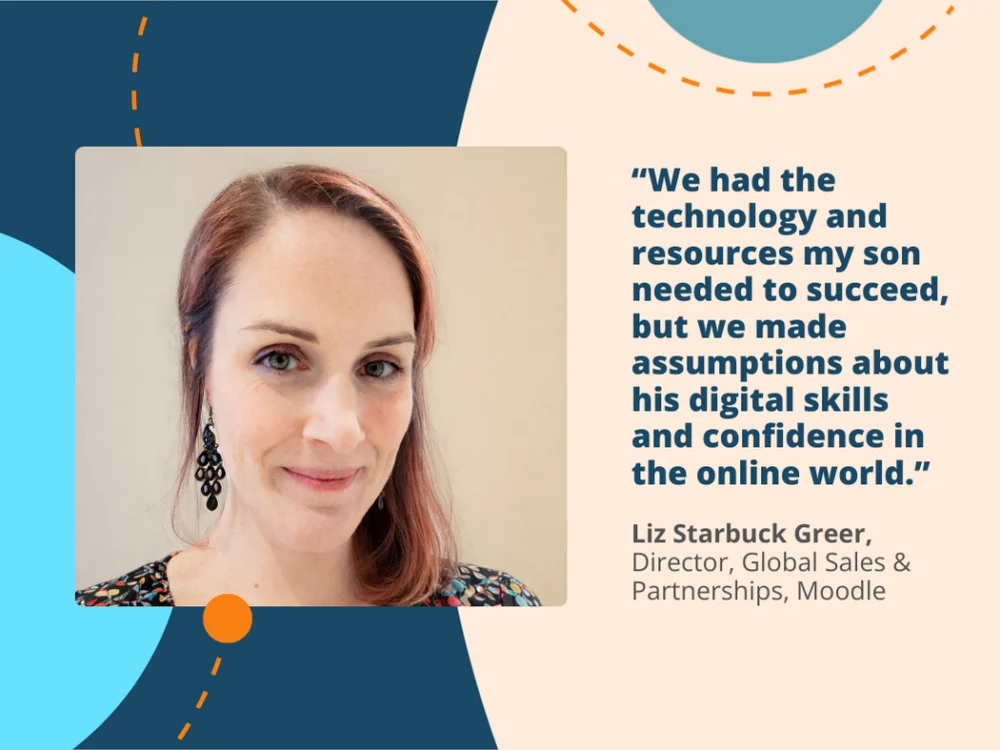
Liz Starbuck Greer, a prominent figure in educational technology and a presenter at MoodleMoot Global 2025, has shared a profound personal experience that highlights a critical distinction often overlooked in the digital age: the difference between digital confidence and digital competence. Her insights, stemming from a deeply personal struggle with her son’s educational journey during the COVID-19 pandemic, offer a stark reminder that mere access to technology does not guarantee success in online learning environments. Greer’s narrative, amplified through her recent podcast appearances and presentations, underscores the multifaceted nature of "digital capital" and its profound impact on learner outcomes.
The COVID-19 pandemic, which began in early 2020, forced an unprecedented and rapid shift to remote learning for educational institutions worldwide. This abrupt transition presented unique challenges for students, educators, and parents alike. While many assumed that the widespread availability of devices and internet access would smoothly facilitate this transition, Greer’s experience reveals a more complex reality. Her son, a high school freshman at the time, found himself thrust into emergency online learning just months after starting a new school. This sudden disruption, coupled with the loss of familiar in-person routines and support structures, proved to be a significant hurdle, despite the family’s seemingly high level of digital capital.
"We had the technology and resources my son needed to succeed, but we made assumptions about his digital skills and confidence in the online world," Greer stated, encapsulating the core of her revelation. This statement serves as a potent thesis for her argument, challenging the prevailing notion that digital fluency in social contexts automatically translates to academic proficiency in online learning.
The Genesis of the Challenge: A Family’s Digital Capital
Greer, a professional working in higher education, possesses extensive experience in online course design and delivery. Her husband, also a professional, relies heavily on technology in his daily work. As a family, they were well-equipped with reliable internet, multiple devices, and a general understanding of technological tools. Furthermore, their children, having grown up overseas, were accustomed to using technology for social connection, and Greer’s son was an avid and skilled gamer, indicating a high degree of comfort and proficiency with digital interfaces and interactive platforms.
This seemingly robust digital infrastructure and personal familiarity with technology positioned them, by conventional metrics, as having high "digital capital." Digital capital, as Greer defines it, is the confluence of access, skills, experience, and social support that dictates an individual’s ability to effectively leverage digital tools and participate in online spaces. It moves beyond mere access to encompass the qualitative aspects of digital engagement.
However, the academic demands of online schooling presented a different set of challenges. While Greer was managing her own professional responsibilities, including supporting hundreds of business school students and stressed faculty, her son began to disengage from his studies. The family remained unaware of the extent of his struggles until a concerned teacher alerted them to his missing assignments and consistent absence from scheduled online classes.
The Unveiling of Incompetence: Hundreds of "Untitled Documents"
The revelation of the depth of the problem came during a family sit-down to address the academic shortfall. When asked to retrieve his schoolwork, Greer’s son revealed a chaotic digital landscape, characterized by hundreds of files named "Untitled Document." This stark visual representation of disorganization pointed to a fundamental lack of foundational digital skills necessary for academic tasks.
Further investigation uncovered a critical deficit: he did not know how to properly title documents, organize files into folders, or efficiently locate his assignments. His typing skills were rudimentary, and he lacked the know-how to articulate questions via email or navigate the varied communication channels used by different teachers for assignment submission and retrieval. The inconsistency in how teachers managed and collected work exacerbated his confusion, leading to a growing sense of being lost and overwhelmed.
"It quickly became clear that we’d completely misjudged the situation," Greer recounted. "He didn’t know how to title a document or create a folder. His typing was slow and basic. He didn’t know where to find the work he needed to complete. He didn’t know how to write or send an email if he had a question. Different teachers used different channels to transmit the work and to receive it and he had no idea what he was meant to be doing and when."

This experience highlighted a crucial disconnect: his proficiency in gaming and social media, which fostered a sense of digital confidence, did not equip him with the specific digital competencies required for academic success in an online environment. The intricacies of navigating an educational platform, managing digital files, and communicating effectively for academic purposes were entirely new and unstructured for him.
The Broader Implications: Rethinking Digital Capital in Education
Greer’s personal narrative has significant implications for the broader educational landscape, particularly as online and blended learning models become increasingly prevalent. The "digital divide" is often discussed in terms of access to technology and internet connectivity, but Greer’s experience emphasizes a more nuanced understanding that includes the skills and competencies necessary to utilize these tools effectively for learning.
Supporting data from various educational research bodies corroborate Greer’s findings. A 2023 report by the National Center for Education Statistics indicated that while a majority of K-12 students have access to a device at home, a significant portion still struggle with digital literacy skills essential for online coursework. Similarly, studies on higher education have shown that students with lower levels of digital competence often experience higher rates of attrition and academic underperformance in online courses, regardless of their access to technology.
The COVID-19 pandemic served as a large-scale, unplanned experiment in remote learning, exposing systemic weaknesses in digital preparedness. Institutions that had invested in robust digital infrastructure and comprehensive digital literacy training for both students and faculty were generally better positioned to adapt. However, many, like the school in Greer’s account, were forced into rapid implementation, often with inconsistent approaches.
Designing for Digital Realities: A Call for Consistency and Clarity
Greer’s reflection leads to a critical call to action for educators and learning designers: to move beyond assumptions and design online learning experiences that acknowledge and cater to the diverse digital capital of their learners.
"Strength in one digital arena doesn’t promise success in another," Greer emphasizes. This means that educators must actively consider that a student’s comfort with social media or gaming does not automatically translate to proficiency in managing academic digital tasks. The skills and norms of educational technology use are distinct and require explicit instruction and support.
Key strategies emerging from Greer’s insights include:
- Explicit Instruction in Digital Skills: Rather than assuming students possess necessary digital competencies, institutions and instructors should provide clear, direct instruction on using learning management systems (LMS), managing files, communicating effectively for academic purposes, and adhering to academic integrity guidelines in an online environment.
- Consistency in Platform Use and Communication: Inconsistent use of platforms, assignment submission methods, and communication channels can create significant confusion for students, especially those with lower digital capital. Standardizing these processes across a course or even an institution can streamline the learning experience.
- Clear Signposting and Structure: Well-organized course structures, clear navigation within the LMS, and explicit instructions for all tasks are crucial. This includes providing unambiguous guidance on where to find materials, how to submit assignments, and how to seek help.
- Modeling Expectations: Instructors can actively model expected behaviors and interactions within the online environment. This includes demonstrating how to use discussion forums effectively, how to pose questions to instructors or peers, and how to present work.
- Proactive Support and Intervention: Regular check-ins and monitoring of student engagement are vital. Identifying students who appear to be falling behind early on allows for timely intervention and support, preventing them from becoming disengaged. This could involve personalized outreach or targeted support sessions.
Greer’s son’s experience, while personally challenging, ultimately led to a stronger understanding of his own learning needs and a renewed commitment to academic success. He "pulled through" and has since moved on to "bigger and better things." This personal triumph, however, is underscored by the broader lesson: the importance of designing inclusive and supportive digital learning environments.
The Moodle community, which Greer references, is a network of educators and developers dedicated to improving online learning. This community, as Greer points out, is a valuable resource for sharing best practices and seeking support. By leveraging such collaborative networks and focusing on the principles of digital capital, educational institutions can work towards building learning environments where all students, regardless of their starting point, have the opportunity to succeed.
The journey from digital confidence to digital competence is not always linear or intuitive. As Greer’s story powerfully illustrates, bridging the "hidden learning gap" requires intentional design, empathetic understanding, and a commitment to equipping learners with the full spectrum of skills needed to thrive in an increasingly digital world. Her advocacy for a holistic approach to digital capital serves as a vital reminder for educators to critically examine their assumptions and actively design for the digital realities their learners bring to the virtual classroom.