

The acquisition of numerical literacy in the Turkish language serves as a critical gateway for international professionals, expatriates, and travelers navigating the Republic of Turkey’s dynamic socio-economic landscape. As a member of the G20 and a pivotal bridge between Europe and Asia, Turkey demands a level of linguistic integration that begins with the most fundamental of tools: numbers. Whether executing a financial transaction in Istanbul’s Grand Bazaar, exchanging contact information for a burgeoning business partnership, or coordinating logistics across the Anatolian corridor, understanding the logic and application of Turkish numerals is an essential competency. The Turkish numerical system is lauded by linguists for its mathematical consistency and logical structure, which, once understood, allows a learner to scale from basic counting to complex financial reporting with relative ease.
The Linguistic Architecture of Turkish Numerals
Turkish is an agglutinative language, meaning it functions through the systematic addition of suffixes and the combination of roots. However, its numerical system is remarkably straightforward, following a decimal base-10 structure that lacks the irregularities found in languages such as French or German. The system is governed by the Turkish Language Association (Türk Dil Kurumu or TDK), which ensures standardization across the country’s educational and official institutions.
The Foundational Decad: 1 to 10
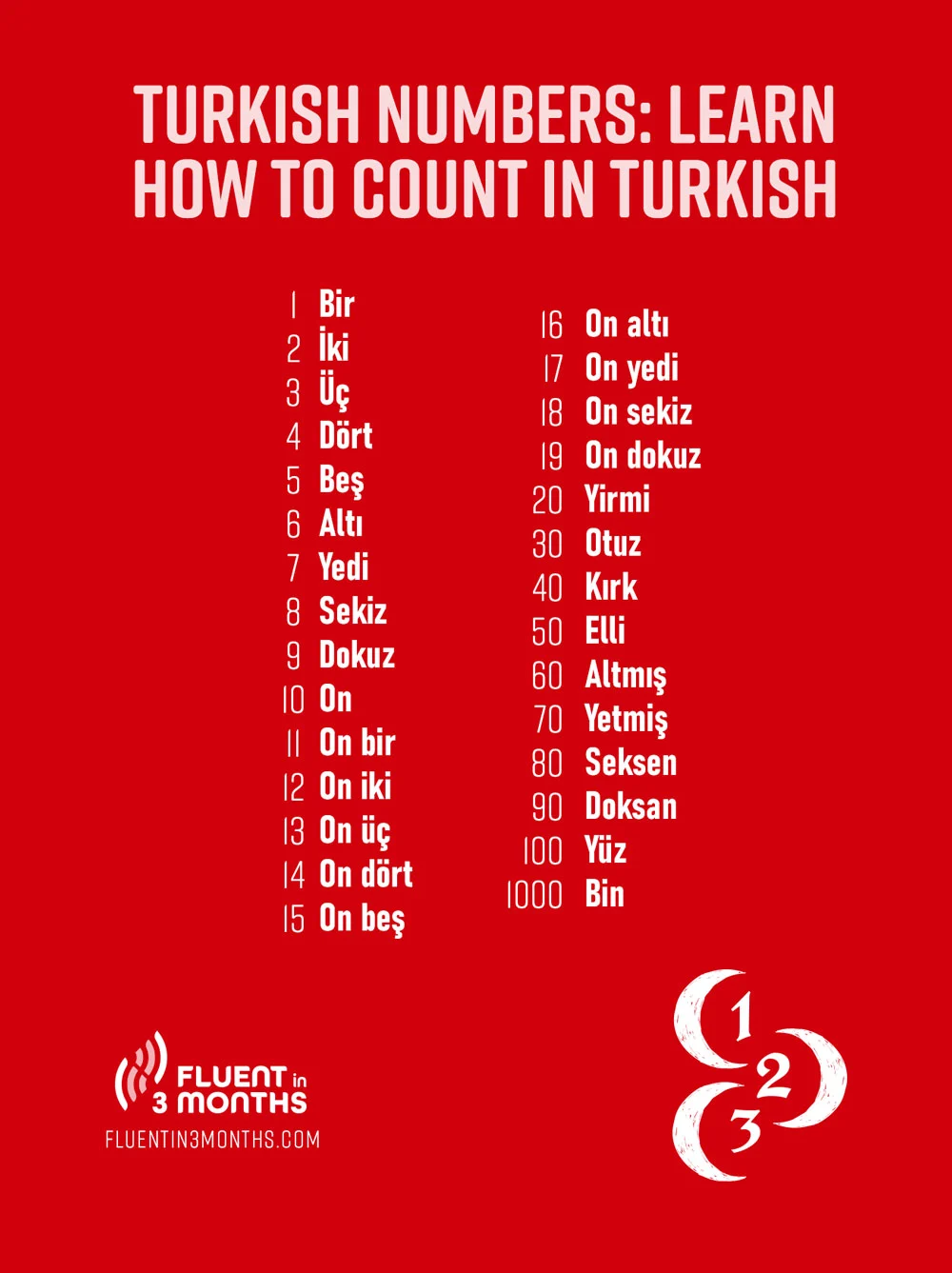
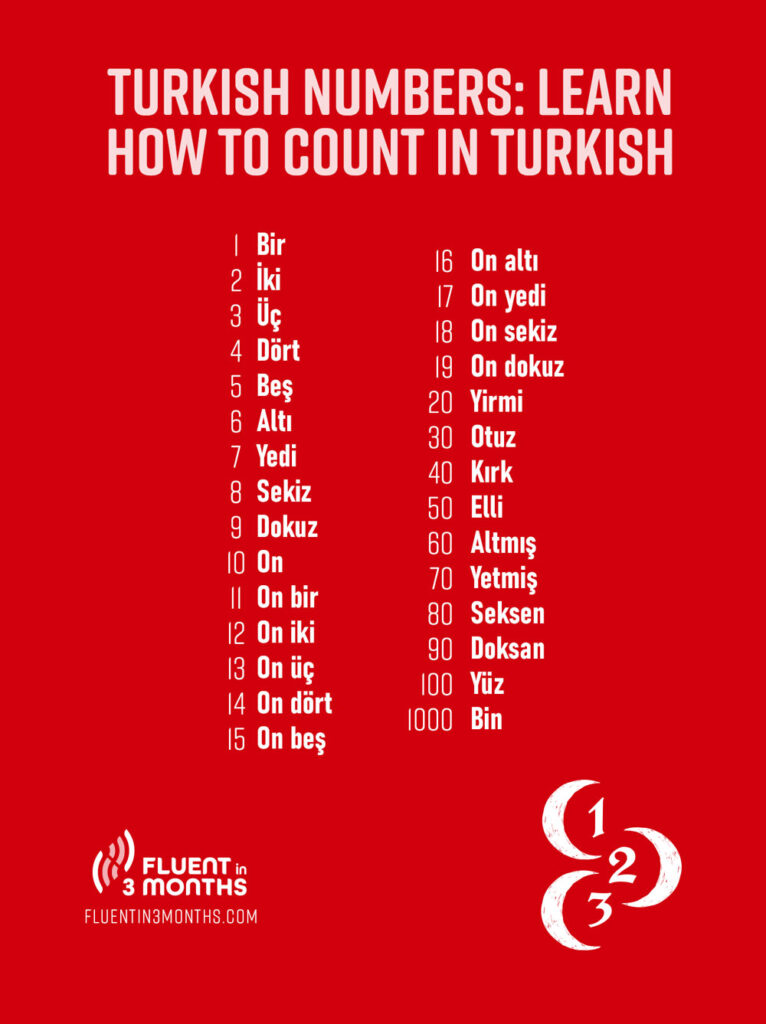
The building blocks of the entire system are the numbers one through ten. Mastery of these ten words is non-negotiable, as they reappear in every subsequent numerical construction, including tens, hundreds, and thousands.
- Bir (One)
- İki (Two)
- Üç (Three)
- Dört (Four)
- Beş (Five)
- Altı (Six)
- Yedi (Seven)
- Sekiz (Eight)
- Dokuz (Nine)
- On (Ten)
The phonetic nature of the Turkish alphabet—adopted in 1928 as part of Atatürk’s reforms—means that these numbers are pronounced exactly as they are written. For instance, the "ç" in üç carries a "ch" sound, while the "ş" in beş is equivalent to the English "sh."
Linear Progression: 11 to 19
The Turkish system for numbers 11 through 19 is purely additive. Unlike the English "eleven" or "twelve," which have unique roots, Turkish simply places the word for ten (on) before the single digit.
- 11: On bir (Ten + One)
- 12: On iki (Ten + Two)
- 13: On üç (Ten + Three)
- 14: On dört (Ten + Four)
- 15: On beş (Ten + Five)
- 16: On altı (Ten + Six)
- 17: On yedi (Ten + Seven)
- 18: On sekiz (Ten + Eight)
- 19: On dokuz (Ten + Nine)
This logical transparency reduces the cognitive load on learners and minimizes errors in high-stakes environments, such as during the verbal confirmation of quantities or dates.
Expanding the Lexicon: Multiples of Ten and Compound Construction
To progress toward fluency, one must memorize the unique names for the multiples of ten. While some, like seksen (80) and doksan (90), bear a slight resemblance to their roots sekiz (8) and dokuz (9), others are distinct and require rote memorization.
- 20: Yirmi
- 30: Otuz
- 40: Kırk
- 50: Elli
- 60: Altmış
- 70: Yetmiş
- 80: Seksen
- 90: Doksan
Once these "anchors" are established, creating any number between 21 and 99 involves a simple two-step verbal process: state the tens place, then state the units place. For example, the number 45 is rendered as kırk beş, and 72 as yetmiş iki. This consistency remains unbroken throughout the language’s numerical range.
Scaling to the Hundreds and Thousands
The transition to larger denominations follows a multiplicative logic. The Turkish word for "hundred" is yüz. To express multiples of a hundred, the multiplier is placed before yüz.
- 100: Yüz (Note: "One hundred" is usually just yüz, though bir yüz is grammatically understood but rarely used).
- 200: İki yüz
- 300: Üç yüz
- 500: Beş yüz
- 900: Dokuz yüz
For complex numbers, such as 235, the components are stated in descending order of magnitude: İki yüz otuz beş (Two hundred + thirty + five).
The same rule applies to "thousand," which is bin.
- 1,000: Bin
- 5,000: Beş bin
- 10,000: On bin
- 100,000: Yüz bin
In the context of the Turkish economy, where large figures are frequently used due to the currency’s denomination, being able to quickly calculate and articulate these "big ones" is a vital skill for anyone involved in trade, real estate, or regional investment.
Ordinal Numbers and the Principle of Vowel Harmony
Ordinal numbers (first, second, third, etc.) are essential for describing sequences, floors in a building, or centuries. In Turkish, these are formed by adding the suffix -ıncı, -inci, -uncu, or -üncü to the cardinal number. The choice of suffix is dictated by "Four-Way Vowel Harmony," a cornerstone of Turkish grammar that ensures the suffix matches the vowel sounds of the root word.
- Birinci (First)
- İkinci (Second)
- Üçüncü (Third)
- Dördüncü (Fourth) – Note: The ‘t’ in dört changes to ‘d’ when a suffix starting with a vowel is added.
- Beşinci (Fifth)
- Altıncı (Sixth)
- Yedinci (Seventh)
- Sekizinci (Eighth)
- Dokuzuncu (Ninth)
- Onuncu (Tenth)
This grammatical precision reflects the broader Turkish emphasis on order and hierarchy in formal communication.
Practical Applications in the Turkish Marketplace
Understanding numbers in isolation is only the first step; applying them within the cultural and economic framework of Turkey is where the true utility lies.
Currency and Financial Transactions
The Turkish Lira (TRY or TL) is the national currency, subdivided into 100 kuruş. When discussing prices, the lira amount is stated first, followed by the kuruş.
- Example: 15.50 TL is expressed as On beş lira elli kuruş.
In casual commerce, the word lira or kuruş may be omitted if the context is clear, such as On beş elli.
Temporal Navigation
Turkey utilizes the 24-hour clock for formal schedules, such as airline departures and government appointments. However, daily conversation often employs a 12-hour format with specific terminology for fractions of time.
- Buçuk (Half past): Saat iki buçuk (2:30).
- Çeyrek (Quarter): Used to indicate 15 minutes past or to the hour.
- Geçiyor / Kala: These terms denote "past" and "to" the hour, respectively.
Communication and Demographics
Phone numbers in Turkey consist of a three-digit area or mobile code followed by a seven-digit number. They are typically recited in a specific rhythm: a group of three, then two, then two. For example, 05XX XXX XX XX would be said as "Zero-five-hundred-X, three-hundred-X, X-two, X-two."
When discussing age, the phrase yaşındayım (I am… years old) follows the number. A 30-year-old would state: Otuz yaşındayım.
Standardization and Writing Conventions
A significant point of divergence for Westerners is Turkey’s use of punctuation in mathematics. Following the European convention, Turkey uses a period (.) as a thousands separator and a comma (,) as a decimal point.
- English standard: 1,250.50
- Turkish standard: 1.250,50
Failure to recognize this distinction can lead to significant errors in accounting, contract drafting, and engineering specifications. Furthermore, in formal documents, it is common practice to write out numbers in parentheses after the numeral to prevent fraudulent alteration—a standard procedure in Turkish banking and law.
Broader Impact and Strategic Implications
The mastery of Turkish numbers is more than a linguistic exercise; it is a strategic asset. Turkey has seen a significant rise in foreign direct investment (FDI) over the last two decades, particularly in the manufacturing, technology, and renewable energy sectors. For the international professional, the ability to discuss metrics, percentages, and valuations in the local tongue builds immediate rapport and demonstrates a commitment to the market.
Linguistic research suggests that the logical consistency of the Turkish counting system may actually aid in mathematical processing. For the learner, this logic provides a sense of security; once the base rules are learned, there are no "irregular" exceptions to fear.
As Turkey continues to expand its influence through initiatives like the Middle Corridor trade route and its growing defense industry, the demand for Turkish-literate professionals is projected to increase. Beginning this journey with the numerical system provides the most immediate "return on investment," enabling the learner to function in the most common and vital of human interactions: the exchange of time, value, and information.
In conclusion, while apps and digital translators offer a temporary bridge, true integration into the Turkish professional sphere requires a foundational grasp of its numerical language. By mastering the sequence from bir to bin, and understanding the nuances of vowel harmony and financial formatting, one positions themselves to navigate the complexities of Turkish life with confidence and precision. Whether for commerce, travel, or academic pursuit, the Turkish numerical system remains a testament to the country’s blend of historic depth and modern logical efficiency.