


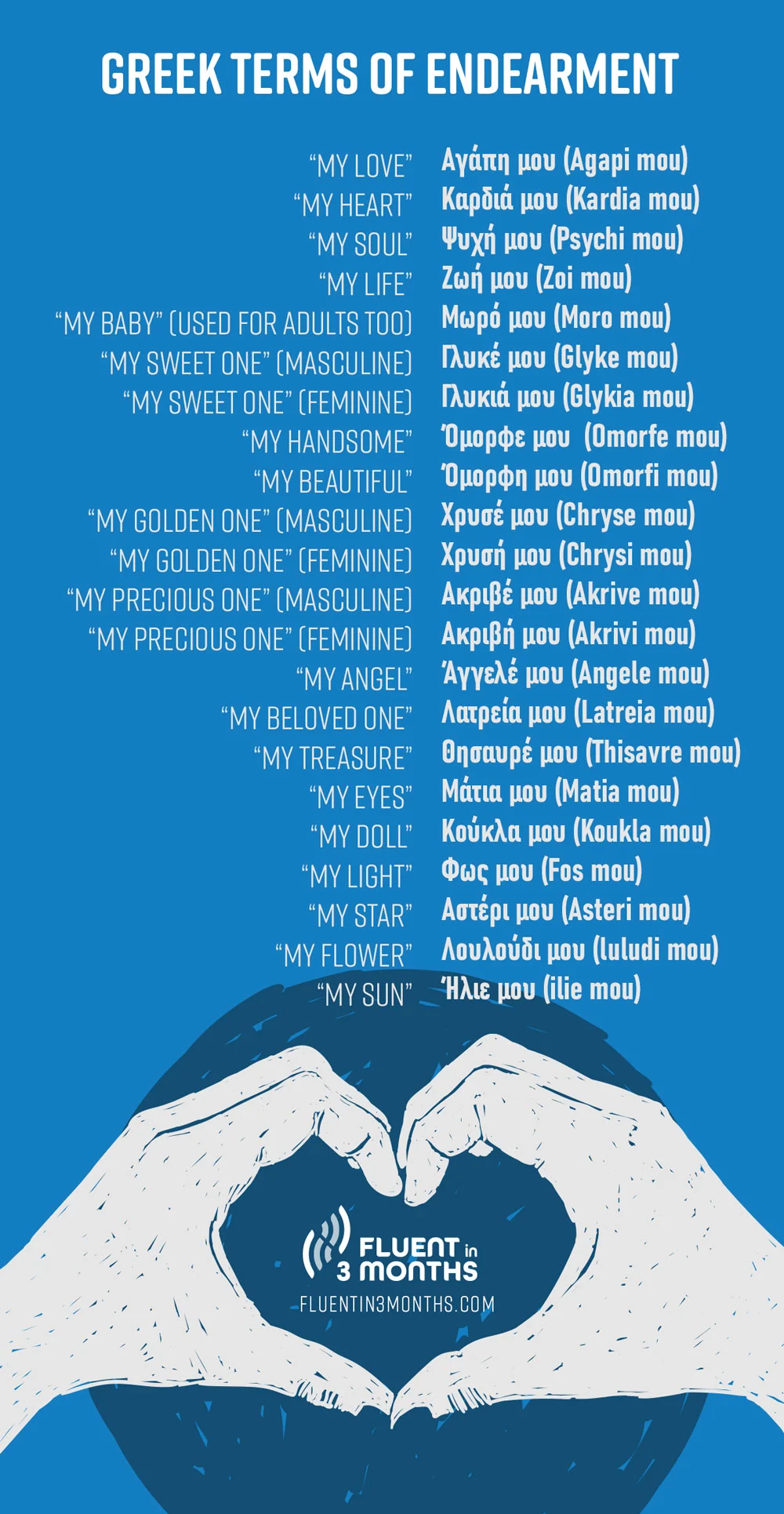
The Greek language, with a history spanning over three millennia, has developed a sophisticated and deeply nuanced vocabulary for expressing affection, intimacy, and social bonding. At the core of this linguistic tradition is the phrase "S’agapo" (Σ’ αγαπώ), meaning "I love you," which serves as the foundation for a wide array of endearments. In contemporary Greek society, from the mainland to the diaspora in Cyprus, Australia, and North America, these terms are not merely decorative but are essential tools for navigating social hierarchies and reinforcing familial and romantic bonds. The systematic use of the possessive pronoun "mou" (μου), meaning "my," following a noun, transforms standard vocabulary into intimate markers of connection, such as "agapi mou" (my love) or "kardia mou" (my heart).
The Philosophical Foundation: The Eight Pillars of Greek Love
To understand modern Greek endearments, one must look back at the classical categorization of love, which remains embedded in the linguistic psyche of the region. Unlike the English language, which often relies on the singular word "love" to cover a spectrum of emotions, Ancient Greek philosophy identified eight distinct types of love, many of which influence modern terminology.
- Eros: Named after the Greek god of love and fertility, this represents passionate, romantic, and physical desire.
- Philia: This refers to the deep, long-standing friendship and loyalty found in platonic bonds.
- Storge: A naturally occurring affection, primarily seen in the bond between parents and children.
- Agape: Often considered the highest form of love, it represents selfless, unconditional love for humanity or the divine.
- Ludus: A playful, uncommitted love, often associated with the early stages of flirting.
- Pragma: A practical, enduring love built on duty, compromise, and long-term commitment.
- Philautia: Self-love, which the Greeks divided into a healthy version (self-compassion) and an unhealthy version (narcissism).
- Mania: An obsessive or possessive love that can lead to jealousy and emotional imbalance.
These categories provide the background context for why a Greek speaker might choose "psychi mou" (my soul) for a deep romantic partner, while opting for "glike mou" (my sweet) for a friend or acquaintance.
Universal Terms of Endearment and Linguistic Structure
The most common Greek endearments are gender-neutral or have easily adaptable masculine and feminine forms. A critical rule of Greek grammar in this context is the placement of the possessive "mou." In Greek syntax, the possessive follows the noun (e.g., "agapi mou"), whereas in English, it precedes it (e.g., "my love").
According to linguistic data, the most frequently utilized universal terms include:
- Agapi mou (Αγάπη μου): Literally "my love," this is the most versatile term, used across romantic, familial, and even platonic contexts.
- Kardia mou (Καρδιά μου): "My heart." This term implies a vital, life-sustaining connection to the person being addressed.
- Psychi mou (Ψυχή μου): "My soul." This is often considered more profound than "agapi mou," suggesting a spiritual or metaphysical bond.
- Zoi mou (Ζωή μου): "My life." Similar to "kardia mou," it elevates the individual to a status of absolute necessity.
- Moro mou (Μωρό μου): "My baby." While used for actual infants, it is ubiquitous among adult romantic partners, regardless of age.
Gendered Expressions in Romantic and Social Contexts
In the Greek language, adjectives and nouns often change their endings based on the gender of the person being addressed. This is particularly evident in terms related to beauty and sweetness.
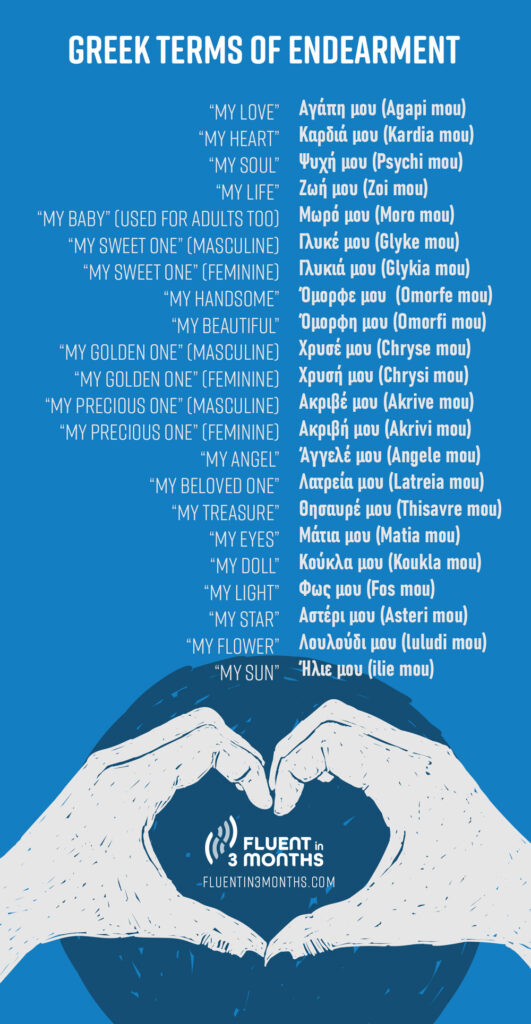
For masculine subjects, the ending "-e" is frequently used in the vocative case (the case used for addressing someone). Examples include "Omorfe mou" (My handsome) and "Glike mou" (My sweet). Conversely, for feminine subjects, the endings "-i" or "-ia" are standard, resulting in "Omorfi mou" (My beautiful) and "Glykia mou" (My sweet).
Additional gender-specific romantic terms include:
- Agori mou (Αγόρι μου): "My boy," used by women for their boyfriends or by parents for their sons.
- Koritsaki mou (Κοριτσάκι μου): "My little girl," a common endearment for a girlfriend or a daughter.
- Koukla mou (Κούκλα μου): "My doll," used frequently for women to denote beauty, but also common among female friends.
The Role of the Family: Diminutives and Domestic Bonds
Family remains the central unit of Greek social life, and the language reflects this through a specialized set of affectionate terms. The transition from formal titles to endearments is a key marker of closeness within the household. For instance, while "Mitera" (Mother) is the formal term, "Manoula" (Mommy) is the affectionate version. Similarly, "Pateras" (Father) becomes "Bambaka" or "Bamboula."
The use of "mou" is nearly mandatory in a family setting to signal belonging. A grandparent will rarely call a grandchild just by their name; they will say "paidi mou" (my child) or "egoni mou" (my grandchild). This linguistic habit reinforces the "Storge" love—the protective, instinctive bond of kinship.
The Mechanics of Diminutives: The Suffix System
A unique feature of the Greek language is its robust system of diminutives, which allow speakers to turn any name or noun into an endearing nickname. By adding specific suffixes, the speaker conveys a sense of smallness, cuteness, or intimacy.
- -aki (–άκι): The most common diminutive, used for both names and objects. For example, "Yiannis" becomes "Yiannaki," and "louloudi" (flower) becomes "louloudaki."
- -itsa (–ίτσα): Primarily used for female names. "Eleni" becomes "Elenitsa."
- -oulis (–ούλης) and -oula (–ούλα): Gendered suffixes that add a layer of playfulness. "Mikros" (small) becomes "mikroulis" (tiny/cute).
- -akis (–άκης): A common masculine diminutive, particularly prevalent in Crete, often used for male names like "Giorgos" becoming "Giorgakis."
This morphological flexibility allows for a high degree of personalization in relationships, where a unique nickname can be constructed to reflect a specific shared history or personality trait.
Phonetic Considerations and Pronunciation
For non-native speakers, the correct pronunciation of these terms is vital for conveying the intended emotion. Greek phonetics include several sounds that do not have direct equivalents in English:
- The Gamma (γ): In words like "agapi," the ‘g’ is soft and voiced, similar to a ‘y’ sound or a soft breathy ‘g’.
- The Delta (δ) and Theta (θ): These represent the voiced and unvoiced "th" sounds respectively (as in "this" and "think").
- The Chi (χ): In "psychi" or "chryse," this is a raspy ‘h’ sound, similar to the ‘ch’ in the Scottish "loch."
Mastery of these sounds is often viewed by native speakers as a sign of respect and cultural integration, further deepening the impact of the endearment.
Societal Implications and Modern Usage
The persistent use of endearments in Greece has broader sociological implications. Observers of Mediterranean cultures often note a higher "emotional temperature" in public and private discourse compared to Northern European or North American standards. In Greece, the use of "agapi mou" with a shopkeeper or a neighbor is not necessarily an indication of deep love, but rather a social lubricant that fosters "Philoxenia"—the ancient Greek concept of hospitality and friendliness toward strangers.
However, in the context of the Greek diaspora, these terms take on a different weight. For second and third-generation Greeks living abroad, using terms like "yiayia" (grandma) or "papou" (grandpa) serves as a vital link to their ancestral heritage. In these communities, the language of affection is often the last part of the mother tongue to be lost, acting as a linguistic bridge between generations.
Analysis of Cultural Impact
The systematic application of these terms suggests a culture that prioritizes emotional expression and relational proximity. Fact-based analysis indicates that societies with high usage of endearments often report stronger perceived social support networks. By constantly reaffirming bonds through language—calling a friend "matia mou" (my eyes) or a partner "thisavre mou" (my treasure)—Greek speakers engage in a continuous cycle of emotional validation.
In conclusion, the Greek lexicon of endearment is a complex, historically rooted system that transcends simple translation. It is a reflection of a worldview that values the heart, the soul, and the family above all else. Whether through the philosophical lenses of the eight types of love or the grammatical precision of the diminutive suffix, these terms remain a vibrant and essential component of the Greek identity, offering a roadmap for intimacy that has survived for thousands of years. As the language continues to evolve in a globalized world, its "language of the heart" remains a steadfast anchor for its speakers worldwide.