



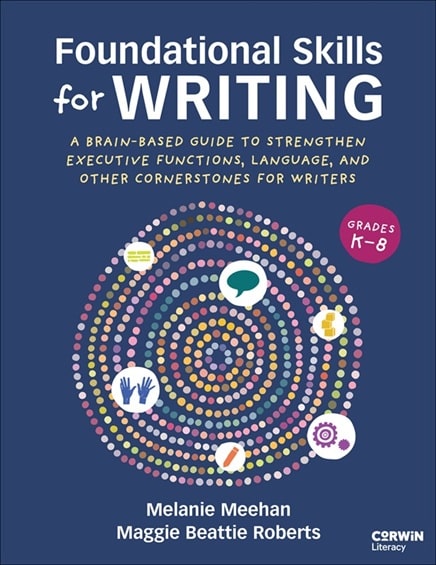
In an educational landscape increasingly dominated by fervent discussions surrounding literacy, a critical element often remains conspicuously absent: writing instruction. While debates on phonics, fluency, and reading comprehension continue to intensify, the equally vital skill of written expression, and its profound intertwinement with reading, rarely receives comparable attention. This glaring omission has prompted two seasoned educators, Melanie Meehan and Maggie Roberts, to publish a groundbreaking new resource, "Foundational Skills for Writing: A Brain-Based Guide to Strengthen Executive Functions, Language, and Other Cornerstones for Writers." Released earlier this month, the book aims to re-center writing in the literacy conversation by meticulously exploring the complex cognitive processes involved in writing and identifying effective, brain-based strategies to support student development.
Melanie Meehan, a former curriculum coordinator who recently established her own in-person writing center, and Maggie Roberts, a literacy consultant and former middle school teacher with nearly two decades of classroom support experience, bring a wealth of practical expertise to this critical topic. Their collaboration addresses a growing concern among educators and policymakers regarding student writing proficiency, which national assessments and classroom observations consistently highlight as an area needing significant improvement. The prevailing focus on reading, while essential, has inadvertently overshadowed the explicit, systematic instruction necessary for students to become proficient writers, capable of articulating complex thoughts and engaging with academic demands.

The Overlooked Pillar of Literacy: A Historical Context
The current era of "literacy wars," particularly the widespread adoption of "the Science of Reading," has undeniably shifted pedagogical practices toward evidence-based approaches for decoding and comprehension. However, the discourse has largely neglected the equally scientific and research-backed principles for teaching writing. Historically, writing instruction has often been relegated to sporadic assignments or a "learn by doing" approach, rather than explicit, scaffolded teaching of foundational skills. This contrasts sharply with the explicit phonics and phonemic awareness instruction now championed for reading.
Experts argue that this imbalance is detrimental, as reading and writing are two sides of the same coin, each reinforcing the other. Strong writing skills contribute to deeper reading comprehension by fostering an understanding of text structure, vocabulary, and authorial intent. Conversely, extensive reading provides models for effective writing, exposing students to varied sentence structures, organizational patterns, and rhetorical devices. The neglect of writing instruction, therefore, represents a missed opportunity to leverage this symbiotic relationship for comprehensive literacy development. Meehan and Roberts’ work directly confronts this oversight, advocating for a holistic approach that views writing as a foundational skill requiring deliberate and sustained attention.
A Brain-Based Approach to Writing: Unpacking Cognitive Demands
At the heart of "Foundational Skills for Writing" is a deep dive into what the brain must actually accomplish when an individual attempts to write. Writing is an incredibly complex cognitive act, requiring the simultaneous coordination of numerous mental processes. From generating ideas to forming letters, selecting vocabulary, constructing sentences, and organizing paragraphs, the brain juggles an immense cognitive load. When foundational skills are not automatized, this cognitive burden becomes overwhelming, leaving little mental capacity for higher-order thinking like planning, revising, and expressing nuanced ideas.
The authors meticulously break down the multifaceted task of writing into three core skill categories, providing teachers with a clear framework for targeted instruction:

- Transcription Skills: These are the mechanical aspects of writing, including handwriting, keyboarding, spelling, and fine and gross motor development. Proficiency in these areas allows writers to record their thoughts efficiently without expending excessive mental energy on the physical act of writing.
- Oral Language: Recognizing that speaking and listening are crucial precursors to written expression, this category focuses on skills such as vocabulary development, sentence construction, and narrative coherence in spoken language. Strong oral language provides a solid base upon which written language can be built.
- Executive Functioning: This encompasses the higher-order cognitive processes essential for planning, monitoring, and regulating one’s writing. Key executive functions include working memory (holding information in mind while writing), cognitive flexibility (adapting strategies and considering alternatives), and inhibitory control (filtering out distractions and irrelevant thoughts).
Meehan and Roberts contend that for students to become truly proficient writers, they must develop and consistently practice all these skills. The book serves as a practical guide, demonstrating how educators can systematically foster these foundational abilities in their students, moving beyond generalized writing prompts to targeted skill-building.
Introducing "Minute Moves": High-Impact, Low-Time Strategies
A central innovation presented in the book is a collection of actionable, time-efficient activities dubbed "Minute Moves." These strategies are designed to be short, flexible, and easily integrated into the existing school day, taking just a few minutes each. Teachers can deploy them as warm-ups, during transitions between subjects, or even on a brief walk to the cafeteria. The primary objective of "Minute Moves" is to help students automatize foundational skills, thereby reducing the cognitive load associated with the mechanics of writing and freeing up mental resources for the more demanding aspects of composition and expression. This approach is particularly valuable in today’s crowded curricula, offering high-impact instruction without requiring extensive class time.

Cultivating Spelling Mastery: Engaging with Word Structure
The authors present three "Minute Moves" specifically targeting spelling, grounded in the idea that understanding word structure is key to mastery.
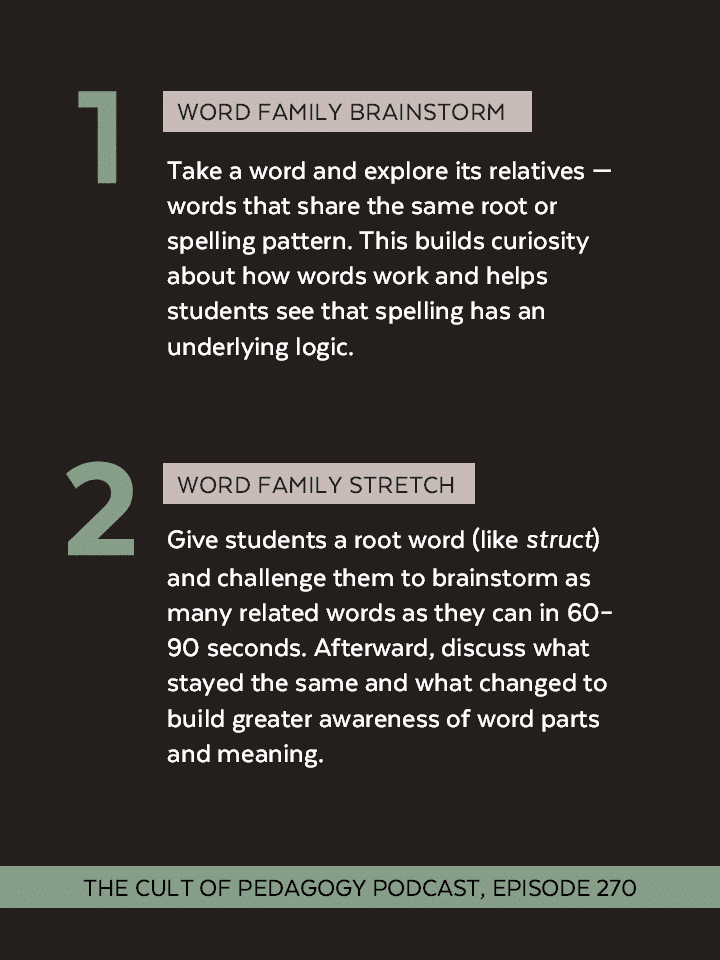
- Word Family Brainstorm: Inspired by spelling researcher Rebecca Treiman, this activity encourages students to explore the etymological and morphological connections between words. Instead of simply memorizing isolated words, students uncover "relatives." For instance, connecting "two" (the number) to "twin," "twine," and "twenty" reveals a pattern where "TW" often relates to "twoness." This fosters a sense of curiosity and makes spelling a detective-like pursuit. A student struggling with "decision" might trace its roots to "decide," then "incision," "concise," and even "scissors"—all stemming from a Latin root meaning "to cut." This deepens understanding and makes spelling more logical.
- Word Family Stretch: Building on the brainstorm, this activity challenges students to generate as many related words as possible from a given root within a tight timeframe (e.g., 60-90 seconds). Using a root like "struct" (meaning "to build"), students might list "structure," "destruction," "construct," "structural," "instruct," and "instruction." The crucial follow-up is a debriefing session: "What stayed the same? What changed? How did the meaning shift?" This metacognitive reflection helps students internalize that word parts carry consistent meaning, a skill vital for unlocking academic vocabulary across subjects. Roberts highlights the distinction between "bound" roots (like "struct," which cannot stand alone) and "free" roots (like "form," which can be a word on its own or part of "reform," "transform," etc.), further enhancing students’ morphological awareness.
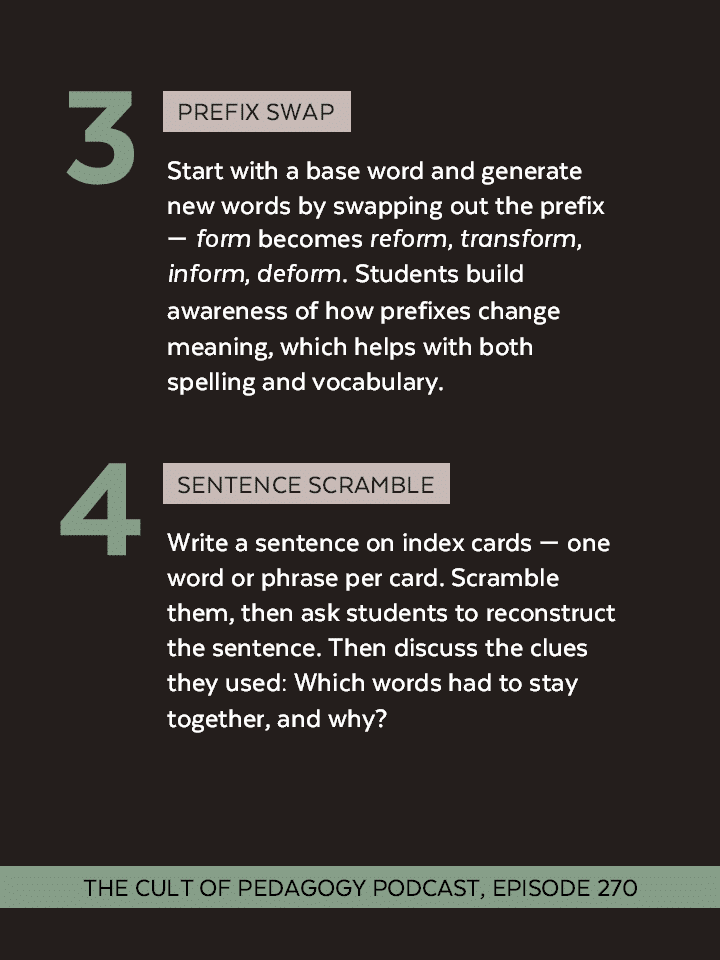
- Prefix Swap: Directly linked to the previous activities, this exercise focuses on the power of prefixes. Students take a base word, such as "form," and experiment with various prefixes to create new words like "reform," "transform," "inform," and "deform." The activity emphasizes observing how each prefix alters the word’s meaning. This is particularly beneficial for multilingual learners, who often recognize prefixes like "bene" and "mal" from their native languages, allowing them to quickly grasp the meaning of words like "benevolent" and "malevolent." Meehan emphasizes that these three spelling activities collectively build essential neurological pathways, enabling students to more efficiently retrieve and apply spelling knowledge.
Building Robust Sentences: From Simple to Sophisticated
The second set of "Minute Moves" targets sentence construction, moving students beyond rudimentary sentence structures to more complex and nuanced expressions.
- Sentence Scramble: Teachers provide a sentence broken into individual words or phrases on index cards. Students then work to reassemble the sentence. The tactile nature of physical cards allows for experimentation. After reconstruction, students reflect on their process: "How did you determine the order? What clues were helpful? Which words had to stay together?" The activity can be intensified by removing punctuation, adding a distractor word, or challenging students to extend the sentence. Roberts underscores that this activity fosters "an internalized understanding of sentence patterns and sentence construction," a critical skill that directly transfers to their own writing.
- Sentence Expander: This strategy begins with a simple "kernel sentence," such as "The cat purrs." Students collaboratively expand the sentence by answering a series of questions: "Which cat? What color? Where? When? Why?" Meehan prefers "doer" and "doing" over the more abstract "subject" and "predicate" to make the core grammatical concepts accessible. Once a sentence is fully expanded (e.g., "The orange cat is sleeping on the couch in the afternoon because he is tired"), students experiment with rearranging its components to create variations. This playfulness helps them understand how to craft richer, more descriptive, and varied sentences.
- Sentence Combining: Roberts describes sentence combining as "a really high-impact, quick way for kids to graduate from writing a series of simple sentences to ones that are more syntactically complex, interesting, and precise." Students are given two short, basic sentences (e.g., "My cat is orange." and "My cat is big.") and asked to merge them into one, such as "My big orange cat…" Scaffolding can include underlining key words to be "harvested" and inserted. As proficiency grows, students combine three or more sentences, experimenting with conjunctions like "because," "and," or "but" to alter meaning and flow. This practice directly translates into students naturally producing more sophisticated sentences in their independent writing.
Enhancing Cognitive Flexibility for Writers: Beyond the Sentence
The final "Minute Moves" address executive functioning, particularly cognitive flexibility—the ability to adapt approaches, consider multiple perspectives, and revise thinking.
- What’s Another Way?: This activity directly practices cognitive flexibility at the sentence level. Students are given a sentence and challenged to rewrite it in multiple different ways. Prompts include: "What if you started with the dependent clause? What if you replaced the noun with a pronoun? What if you made it shorter?" Meehan highlights that effective writing isn’t solely about length or complexity; sometimes, a concise sentence carries the most impact. The "art and craft of writing" involves intentionally varying sentence structure and length. Crucially, naming this skill as "cognitive flexibility" empowers students, especially those who struggle with writing, by reframing their efforts as practicing a sophisticated cognitive skill. This validation can significantly boost their confidence and self-perception as capable writers.
- New Angle: Zooming out from the sentence, this move targets cognitive flexibility at the narrative level. Students retell a familiar story, scene from a class text, or short film from an alternative character’s perspective. Roberts vividly illustrates this with a memory of a high school cafeteria food fight, noting how different the retelling would be from the perspective of the teacher who had applesauce dumped on her. This exercise demands holding multiple viewpoints simultaneously, making deliberate choices about voice, detail, and interpretation. Meehan uses short animated films, like Pixar’s "Snack Attack," which presents the same event from two distinct viewpoints. In a tutoring session, she and a student each wrote one character’s perspective, then swapped documents to continue the other character’s story. Beyond fostering writing skills, this activity cultivates empathy and the ability to understand diverse perspectives, a skill Meehan rightly connects to "democracy and thinking about how other people think."
Implications for Modern Education: A Holistic Path Forward
The release of "Foundational Skills for Writing" comes at a critical juncture in education. Concerns over declining writing proficiency among students, often highlighted in national assessments and employer feedback, underscore the urgent need for more effective instructional strategies. By providing a clear, brain-based framework and a collection of readily implementable "Minute Moves," Meehan and Roberts offer a powerful tool for educators.
The book’s emphasis on explicit, systematic instruction for transcription, oral language, and executive functions represents a significant shift from traditional, often unstructured, approaches to writing. It aligns with the broader movement towards evidence-based practices in literacy, extending the "Science of Reading" to encompass the equally vital "Science of Writing." This holistic approach promises to empower teachers, many of whom report feeling inadequately prepared to teach writing effectively, by equipping them with concrete strategies that address specific student needs.
Furthermore, the focus on automatizing foundational skills has profound implications for equity. Students who struggle with the mechanics of writing are often prevented from demonstrating their true intellectual capacity. By systematically building these underlying skills, the "Minute Moves" can level the playing field, allowing all students to allocate their cognitive energy to generating and organizing complex ideas. This can foster greater engagement, reduce frustration, and ultimately cultivate a new generation of confident, capable communicators who are well-prepared for academic success and future professional demands. The work of Meehan and Roberts is poised to spark a much-needed re-evaluation of writing’s place in the literacy curriculum, advocating for its rightful position as an indispensable cornerstone of education.