



Microsoft has officially unveiled a comprehensive suite of initiatives and artificial intelligence tools aimed at modernizing the global educational landscape, headlined by the launch of the "Microsoft Elevate for Educators" program. This strategic move, announced ahead of the Bett UK 2026 conference, represents a significant expansion of the company’s long-standing commitment to education, focusing on the integration of secure, education-specific AI technology and professional development. The initiative aims to bridge the gap between emerging technological capabilities and practical classroom application, providing teachers, students, and institutional leaders with the resources necessary to navigate the complexities of the AI era.
At the core of the announcement is a trio of new AI-powered tools: "Teach," a feature within the Microsoft 365 Copilot app designed to automate administrative and preparatory tasks; "Microsoft Learning Zone," an interactive platform leveraging on-device AI for Copilot+ PCs; and the "Study and Learn Agent," a pedagogical companion for students. These tools are supplemented by a broader commitment to workforce readiness, including a global goal to provide 20 million people with AI skilling credentials over the next two years.
The Strategic Framework: Microsoft Elevate for Educators
The Microsoft Elevate for Educators program serves as the foundational pillar of this new rollout. It is positioned as a specialized branch of the company’s wider "Microsoft Elevate" initiative, which focuses on social impact and economic opportunity through technology. By creating a dedicated ecosystem for educators, Microsoft is attempting to solve one of the primary hurdles in educational technology adoption: the lack of standardized training and professional community support.
The program offers educators access to one of the world’s most extensive peer-to-peer networks, facilitating the exchange of best practices for AI integration. Furthermore, it provides free professional development pathways and recognized credentials. This focus on "skilling" is a direct response to data suggesting that while many educators are interested in AI, a significant percentage feel unprepared to use it effectively or safely in a classroom setting.
The initiative also extends into higher education, where Microsoft is deepening its partnerships with colleges and universities. Through the AI Skills Navigator and "Microsoft Learn for Educators," faculty members are provided with ready-to-use courseware. This ensures that the curriculum remains current with the rapid pace of technological change, allowing students to graduate with skills that are immediately applicable in an AI-driven job market.

Innovations in Classroom Productivity: The "Teach" Assistant
One of the most immediate practical applications of this rollout is "Teach," a specialized AI assistant integrated into the Microsoft 365 Copilot app. Designed to address the growing crisis of teacher burnout and the increasing administrative burden on faculty, Teach focuses on streamlining the "behind-the-scenes" work of education.
The tool allows educators to generate comprehensive lesson plans aligned with specific academic standards through simple natural language prompts. Beyond basic planning, Teach can develop quizzes, create grading rubrics, and, perhaps most importantly, adapt existing instructional materials to various reading levels. This capability for instant differentiation allows teachers to cater to diverse student needs—including those with different learning abilities or language proficiencies—without the hours of manual labor typically required for such customization.
Microsoft has confirmed that Teach will be available at no additional cost for existing Microsoft 365 Education customers. This pricing strategy reflects a move to ensure that AI tools do not become a "premium-only" luxury, but rather a standard component of the modern educator’s toolkit.
Hardware and Software Synergy: Microsoft Learning Zone and Copilot+ PCs
A significant portion of the announcement focuses on the "Microsoft Learning Zone," an application specifically designed to harness the hardware capabilities of Copilot+ PCs. These devices, which feature integrated Neural Processing Units (NPUs), allow for "on-device" AI processing. This technical distinction is crucial for education, as it offers faster performance and enhanced data privacy by processing information locally rather than relying solely on cloud-based servers.
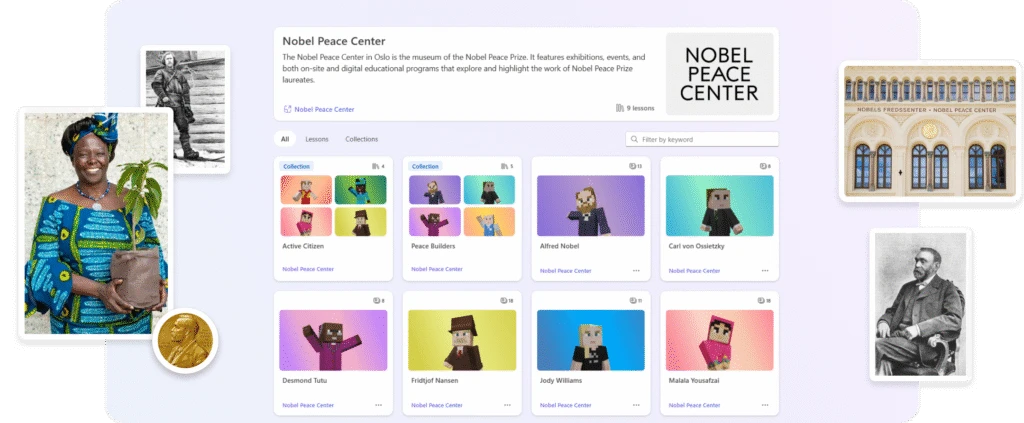
The Microsoft Learning Zone has already earned the ISTE (International Society for Technology in Education) Seal of Alignment, recognizing its adherence to research-backed teaching practices and learning design. The app features high-quality content from a prestigious roster of partners, including NASA, OpenStax, PBS NewsHour, the Nobel Peace Center, and the World Wildlife Fund.
A notable addition to the platform is a collection of lessons from the Nobel Peace Center, which utilizes the stories of laureates like Malala Yousafzai to teach concepts of human rights and global citizenship. These lessons are often paired with interactive experiences in Minecraft Education, creating a multi-modal learning environment. While currently available in English and Spanish, Microsoft has outlined a timeline for expansion, with Portuguese, French, and German support arriving in 2026, followed by integration into major Learning Management Systems (LMS) later that year.
Student Autonomy and the Study and Learn Agent
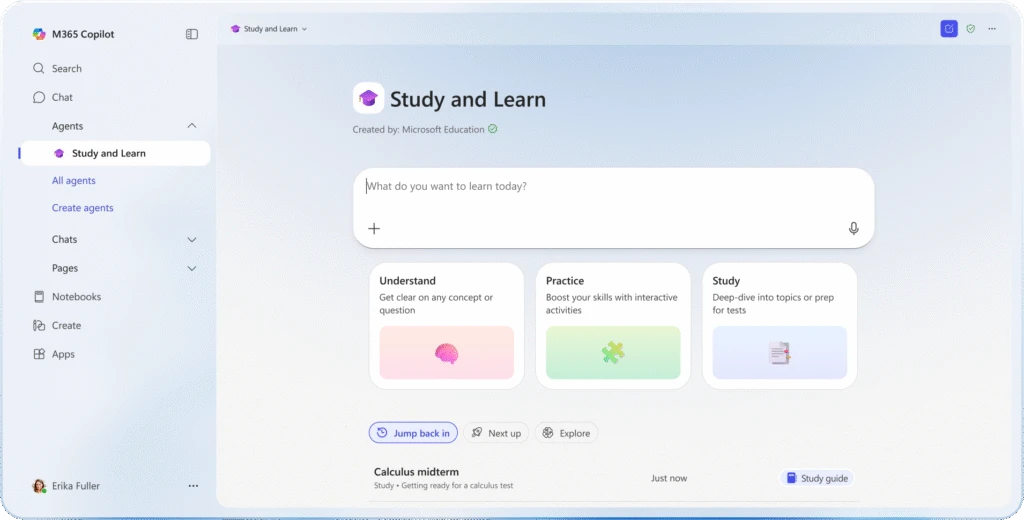
Shifting the focus from instruction to acquisition, the new "Study and Learn Agent" is designed for students aged 13 and older. Built on established learning science principles, the agent acts as a sophisticated tutor rather than a simple answer engine. It encourages critical thinking by guiding students through concepts rather than merely providing the final result.
The agent includes features such as adaptive exercises, flashcards, and matching games. By analyzing a student’s progress, the AI can identify areas of struggle and provide targeted practice, fostering a sense of independence and self-directed learning. This tool addresses a common concern among parents and administrators that AI might be used as a shortcut; instead, the Study and Learn Agent is framed as a scaffold that supports the cognitive process.
Higher Education and Career Readiness
To support students transitioning from the classroom to the workforce, Microsoft is offering a limited-time incentive for higher education students. Eligible individuals can receive 12 months of Microsoft 365 Premium and LinkedIn Premium Career at no extra cost.
This package is designed to provide an end-to-end support system. While Microsoft 365 facilitates academic tasks like research and presentation building, LinkedIn Premium offers tools for internship hunting, professional networking, and career planning. In an increasingly competitive global economy, providing students with these premium tools is seen as a move to democratize access to career advancement resources.
Supporting Data and Institutional Guidance
The announcement coincides with the release of an IDC White Paper, sponsored by Microsoft, titled "A Blueprint for AI-Ready Schools: Strategies from the Front Lines of K-12 Education." This report provides empirical data and case studies from early adopters of AI in education, including the Coquitlam School District in Canada and Brisbane Catholic Education in Australia.
The research highlights several key findings:
- Efficiency Gains: Schools using AI tools for administrative tasks reported a significant reduction in time spent on grading and scheduling.
- Personalization: AI-driven data analytics allowed teachers to identify "at-risk" students much earlier in the semester.
- Security Priorities: The report emphasizes that for AI adoption to be successful, it must be built on a foundation of "Trustworthy AI," prioritizing student data privacy and algorithmic transparency.
In response to these findings, Microsoft introduced the "Microsoft Education Security Toolkit." This resource is designed to help IT administrators and school leaders strengthen their cybersecurity posture, providing a roadmap for strategic planning and compliance in an era where educational institutions are increasingly targeted by cyber threats.
Industry Implications and Future Outlook
The comprehensive nature of Microsoft’s announcement suggests a pivot in how technology giants approach the education sector. Rather than simply providing software, Microsoft is positioning itself as a holistic partner in "institutional transformation." By combining hardware (Copilot+ PCs), software (Copilot, Teach, Learning Zone), and professional development (Elevate), the company is attempting to create a closed-loop ecosystem.
Industry analysts suggest that this move is a preemptive strike in the "AI arms race" within the education sector, where competitors like Google and Apple are also vying for dominance. However, Microsoft’s deep integration with existing productivity software like Word, Excel, and Teams gives it a significant advantage in terms of workflow continuity.
The broader implications of these tools point toward a future where "personalized learning" is no longer a theoretical ideal but a scalable reality. However, the success of these programs will ultimately depend on the willingness of school districts to invest in new hardware and the ability of educators to find the time for the necessary training.
Conclusion and Bett UK 2026
The rollout of Microsoft Elevate for Educators and the associated AI tools marks a pivotal moment in the 50-year history of Microsoft’s involvement in schools. As the company prepares to showcase these innovations at Bett UK 2026 in London, the focus remains on the "human connection." Microsoft leadership has emphasized that these tools are not intended to replace teachers, but to "reclaim time" for the interpersonal relationships that define successful education.
With the first phase of tools now available and a clear roadmap for language expansion and LMS integration through late 2026, the global education community will be watching closely to see if AI can truly fulfill its promise of enhancing, rather than complicating, the classroom experience.