


The global educational landscape is undergoing a fundamental transformation as generative artificial intelligence moves from an experimental novelty to a foundational pillar of institutional strategy. According to the 2025 AI in Education Report released by Microsoft, the integration of AI within schools and universities has reached a critical inflection point, with adoption rates in the education sector now outstripping those of any other major industry. The comprehensive study, which incorporates data from numerous surveys, academic collaborations, and independent research firms like IDC, suggests that the conversation among stakeholders has shifted from questioning the validity of AI to determining the most effective methods for its implementation.
The Rapid Acceleration of AI Integration in Global Education
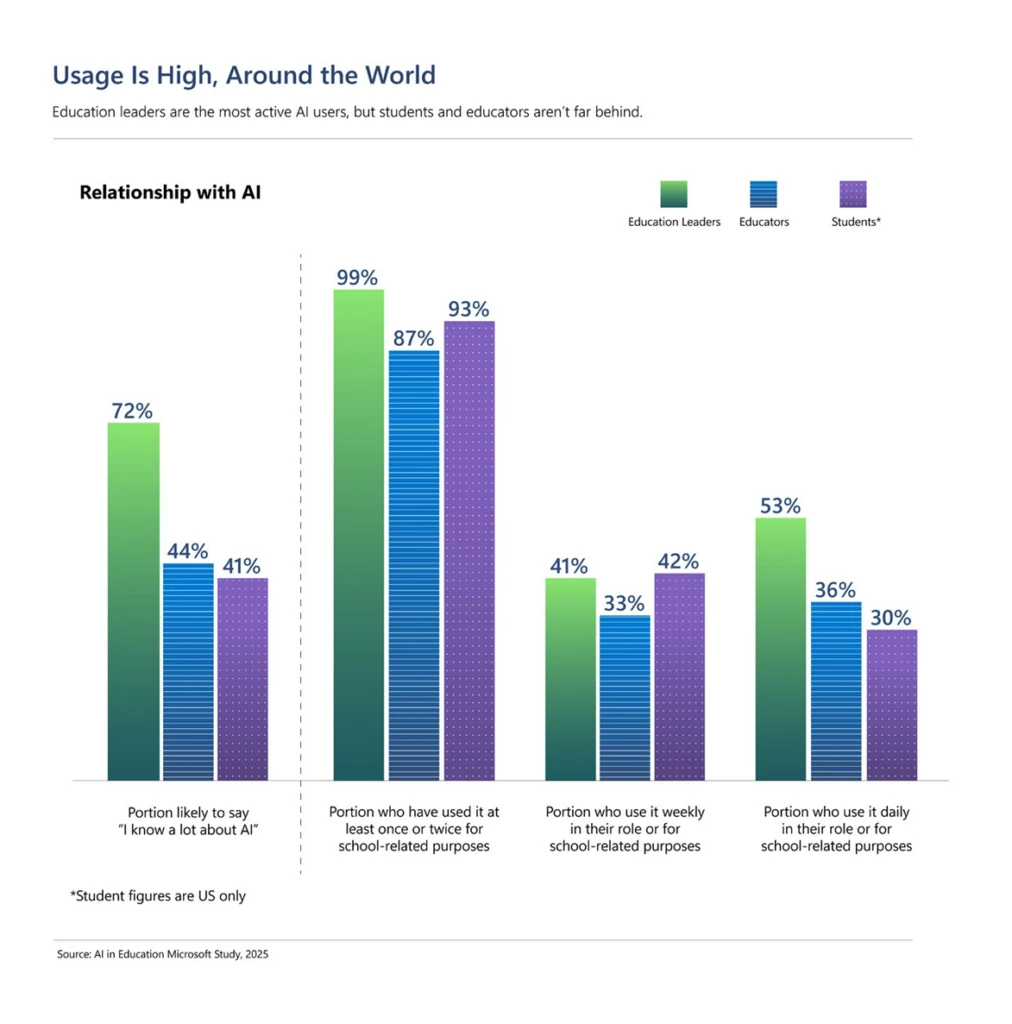
The report reveals that 86% of educational organizations are currently utilizing generative AI, a figure that represents the highest adoption rate among all industries surveyed in the 2024 IDC Business Opportunity of AI study. This surge in usage highlights a proactive approach by academic institutions to leverage technology for administrative efficiency and pedagogical advancement. In the United States specifically, the data indicates a high level of engagement across all levels of the academic hierarchy. Education leaders emerge as the most active demographic, followed closely by students and educators.
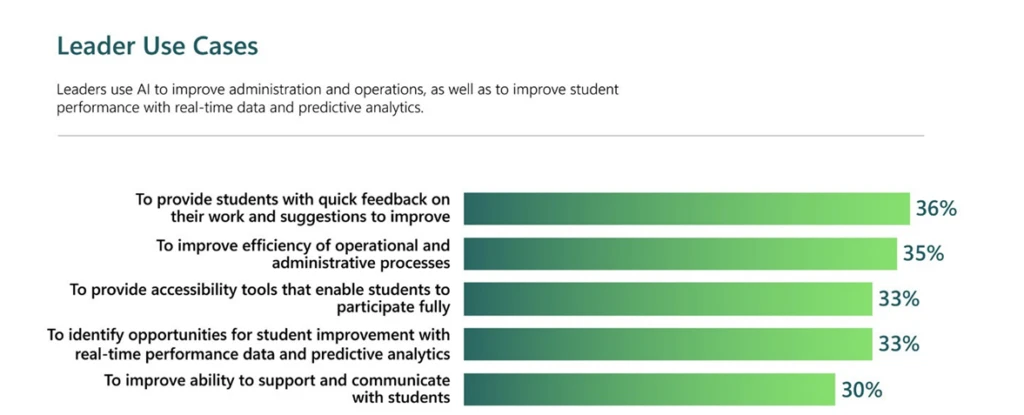
This rapid adoption is not limited to high-level administrative functions. In K-12 environments, AI is being utilized to facilitate personalized learning paths, allowing for differentiated instruction that meets the specific needs of diverse student populations. In higher education, the focus has expanded toward AI-powered administrative tools designed to optimize campus operations and improve student retention through predictive analytics. However, despite this high level of usage, the report identifies a significant "perception gap" regarding the adequacy of institutional support and training.

The Training Disconnect: A Perception Gap Between Leaders and Educators
One of the most striking findings in the 2025 report is the mismatch between the perceptions of institutional leadership and the lived experiences of those on the front lines of education. While a majority of academic and IT leaders believe they have provided sufficient resources and training for the transition to AI-augmented teaching, surveys of educators and students tell a different story.
This discrepancy signals that while the tools are being deployed at a system-wide level, the "last mile" of implementation—comprehensive, job-embedded professional development—remains incomplete. Leaders often view the provision of software licenses as the end of the deployment phase, whereas educators express a need for ongoing guidance on how to integrate these tools into specific curricula without compromising academic integrity. The report suggests that for AI to reach its full potential, institutions must move beyond one-off workshops and toward a culture of continuous, relevant training that is integrated into the daily workflow of the teaching staff.
Chronology of the AI Shift: From Disruption to Strategic Alignment
The journey toward the current state of AI in education has followed a distinct timeline, characterized by three primary phases:
- The Disruptive Entry (2022–2023): Following the public release of advanced large language models, the education sector initially reacted with a mixture of awe and apprehension. Many districts and universities implemented temporary bans or restrictive policies as they grappled with the implications for academic honesty and traditional assessment methods.
- The Exploratory Phase (2023–2024): As the technology proved resilient and increasingly ubiquitous, institutions began to shift toward exploration. Pilot programs were launched, and organizations like TeachAI and Code.org began developing frameworks for AI literacy. Educators started using AI for "behind-the-scenes" tasks such as lesson planning and email drafting.
- The Strategic Integration Phase (2024–2025): The current era is defined by the move toward "AI-ready campuses." AI is no longer viewed as an external tool but as a collaborative partner. This phase is marked by the development of formal institutional strategies, the appointment of Chief AI Officers in some universities, and a focus on "AI fluency" as a core competency for graduates.
AI as a Catalyst for Creativity and Collaborative Learning
The 2025 report challenges the narrative that AI diminishes human creativity. Instead, the data suggests that AI acts as a "thought partner" and "force multiplier." Students and educators are increasingly using generative AI to overcome the "blank page" syndrome, using it to brainstorm ideas, structure complex arguments, and explore ambitious concepts that might have previously seemed out of reach.
A pivotal study conducted by Microsoft Research in collaboration with Cambridge University Press & Assessment provides empirical weight to these claims. The research found that students who used AI tools in conjunction with traditional learning methods—such as active note-taking and critical synthesis—demonstrated higher levels of retention and understanding than those who relied on AI alone. This finding reinforces the "human-in-the-loop" philosophy, suggesting that AI is most effective when it complements rather than replaces human cognitive effort. Pragya Modgil, a student at Johns Creek High School, echoed this sentiment in the report, noting that AI serves as a partner to expand creativity rather than a tool to perform the work in its entirety.
The Workforce Imperative: AI Fluency as a Foundational Skill
As the global economy evolves, the report emphasizes that AI fluency has become a non-negotiable requirement for workforce readiness. This skill set is being categorized alongside traditional "soft skills" such as adaptability, conflict mitigation, and emotional intelligence. The data indicates that 54% of global educators and 76% of global leaders now view AI literacy as an essential component of basic education, equivalent to reading and mathematics.
The implications for curriculum development are profound. Today’s students are expected to graduate with the ability to:
- Critically evaluate AI-generated content for bias and inaccuracy.
- Prompt AI systems effectively to achieve specific professional outcomes.
- Understand the ethical and privacy implications of data-driven technologies.
- Collaborate with AI agents in a hybrid work environment.
To meet this demand, the report recommends that institutions integrate AI literacy across all disciplines, not just in computer science or technical fields. This holistic approach ensures that all students, regardless of their major, are prepared for a labor market that increasingly prioritizes "AI-plus" skill sets.
Addressing Institutional Concerns: Privacy, Ethics, and Integrity
Despite the optimism surrounding AI’s potential, the 2025 report does not ignore the significant challenges that remain. Educators continue to cite academic integrity—specifically plagiarism—as their primary concern. This is followed by worries regarding data privacy, the potential for algorithmic bias, and the risk of a "digital divide" where students with better access to AI tools gain an unfair advantage.
To address these concerns, the report advocates for a policy of transparency and open communication. Rather than adopting a punitive stance toward AI use, institutions are encouraged to create "safe-to-fail" environments where students and staff can experiment with the technology under clear ethical guidelines. Recommendations include the creation of institutional AI councils that include student voices and the implementation of "always-on" training modules that can be updated as the technology evolves.
Official Responses and Expert Analysis
The report’s findings have drawn reactions from across the educational spectrum. Pat Yongpradit, Chief Academic Officer of Code.org and Lead of TeachAI, emphasized that the demand for training is coming directly from the teachers themselves. He noted that educators are not asking for the technology to be removed; rather, they are requesting high-quality, job-embedded professional development that acknowledges the realities of the modern classroom.
Analysis of the report suggests that the "success" of AI in education will not be measured by the number of licenses purchased, but by the degree to which the technology enhances the human connection between teacher and student. By automating routine administrative tasks—such as grading multiple-choice assessments or managing scheduling—AI can potentially free up educators to focus on the mentorship and social-emotional support that machines cannot provide.

Conclusion: Toward an Inclusive and Informed AI Culture
The 2025 AI in Education Report paints a picture of a sector in the midst of a historic transition. The data clearly shows that while adoption is high and the potential for innovation is vast, the journey is fraught with complexities. The gap between leadership perception and educator reality remains a significant hurdle that requires targeted investment in human capital.
As institutions move forward, the report concludes that the most successful organizations will be those that commit to responsible use, foster a culture of continuous learning, and view AI not as a replacement for the human element of education, but as a powerful tool to amplify it. The move toward AI-ready campuses is a collaborative effort, requiring the synchronized participation of students, educators, and administrators to ensure that the benefits of this technological revolution are realized equitably across the global academic community.