



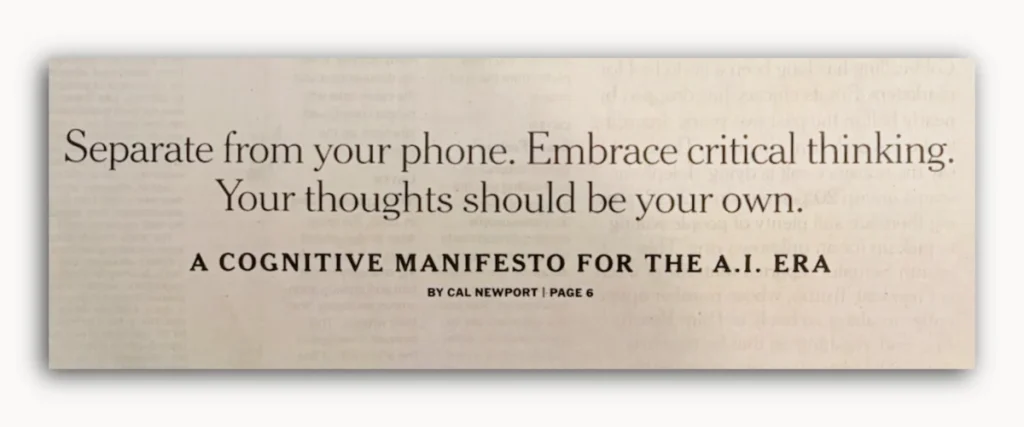
Ten years after the publication of his seminal work, Deep Work: Rules for Focused Success in a Distracted World, author and computer science professor Cal Newport has issued a stark warning regarding the accelerating decline in human cognitive abilities, urging a "revolution in defense of thinking." Marking the tenth anniversary of the book that challenged conventional wisdom about productivity, Newport’s recent long-form essay in The New York Times paints a grim picture of a world increasingly losing its capacity for sustained, deep thought, regardless of available time. His assessment suggests that the problems he identified a decade ago have not merely persisted but have significantly worsened, driven by an ever-intensifying barrage of digital distractions and the pervasive influence of technology.
The Genesis of Deep Work: A Counter-Narrative Emerges
Published in 2016, Deep Work was Newport’s second mainstream hardcover "idea book," following the 2012 release of So Good They Can’t Ignore You: Why Skills Trump Passion in the Quest for Work You Love. The latter, while offering a compelling argument for skill development over passion-chasing, had not achieved the commercial success hoped for by its publishers. This comparatively lower expectation for Deep Work inadvertently provided Newport with the freedom to explore the conceptual frontiers of distraction and focus without the pressure to conform to typical genre conventions.
Newport approached Deep Work with a unique blend of economic and philosophical inquiry. He observed a fundamental paradox in the knowledge economy: organizations systematically undervalued focused work, despite its clear economic benefits. He posited that this oversight presented a massive competitive advantage for individuals and companies willing to cultivate intense concentration. Drawing parallels to Michael Lewis’s Moneyball, Newport aimed to articulate a strategic advantage for the "cubicle class" – those who could master the art of deep work in a sea of superficiality. Beyond the economic rationale, Newport also held a profound belief in the intrinsic value of thinking itself, seeing it as central to the post-Paleolithic human experience, the wellspring of our greatest innovations, deepest satisfactions, and even moments of transcendence.
This idiosyncratic approach immediately set Deep Work apart. At a time when productivity literature often relied on anecdotal tales of overworked executives, regurgitated statistics on interruptions, and offered easily digestible, non-challenging tips, Newport delved into more profound and often unexpected territories. Instead of beginning with a relatable yet conventional narrative, he explored the intellectual struggles of figures like Carl Jung breaking free from Sigmund Freud’s influence. His narratives spanned an eclectic range of subjects, from philosophers of religion to blacksmiths using ancient techniques, memory champions, and the Jewish practice of chavruta (studying Talmud or Torah in pairs). This rich tapestry of examples, seemingly disparate from the modern knowledge sector, resonated deeply with readers, suggesting that Newport had tapped into a fundamental truth about the problematic state of contemporary work and life.
An Unexpected Triumph and Retrospective Vindication
The unconventional nature of Deep Work proved to be its strength. It defied initial expectations, quickly finding a substantial audience and going on to sell more than two million copies globally, translated into over forty-five languages. This widespread success not only solidified Newport’s reputation as a leading voice in productivity and technology ethics but also provided a measure of retrospective vindication for his earlier work. So Good They Can’t Ignore You, buoyed by the popularity of its successor, quietly gained traction, selling over half a million copies and finding its "groove" in the market. The success of Deep Work underscored a growing collective anxiety about attention and focus in an increasingly fragmented digital world.
The book defined "deep work" as professional activities performed in a state of distraction-free concentration that push one’s cognitive capabilities to their limit. These efforts, Newport argued, create new value, improve skill, and are difficult to replicate. Conversely, "shallow work" refers to non-cognitively demanding, logistical tasks often performed while distracted, which do not create much new value and are easily replicable. The core premise was that in an economy valuing complex problem-solving and creative output, the ability to perform deep work would become an increasingly rare and valuable skill.
The Deepening Crisis: 2016 to 2026
A decade after Deep Work‘s release, Newport’s recent essay, published in The New York Times (dated March 27, 2026, implying a forward-looking analysis from the author’s perspective), revisits the landscape of distraction and offers a sobering assessment. His conclusion is unequivocally pessimistic: "The problems I focused on in Deep Work, and in my writing since, have been getting steadily worse. In 2016 my main concern was helping people find enough free time for deep work. Today I think we’re rapidly losing the ability to think deeply at all, regardless of how much space we can find in our schedules for these efforts."
This alarming deterioration, Newport contends, is a direct consequence of several interconnected technological and cultural shifts that have accelerated since 2016. In the workplace, the proliferation and normalization of instant messaging platforms like Slack and low-friction digital meeting solutions such as Zoom have created an environment of "hyperactive hive mind" communication. Employees are now expected to be constantly available, responding instantaneously to messages and participating in frequent, often unstructured, virtual meetings. This incessant stream of interruptions fragments attention, prevents sustained focus, and conditions the brain for constant context-switching, eroding the capacity for deep concentration.
Outside of professional life, the transformation of social media has been equally detrimental. In 2016, platforms like Facebook and Instagram were still largely viewed with a degree of admiration, seen as tools for connection and community. However, in the intervening years, they have evolved into what Newport describes as an "addictive TikTok-ified slurry of optimized brain rot." The rise of short-form, algorithmically driven content, designed to maximize engagement through dopamine hits and endless scrolling, has further fragmented attention spans. Research indicates that the average attention span has significantly decreased, with some studies suggesting it has dropped from 12 seconds in 2000 to 8 seconds by 2015, a trend that has likely intensified with the pervasive influence of platforms like TikTok. Users spend an average of 95 minutes per day on TikTok, contributing to a broader culture of immediate gratification and superficial information consumption.
Adding another layer of complexity to this already challenging environment is the advent of new artificial intelligence tools. While offering unprecedented capabilities, these AI technologies also present a temptation for "quick-fix short-cuts" to intellectually engaging work activities. Instead of grappling with complex problems, individuals and organizations may increasingly delegate critical thinking tasks to AI, potentially stunting the development of their own cognitive faculties. This raises concerns about deskilling and the erosion of human expertise in areas that require deep analytical and creative thought.
Supporting Data and the Cost of Cognitive Decline
The concerns raised by Newport are corroborated by a growing body of research into the cognitive impacts of digital technology. Studies consistently show that knowledge workers experience interruptions every few minutes, and it can take an average of 23 minutes to regain focus after being distracted. The cumulative effect of these interruptions is a significant loss in productivity, estimated by some reports to cost the U.S. economy billions of dollars annually. For instance, a 2022 report by the University of California, Irvine, found that employees spend 60-80% of their time on email and other communication tools, leading to constant context switching.
Furthermore, the "attention economy" thrives on capturing and monetizing user attention, leading tech companies to design products that are inherently addictive. Neuroscientific research demonstrates that variable reward schedules and social validation loops, common in social media, activate the brain’s reward pathways, making it difficult to disengage. This constant stimulation rewires neural pathways, making it harder to sustain attention on less immediately gratifying, but more cognitively demanding, tasks. The long-term implications include diminished capacity for critical thinking, problem-solving, and sustained creative output, which are crucial for innovation and societal progress.
A Call to Arms: The Revolution in Defense of Thinking
Confronted with this escalating crisis, Newport asserts that merely reading or re-reading Deep Work is no longer sufficient, though he still encourages it. He advocates for a far more assertive and collective response: "a revolution in defense of thinking." This revolution, he argues, must transcend individual strategies and encompass systemic changes. While his New York Times piece outlines multiple concrete actions such, it emphasizes the spirit of rebellion against the current trajectory.
Such a revolution could manifest in various forms. At the individual level, it might involve digital minimalism – intentionally reducing one’s digital footprint and cultivating deliberate habits of focus. For organizations, it could mean a fundamental re-evaluation of communication policies, perhaps implementing "no-meeting days," designated "deep work blocks," or explicit guidelines to reduce reliance on instant messaging. Education systems might need to re-emphasize analog learning, critical analysis, and sustained reading over digital engagement. Policymakers could explore regulations that address the addictive nature of technology or incentivize the design of "attention-friendly" digital tools.
Newport’s concluding statement in his Times op-ed encapsulates the urgency and resolve required: "I’m done ceding my brain — the core of all that makes me who I am — to the financial interests of a small number of technology billionaires or the shortsighted conveniences of hyperactive communication styles. It’s time to move past fretting about our slide into the cognitive shallows and decide to actually do something about it." This declaration is not just a personal stance but a rallying cry for a collective reassertion of cognitive autonomy.
Broader Impact and Implications
The implications of a society losing its ability to think deeply are profound and far-reaching. Economically, it could stifle innovation, as complex problems require sustained, focused effort to solve. Companies that fail to cultivate environments conducive to deep work risk falling behind competitors whose employees can engage in higher-level cognitive tasks. Socially, a decline in critical thinking skills could lead to increased susceptibility to misinformation, erosion of informed public discourse, and a weakened democratic process. Individually, the constant state of distraction contributes to mental fatigue, increased stress, and a diminished sense of purpose and satisfaction derived from meaningful work.
The challenge articulated by Cal Newport is not merely about personal productivity; it is about safeguarding fundamental human capabilities essential for individual flourishing and societal advancement. The "revolution in defense of thinking" he proposes is a recognition that the stakes have never been higher. As the digital landscape continues to evolve at a dizzying pace, the ability to cultivate and protect one’s cognitive depth may well be the defining skill of the coming decades, demanding not just individual discipline but a collective societal commitment to valuing and preserving the profound act of human thought.