

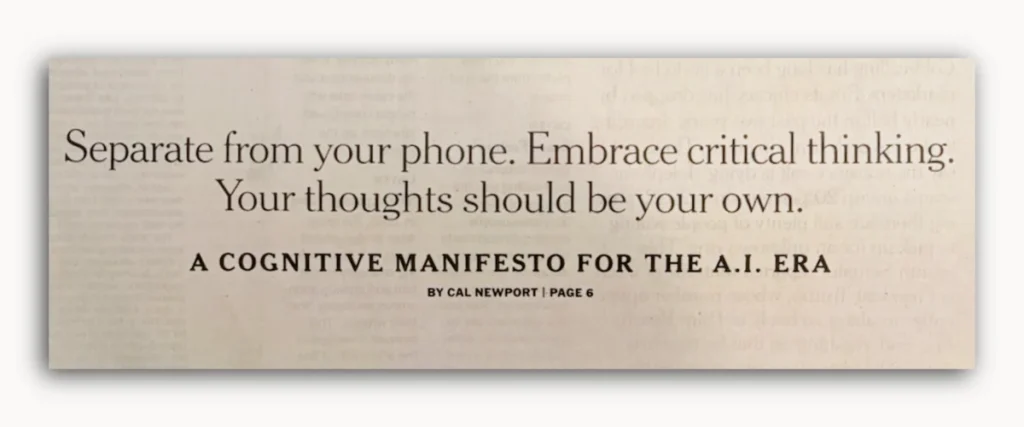
Ten years after the publication of his seminal work, Deep Work: Rules for Focused Success in a Distracted World, author and computer science professor Cal Newport has issued a stark warning regarding the accelerating decline of human cognitive capacity in an increasingly fragmented digital landscape. In a recent long-form essay published in The New York Times, Newport asserts that the problems he identified a decade ago have not merely persisted but have significantly worsened, pushing society toward a critical juncture where the very ability to engage in profound thought is at risk. His call to action is not for minor adjustments but for a fundamental "revolution in defense of thinking."
The Genesis of Deep Work and Its Unexpected Success
Published in 2016, Deep Work was Newport’s second mainstream hardcover "idea book," following the 2014 release of So Good They Can’t Ignore You: Why Skills Trump Passion in the Quest for Work You Love. Expectations for Deep Work were initially modest, particularly given the relatively lukewarm commercial performance of its predecessor. This lower pressure, Newport reflects, afforded him the freedom to write the book largely for himself, delving into the conceptual edges of issues surrounding distraction that genuinely captivated his intellect.
At its core, Deep Work articulated the concept of "deep work" as the ability to focus without distraction on a cognitively demanding task. It posited that in an economy increasingly reliant on complex intellectual output, this skill was becoming exceedingly rare and, consequently, incredibly valuable. Newport was particularly fascinated by the economic paradox that many knowledge work organizations systematically undervalued focus, seeing this as a massive, untapped opportunity for individuals and entities willing to defy the prevailing trends. He famously likened his perspective to "Moneyball for the cubicle class," suggesting that a strategic advantage could be gained by investing in a quality (focused attention) that others overlooked.
Beyond the economic calculus, Newport infused his argument with a philosophical depth, asserting that the act of thinking itself lay at the heart of the post-Paleolithic human experience. He viewed it as the wellspring of our greatest ideas, satisfactions, and even moments of transcendence. This blend of economic pragmatism and philosophical inquiry diverged significantly from the typical productivity genre books of the era, which often relied on anecdotal executive tales, generic statistics on interruptions, and anodyne lists of tips.
Indeed, Deep Work stood out for its idiosyncratic approach. Newport eschewed the conventional narrative structure, instead drawing from a diverse array of sources. He quoted philosophers of religion, explored the meticulous craft of a blacksmith forging swords with ancient techniques, profiled a memory champion, and discussed chavruta, the Jewish practice of studying sacred texts in pairs. Rather than opening with a frustrated corporate executive, he began by examining Carl Jung’s struggles to liberate himself from the intellectual influence of Sigmund Freud. This deeply personal and intellectually rigorous approach, rooted in the sources and ideas that resonated most profoundly with Newport, proved unexpectedly resonant with a global audience.
The book found its stride, selling over two million copies in more than forty-five languages. Its success also retrospectively boosted So Good They Can’t Ignore You, which quietly went on to sell over half a million copies, offering Newport a measure of vindication for his earlier work. The enduring appeal of Deep Work underscored a widespread, albeit often unarticulated, yearning for greater focus and meaning in a professional landscape increasingly characterized by digital fragmentation.
The Accelerating Erosion of Focus: 2016 to 2026
The widespread adoption and intensification of digital communication tools have dramatically reshaped the modern workplace and personal lives since Deep Work‘s publication. In 2016, while digital distractions were certainly present, the landscape was less saturated and less aggressive in its demands on attention. The intervening decade, however, has witnessed a relentless march toward hyper-connectivity and optimized engagement, leading to what Newport now describes as a precipitous decline in collective cognitive ability.
One of the most significant shifts has been the ubiquity of instant messaging platforms like Slack and Microsoft Teams, along with low-friction digital meeting programs such as Zoom. These tools, initially hailed for their ability to foster collaboration and remote work capabilities, have inadvertently created environments of "hyperactive communication." Studies by organizations like the American Psychological Association and various corporate productivity consultants have consistently highlighted the detrimental impact of constant notifications and fragmented attention. Research indicates that knowledge workers are interrupted, on average, every 3-11 minutes, and it can take up to 23 minutes to fully regain focus after an interruption. This constant context-switching not only reduces productivity but also increases cognitive load, leading to higher stress levels and burnout. Data from companies specializing in workplace analytics suggests that the average worker spends upwards of 30-50% of their workday engaged in shallow, reactive tasks, rather than deep, proactive work.
Outside the professional sphere, the evolution of social media has been even more dramatic. In 2016, platforms like Facebook and Instagram were largely admired for their ability to connect people and share experiences. The subsequent rise of TikTok, however, marked a significant pivot. Characterized by short-form, algorithmically optimized video content designed for maximal engagement and rapid dopamine hits, TikTok’s model has influenced nearly all other major platforms, transforming social media into what Newport vividly describes as an "addictive TikTok-ified slurry of optimized brain rot." This constant exposure to rapidly shifting, high-stimulation content is reshaping neural pathways, diminishing attention spans, and potentially hindering the brain’s capacity for sustained, linear thought. A 2023 study by the Pew Research Center found that teenagers spend an average of 4.8 hours a day on social media, with significant portions of that time dedicated to short-form video content, raising widespread concerns among educators and psychologists about long-term cognitive development.
Adding another layer of complexity to this already challenging environment is the recent proliferation of advanced Artificial Intelligence (AI) tools. While offering unprecedented opportunities for efficiency and innovation, these tools also present a new temptation: the allure of quick-fix shortcuts for intellectually demanding tasks. From AI-powered writing assistants that can draft reports and emails to sophisticated data analysis tools that summarize complex information, the convenience offered by AI risks disincentivizing the very act of deep engagement and critical thinking. If readily available AI can perform or assist with tasks that previously required sustained intellectual effort, there is a legitimate concern that individuals may lose the motivation or even the capacity to develop those deep cognitive muscles themselves. This could lead to a workforce that is adept at prompting AI but less skilled in original thought, complex problem-solving, or creative synthesis.
The Economic and Societal Implications
The cumulative effect of these trends is not merely a matter of individual frustration; it poses significant economic and societal risks. In an increasingly complex global economy, the capacity for innovation, strategic thinking, and complex problem-solving—all hallmarks of deep work—is paramount. If organizations and individuals are steadily losing the ability to engage in such cognitive efforts, the long-term implications for competitiveness, scientific advancement, and cultural output are profound.
Economists and productivity experts have begun to quantify the cost of cognitive fragmentation. Estimates suggest that productivity losses due to constant interruptions and shallow work could amount to billions annually across major economies. Beyond sheer output, there’s a concern about the quality of innovation. Truly groundbreaking ideas often emerge from sustained, uninterrupted periods of deep thought, allowing for novel connections and insights. A culture of constant distraction may favor iterative improvements over revolutionary breakthroughs.
Furthermore, the impact on individual well-being cannot be overstated. The incessant demands on attention, coupled with the addictive nature of digital platforms, contribute to rising rates of anxiety, stress, and mental fatigue. A 2022 survey by the American Institute of Stress reported that workplace stress has reached alarming levels, with digital overload cited as a significant contributing factor. The erosion of deep work also robs individuals of the profound satisfaction that comes from mastering complex challenges and producing high-quality output, contributing to a sense of intellectual malaise.
A Call for Revolution: Reclaiming Cognitive Sovereignty
Faced with this worsening outlook, Newport’s recent New York Times essay, published on March 27, 2026 (as implied by the linked article, indicating a forward-looking perspective), doesn’t merely diagnose the problem; it issues a fervent call to action. He asserts that passive fretting is no longer sufficient and advocates for a "revolution in defense of thinking." This revolution, he suggests, must be multifaceted and aggressive, encompassing individual habit changes, organizational policy shifts, and a broader cultural re-evaluation of the role of technology and focus.
While specific actions detailed in his Times piece are not enumerated in the provided text, the spirit of his recommendations is clear:
- Individual Empowerment: This likely involves adopting strict digital minimalism, scheduling dedicated deep work blocks, creating "focus rituals," and consciously cultivating a preference for activities that build cognitive endurance over those that offer instant gratification.
- Organizational Reform: Companies might need to implement "no-meeting days," enforce email-free hours, restructure communication protocols to reduce constant interruptions, and actively incentivize deep work outcomes rather than merely activity. This would require a cultural shift away from "hyperactive communication" as a proxy for productivity.
- Technological Re-evaluation: Society needs to critically examine the design principles of digital tools, pushing for features that promote well-being and focus over pure engagement metrics. This could involve advocating for "calmer" technologies and greater transparency about algorithmic impacts.
- Educational Emphasis: There’s a need to re-emphasize the importance of sustained attention and critical thinking skills in educational curricula, preparing future generations for a world where cognitive resilience is a superpower.
Newport’s concluding sentiment in his Times op-ed encapsulates the urgency of his message: "I’m done ceding my brain — the core of all that makes me who I am — to the financial interests of a small number of technology billionaires or the shortsighted conveniences of hyperactive communication styles. It’s time to move past fretting about our slide into the cognitive shallows and decide to actually do something about it."
Broader Impact and Future Implications
The call for a "revolution in defense of thinking" resonates with a growing number of voices in academia, industry, and the public health sector. As concerns about mental health, digital addiction, and the long-term effects of screen time mount, there is a discernible shift in public discourse. What began as individual struggles with productivity has evolved into a societal challenge demanding systemic solutions.
Newport’s continued advocacy, particularly his ability to bridge the gap between academic rigor and practical advice, positions him as a leading figure in this emergent movement. His work provides a framework for understanding not just how to achieve focus, but why it is fundamentally important for human flourishing and societal progress. The success of Deep Work demonstrated an underlying hunger for this message, and his current warnings underscore its increasing criticality.
The future of work, innovation, and even democracy may well depend on whether individuals and institutions heed this call. The choice, as Newport suggests, is no longer merely about personal productivity hacks but about reclaiming cognitive sovereignty in an age designed to dismantle it. A revolution in thinking, therefore, is not just an intellectual exercise; it is increasingly framed as an imperative for navigating the complexities of the 21st century.