


The Hellenic Republic remains one of the world’s premier travel destinations, drawing over 30 million international visitors annually to its historic landmarks, islands, and vibrant urban centers. While English is widely spoken in major tourist hubs like Athens, Santorini, and Mykonos, the ability to navigate the local language—Modern Greek—remains a significant asset for travelers seeking authentic cultural engagement and logistical efficiency. Linguistic experts and tourism officials emphasize that even a rudimentary command of basic Greek phrases can drastically alter the quality of interpersonal interactions, fostering a sense of mutual respect and hospitality, known locally as "philoxenia." This comprehensive guide explores the essential vocabulary, cultural nuances, and historical context required to communicate effectively in modern Greece.
The Evolution of the Greek Language: Historical Context
To understand the phrases used today, one must acknowledge the deep chronological roots of the Greek language. As an independent branch of the Indo-European family, Greek has a documented history spanning over 3,400 years, the longest of any living language in that category. The transition from Ancient Greek to the Koine of the Byzantine era, and eventually to the Modern Greek spoken today, reflects the resilience and adaptability of the culture.
For much of the 19th and 20th centuries, Greece experienced a period of "diglossia," a linguistic phenomenon where two versions of the language coexisted: Katharevousa, a formal, archaizing version used by the state and academia, and Demotic, the natural language of the people. This division was formally resolved in 1976 when Demotic was adopted as the official language of the Hellenic Republic. Today’s learners focus on Standard Modern Greek, which incorporates elements of both traditions but remains accessible and rhythmic in its delivery.
Fundamental Social Etiquette and Greetings
In Greek culture, social interactions are governed by a distinct hierarchy of formality. The most critical distinction for a visitor to master is the difference between formal/plural and informal address. This distinction is not merely grammatical but serves as a marker of social distance and respect.
The primary greeting, "Yassas" (Γειά σας), is used when addressing elders, strangers, or groups of people. Conversely, "Ya sou" (Γειά σου) is reserved for friends, children, and informal acquaintances. The versatility of these phrases is significant, as they serve as both "hello" and "goodbye."
As the day progresses, specific temporal greetings become mandatory in social settings. "Kalimera" (Καλημέρα), meaning "good morning," is typically used until midday. Following this, "Kalispera" (Καλησπέρα) serves as the standard "good evening" greeting. Travelers should note that "Kalo apogevma" (Καλό απόγευμα) is used specifically when wishing someone a "good afternoon" upon departure, rather than as an initial greeting. For the conclusion of the evening, "Kalinihta" (Καληνύχτα) is the standard "good night."
The basic building blocks of any conversation include "Ne" (Ναι) for "yes" and "Ochi" (Όχι) for "no." Paradoxically for English speakers, "Ne" sounds like "nay," which often leads to initial confusion. Polite interjections such as "Parakalo" (Παρακαλώ) for "please" or "you’re welcome" and "Efcharisto" (Ευχαριστώ) for "thank you" are considered essential for any transaction, from ordering a coffee to asking for directions.
Survival Vocabulary for the Modern Traveler
Logistical navigation in Greece requires a specific set of survival phrases designed to handle commerce, transportation, and emergencies. Data from the Greek National Tourism Organization (GNTO) suggests that visitors who utilize local phrases in dining establishments often report higher levels of service satisfaction.
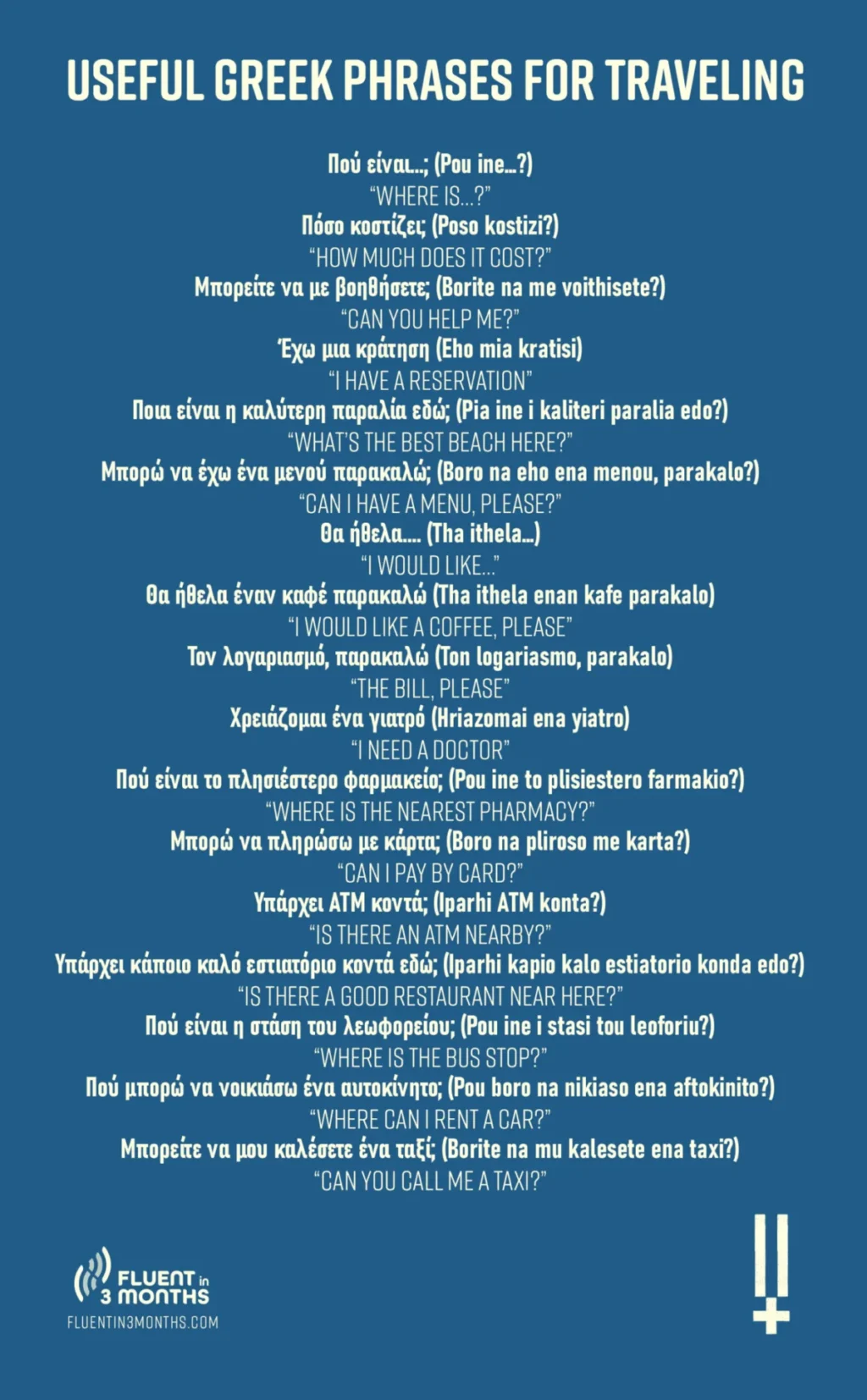
When dining, "Kali orexi" (Καλή όρεξη) is the equivalent of "bon appétit." To conclude a meal, a traveler should ask, "Boro na eho ton logariasmo, parakalo?" (Μπορώ να έχω τον λογαριασμό, παρακαλώ?), which translates to "Can I have the bill, please?" In the context of the Greek islands, where beach culture is paramount, asking "Pia ine i kaliteri paralia edo?" (Ποια είναι η καλύτερη παραλία εδώ?)—"Which is the best beach here?"—is a common way to solicit local recommendations.
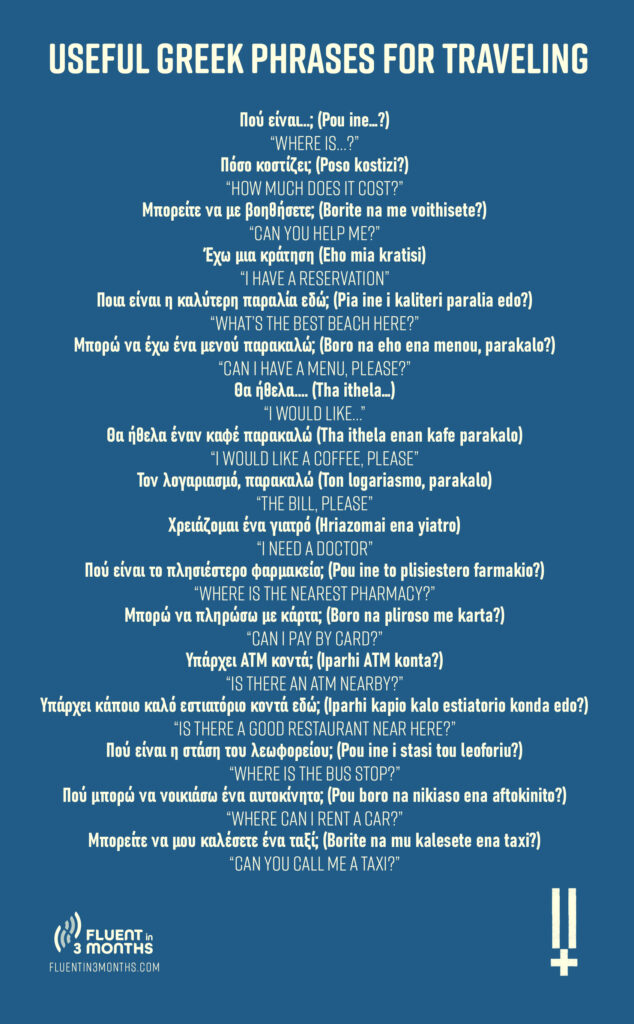
Transportation and financial transactions also necessitate specific inquiries. With the expansion of digital payment systems across the Eurozone, the phrase "Boro na pliroso me karta?" (Μπορώ να πληρώσω με κάρτα?), or "Can I pay by card?", has become increasingly relevant. For those navigating the public transit system or looking for taxis, "Pou ine i stasi tou leoforiu?" (Πού είναι η στάση του λεωφορείου?)—"Where is the bus stop?"—and "Borite na mu kalesete ena taxi?" (Μπορείτε να μου καλέσετε ένα ταξί?) are vital tools.
In the rare event of a medical emergency, travelers must be able to state "Hriazomai ena yiatro" (Χρειάζομαι ένα γιατρό), meaning "I need a doctor," or inquire about the nearest pharmacy with "Pou ine to plisiestero farmakio?" (Πού είναι το πλησιέστερο φαρμακείο?).
Personal Identity and Social Integration
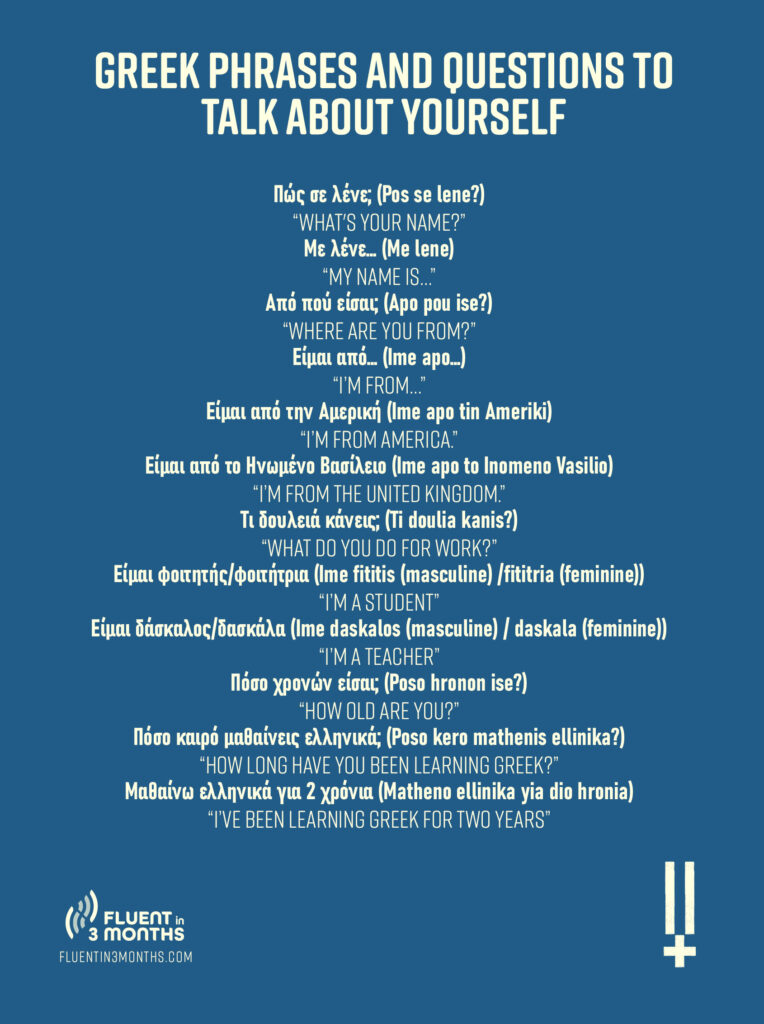
Establishing a personal connection is a hallmark of Greek hospitality. When meeting locals, the question "Pos se lene?" (Πώς σε λένε?)—"What is your name?"—is often followed by "Apo pou ise?" (Από πού είσαι?), or "Where are you from?"
Responding to these queries allows the visitor to provide context for their journey. Common responses include "Ime apo tin Ameriki" (Είμαι από την Αμερική) for those from the United States, or "Ime apo to Inomeno Vasilio" (Είμαι από το Ηνωμένο Βασίλειο) for those from the United Kingdom. Discussions regarding one’s profession or status are also common; for instance, "Ime fititis" (Είμαι φοιτητής) identifies a male student, while "Ime fititria" (Είμαι φοιτήτρια) identifies a female student.
Linguistic Nuance: Slang, Idioms, and Proverbs
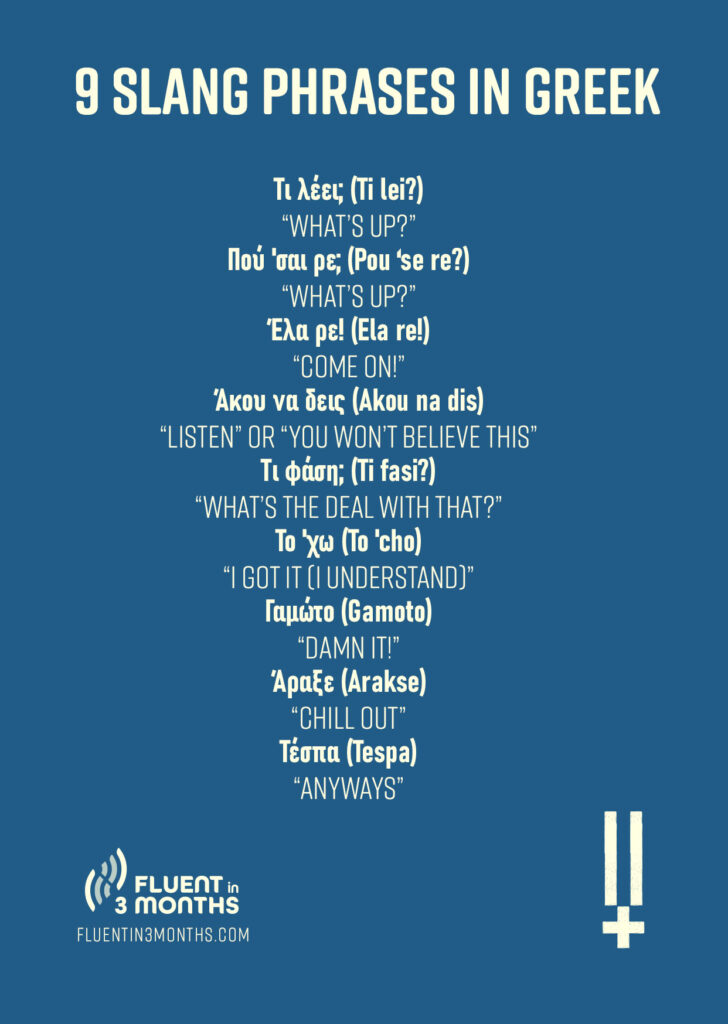
To move beyond basic survival and toward linguistic fluency, one must understand the informal "slang" that permeates daily life in Athens and other urban centers. The word "Malaka" (μαλάκα) is perhaps the most famous—and infamous—word in the Greek lexicon. While technically a profanity, it is used ubiquitously among friends as a term of endearment or a casual filler, similar to "dude" or "mate" in English. However, experts warn that it should never be used with strangers or in formal settings, as it can be deeply offensive.
Other informal expressions include "Ta leme" (Τα λέμε), an informal "see you later," and "Ela re!" (Έλα ρε!), a versatile exclamation meaning "Come on!" or "You don’t say!" When socialising over drinks, the toast "Yamas!" (Γειά μας!), meaning "to our health," is the standard accompaniment to a clink of glasses.
Greek proverbs also offer a window into the national psyche. For example, the phrase "Kathe empodio gia kalo" (Κάθε εμπόδιο για καλό) translates to "Every obstacle is for the best," reflecting a cultural stoicism and optimism. These idioms provide a bridge between simple communication and a deeper understanding of the Greek worldview.
The Impact of Language on Tourism and Economy
The economic implications of language learning in the Mediterranean cannot be understated. According to the Hellenic Statistical Authority (ELSTAT), the tourism sector accounts for approximately 20% of Greece’s GDP. As the market shifts toward "experiential tourism," there is a growing demand for localized interactions.
Industry analysts suggest that travelers who invest time in learning the Greek alphabet and basic phrases are more likely to venture outside of traditional "tourist traps" and into local neighborhoods and lesser-known islands. This decentralization of tourism is a key goal for the Greek government, as it helps distribute economic benefits more evenly across the various regions of the country.
Furthermore, the rise of language-learning technology—including apps like Duolingo and platforms like Fluent in 3 Months—has made the Greek language more accessible to a global audience. While the Greek alphabet (with its distinct characters like Δ, Γ, and Ω) can be intimidating, the phonetic consistency of the language means that once the rules are learned, pronunciation becomes predictable.
Broader Implications and Cultural Synthesis
Learning Greek is more than a functional exercise; it is an act of cultural synthesis. The language has provided the foundational terminology for Western science, philosophy, and politics. Words such as "democracy," "theater," "biology," and "philosophy" all find their origins in the Greek tongue. By engaging with the modern iteration of this language, visitors are participating in a linguistic lineage that has shaped the modern world.
As Greece continues to modernize and integrate further into the global digital economy, the preservation of its linguistic identity remains a priority. For the traveler, the effort to say "Efcharisto" instead of "Thank you" is a small but powerful gesture that acknowledges this heritage. It signals an appreciation for the local culture that transcends the typical consumer-tourist relationship.
In conclusion, while the Greek language presents certain challenges to the English speaker—most notably a different alphabet and unique phonemes—the rewards of mastery are substantial. From navigating a busy taverna to understanding the stoic wisdom of a local proverb, the ability to speak even a small amount of Greek opens doors that remain closed to those who rely solely on English. As the tourism season approaches, linguistic preparation stands as one of the most effective ways to ensure a meaningful and seamless journey through the cradle of Western civilization.