



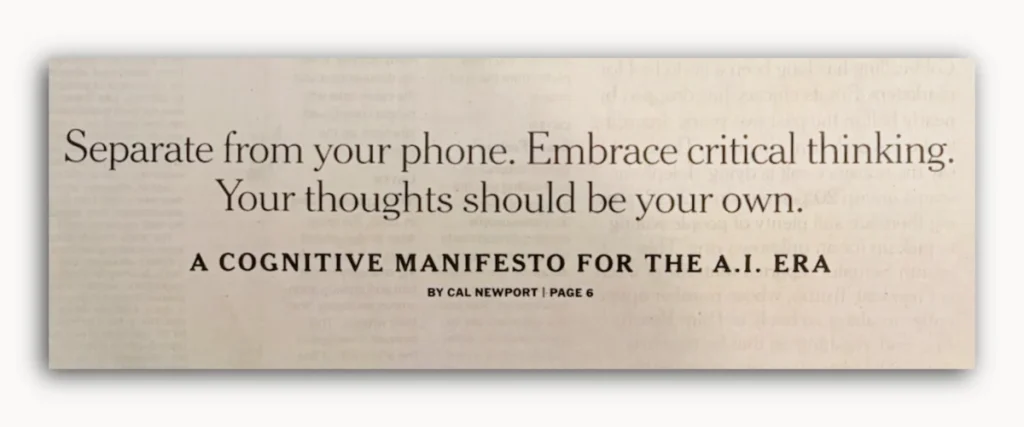
Ten years after the publication of his seminal work, Deep Work: Rules for Focused Success in a Distracted World, author and computer science professor Cal Newport is reflecting on the book’s enduring impact while issuing a stark warning about the accelerating degradation of human cognitive abilities. Newport, whose book has sold over two million copies across more than 45 languages since its release in 2016, recently penned a long-form essay for The New York Times, where he asserted that the problems he addressed a decade ago have not only persisted but have significantly worsened, leading to a critical juncture for intellectual engagement. His analysis culminates in a powerful call for a "revolution in defense of thinking," urging individuals and institutions to actively resist the forces undermining sustained concentration.
The Genesis of an Unconventional Idea
When Deep Work was published in January 2016, it emerged from a landscape where the challenges of digital distraction were beginning to gain widespread recognition, yet systematic solutions remained largely elusive. Newport, then a relatively nascent author in the mainstream "idea book" genre, had experienced moderate success with his previous title, So Good They Can’t Ignore You. The comparatively lower expectations for Deep Work provided him with the freedom to explore the conceptual boundaries of focus and distraction without conforming to prevailing genre conventions.
Newport’s approach was distinct. Rather than a conventional self-help manual filled with anecdotal accounts of harried executives and easily digestible "life hacks," Deep Work wove together economic arguments, philosophical insights, and diverse historical examples to build a compelling case for the profound value of deep, uninterrupted concentration. He observed an economic reality where many knowledge work organizations systematically undervalued focus, perceiving this oversight as a massive, untapped opportunity for those willing to cultivate deep work practices. This perspective resonated with the "Moneyball" concept – identifying undervalued assets (in this case, sustained attention) for competitive advantage.
Beyond the economic rationale, Newport posited a philosophical dimension, arguing that the act of deep thinking constitutes the core of the post-Paleolithic human experience, serving as the wellspring of our greatest innovations, deepest satisfactions, and moments of transcendence. This blend of the pragmatic and the profound set the book apart. While readers might have anticipated a narrative opening with a stressed corporate leader, followed by generic statistics on interruptions and superficial tips, Newport instead delved into the intellectual struggles of figures like Carl Jung breaking free from Sigmund Freud’s influence, quoted philosophers of religion, and drew lessons from a blacksmith forging swords using ancient techniques, memory champions, and the Jewish practice of chavruta (paired Talmudic study). This idiosyncratic, intellectually rigorous framework directly reflected the ideas and sources that most deeply resonated with the author, offering a more intense and unconventional exploration of the topic.
The book’s initial reception, while perhaps unexpected given its divergence from typical genre expectations, quickly affirmed the resonance of its core message. Deep Work steadily gained traction, becoming a bestseller and cementing Newport’s reputation as a leading voice in productivity and technology criticism. Its success also had a ripple effect, retrospectively boosting sales of So Good They Can’t Ignore You, which subsequently sold over half a million copies, providing a measure of vindication for Newport’s distinctive intellectual path.
The Accelerating Crisis: 2016 to 2026
The decade following Deep Work‘s publication has witnessed a dramatic and concerning transformation in the digital landscape, profoundly impacting human attention and cognitive function. Newport’s recent assessment highlights that the very problems he aimed to address have not merely persisted but have intensified, evolving into a more insidious threat to our capacity for deep thought.
In 2016, the primary concern was often framed as finding sufficient "free time" for deep work amidst a growing barrage of emails and nascent digital communication tools. Today, the challenge is far more fundamental: a widespread erosion of the ability to think deeply, regardless of schedule availability. This shift represents a critical escalation of the problem, moving from a logistical hurdle to a profound cognitive impairment.
Several key technological and cultural developments have contributed to this alarming trajectory:
- Workplace Hyper-connectivity: The proliferation of instant messaging platforms like Slack and Microsoft Teams, alongside ubiquitous video conferencing tools such as Zoom, has fundamentally reshaped the modern workplace. These platforms, designed for low-friction, real-time communication, have fostered a culture of constant availability and rapid response, often referred to as the "hyperactive hive mind." Studies indicate that knowledge workers are interrupted, on average, every three to five minutes, and it can take over 20 minutes to regain full focus after a significant interruption. The expectation of immediate replies and continuous digital presence fragments attention, making sustained concentration increasingly difficult. A 2023 survey by Microsoft found that 60% of workers felt overwhelmed by the pace of digital communication.
- The "TikTok-ification" of Social Media: In 2016, social media platforms, though already influential, were generally viewed with more optimism or, at worst, as benign distractions. The subsequent decade saw the rise of TikTok and the widespread adoption of its short-form, algorithmically optimized content model by other platforms. This transformation has resulted in a "slurry of optimized brain rot," as Newport describes it, where content is engineered for maximum engagement and dopamine hits, further shortening attention spans and conditioning users for constant novelty and superficial consumption. Data shows average daily social media usage has steadily climbed, with some estimates reaching over 2.5 hours per day, disproportionately spent on highly addictive, short-form video platforms.
- The Double-Edged Sword of AI: The recent explosion of artificial intelligence tools, from sophisticated language models to advanced automation, presents a new layer of complexity. While offering unprecedented capabilities, AI also introduces the temptation of "quick-fix shortcuts" for intellectually engaging tasks. Over-reliance on AI for tasks requiring critical analysis, creative problem-solving, or nuanced synthesis risks outsourcing the very cognitive processes that foster deep thinking, potentially atrophying human intellectual muscles.
These interwoven trends have created an environment where sustained focus is not just challenging, but actively undermined by pervasive digital architecture and cultural norms.
Newport’s Urgent Diagnosis: A Crisis of Cognition
Newport’s New York Times essay underscores the gravity of the situation: "The problems I focused on in Deep Work, and in my writing since, have been getting steadily worse. In 2016 my main concern was helping people find enough free time for deep work. Today I think we’re rapidly losing the ability to think deeply at all, regardless of how much space we can find in our schedules for these efforts." This statement marks a significant evolution in his concern, shifting from time management to a fundamental erosion of cognitive capacity.
This decline is not merely about productivity; it has profound implications for individual well-being and societal progress. Neuroscientific research increasingly points to the plasticity of the brain, highlighting how constant task-switching and exposure to rapid-fire stimuli can reshape neural pathways, making it harder to engage the prefrontal cortex for sustained, effortful cognition. The ability to concentrate is a skill, and like any skill, it atrophies without consistent practice. The current digital environment provides little opportunity for such practice, instead rewarding shallow, fragmented attention.
The implications are far-reaching. On an individual level, it contributes to increased stress, burnout, and a sense of intellectual unfulfillment. Psychologists have noted a rise in "attention residue," where the lingering thoughts from previous tasks impede focus on the current one, leading to decreased performance and heightened cognitive load. For society, a populace less capable of deep, critical thinking is more susceptible to misinformation, less able to tackle complex global challenges, and potentially less innovative.
The Call to Arms: A "Revolution in Defense of Thinking"
Given the escalating nature of this crisis, Newport argues that incremental adjustments are no longer sufficient. Instead, he advocates for a more radical and systemic response: a "revolution in defense of thinking." This revolution moves beyond individual tips and tricks, calling for a fundamental reevaluation of our relationship with technology and a societal commitment to valuing and protecting sustained cognition.
While the original article does not list the specific actions Newport proposes in his Times piece, his broader body of work and public discourse suggest that such a revolution would encompass multiple concrete actions at various levels:
- Individual Empowerment: Encouraging individuals to adopt disciplined practices such as digital minimalism, scheduled periods of deep work, strategic disconnection from hyperactive communication channels, and the deliberate cultivation of analog habits (e.g., reading physical books, long walks for reflection). This involves a conscious decision to reclaim agency over one’s attention.
- Organizational Reform: Challenging the prevailing "hyperactive hive mind" culture in workplaces. This could include implementing "focus days" or "no-meeting blocks," establishing clear communication protocols that prioritize asynchronous methods, designing physical and digital environments conducive to concentration, and educating employees on the economic and personal benefits of deep work. Some forward-thinking companies are already experimenting with "no-email Fridays" or mandatory "focus hours."
- Technological Re-evaluation: Advocating for more ethical and humane technology design. This involves pushing for platforms that prioritize user well-being and productivity over engagement metrics, offering tools for intentional focus rather than endless distraction. It also means questioning the default assumption that more communication and connectivity are always better.
- Societal and Educational Shifts: Fostering a cultural appreciation for sustained intellectual effort, from early education emphasizing focused learning and critical thinking, to public discourse that highlights the dangers of cognitive fragmentation. This could involve public health campaigns akin to those for physical fitness, but focused on "mental fitness" and cognitive resilience.
Newport’s concluding statement in his Times op-ed encapsulates the revolutionary spirit: "I’m done ceding my brain – the core of all that makes me who I am – to the financial interests of a small number of technology billionaires or the shortsighted conveniences of hyperactive communication styles. It’s time to move past fretting about our slide into the cognitive shallows and decide to actually do something about it." This declaration is a powerful rejection of passive acceptance and a rallying cry for active resistance against the forces that diminish our intellectual capacities.
Broader Implications and Expert Reactions
The call for a revolution in thinking resonates deeply across various sectors, prompting discussions among economists, psychologists, educators, and technology ethicists.
- Economic Impact: Economists warn that a widespread decline in deep thinking could severely hamper innovation and long-term economic growth. Knowledge-based economies rely on complex problem-solving and original thought, activities that are impossible without sustained focus. The cumulative effect of lost productivity due to distraction is estimated to cost billions of dollars annually in major economies. Companies that fail to cultivate environments for deep work risk falling behind competitors who can produce higher-quality, more innovative output.
- Psychological and Public Health: Mental health professionals increasingly link constant digital stimulation and fragmented attention to rising rates of anxiety, depression, and chronic stress. The pressure to be constantly "on" and responsive contributes to burnout. Public health advocates are beginning to frame the issue of digital distraction not just as a productivity problem but as a significant mental health challenge requiring societal-level interventions.
- Educational Reform: Educators are grappling with how to prepare students for a world saturated with distractions. There is a growing consensus that schools need to explicitly teach attention regulation, critical thinking, and media literacy skills from an early age, equipping future generations with the tools to navigate a complex digital landscape without succumbing to cognitive fragmentation.
- Technology Industry’s Role: While technology companies are often seen as the source of the problem, there’s also a burgeoning movement within the industry towards more ethical and "humane" design. Some developers and researchers are exploring ways to build tools that empower focus rather than erode it, or to provide users with greater control over their digital environments. However, the fundamental business models of many dominant platforms still rely on maximizing engagement, creating an inherent tension.
- Societal Discourse: Newport’s work has significantly influenced public discourse around technology and its impact. His consistent message has helped shift the conversation from mere "digital detoxes" to a more profound examination of the ethical and societal responsibilities of technology creators and consumers. The idea of a "revolution" signals a move towards collective action and policy considerations, beyond individual self-regulation.
The tenth anniversary of Deep Work serves as a poignant milestone, not just for the book’s success, but for the intensifying debate it continues to fuel. Cal Newport’s latest pronouncement is a powerful reminder that the battle for our attention is ultimately a battle for our minds – for the very essence of human cognition and creativity. His call for a "revolution in defense of thinking" underscores the urgency of addressing this pervasive challenge, positioning it as one of the defining struggles of the 21st century. The path forward, as Newport implies, requires not just personal discipline, but a collective commitment to valuing and protecting the profound act of thought itself.