



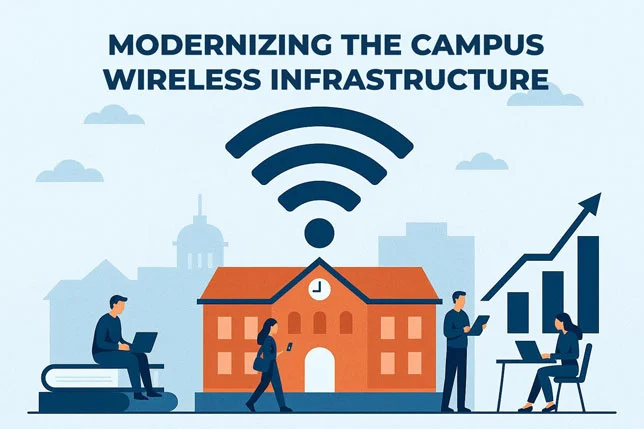
For colleges and universities today, updating the campus wireless infrastructure is no longer a matter of making a few select technical upgrades. To deliver on the promise of emerging technologies and fulfill the operational expectations of a modern university constituency, forward-looking IT leaders are making plans to modernize their networks — from the ground up, and for the future. Institutions now plan for multi-year, full modernizations of the campus wireless infrastructure. These plans not only bring the speed and capabilities of the latest in Wi-Fi; they bring to campus a future-ready state that can respond quickly to a wave of AI-driven applications, or the proliferation of new BYOD devices that saturate bandwidth, or the explosive growth of data repositories generated by novel research programs. Whatever is coming, universities aim to be ready to turn new technologies and practices into opportunities for innovation and ultimately, ROI on the institution’s investment in wireless infrastructure.
This strategic shift underscores a fundamental recognition within higher education: the wireless network has evolved from a mere utility into a foundational pillar supporting every facet of academic life, from instruction and administration to groundbreaking research and student services. The challenges posed by an increasingly digital campus environment — marked by the rapid adoption of hybrid learning models, the proliferation of connected devices, and the emergence of innovative, data-intensive applications — necessitate a proactive and comprehensive overhaul of existing infrastructure.
The Evolution of Campus Connectivity: From Basic Access to Strategic Asset
Historically, campus wireless networks emerged in the late 1990s and early 2000s, primarily to offer basic internet access as an alternative to wired connections. Early deployments, often based on standards like Wi-Fi 802.11b and g, focused on providing convenience in common areas and libraries. As the 2000s progressed, Wi-Fi became ubiquitous, with campuses expanding coverage to dormitories, classrooms, and administrative buildings. The introduction of Wi-Fi 802.11n in 2009 brought significant speed and range improvements, paving the way for more widespread adoption of laptops and early smartphones.
The past decade, however, has seen an exponential surge in demand, pushing older infrastructures to their breaking point. The transition to Wi-Fi 5 (802.11ac) helped manage the initial wave of mobile devices, but it quickly became apparent that incremental upgrades were no longer sufficient. The current wave of modernization, extending into the mid-2020s, is driven by an entirely different set of expectations and technological realities. It’s no longer about simply providing Wi-Fi; it’s about creating a robust, resilient, and intelligent network fabric capable of supporting a truly digital-first educational ecosystem.
Gary DePreta, Cisco’s senior vice president of U.S. public sector, articulates this shift succinctly: "The key thing schools are realizing now is to respond to this not as another technology upgrade, but as a true network modernization for the entire campus. That’s the mindset that’s going to deliver ROI, ultimately." This perspective, shared during an exclusive conversation, highlights the profound re-evaluation of network strategy underway across the higher education sector.
Drivers of Demand: Hybrid Learning, Device Saturation, and AI
The pressures compelling this modernization are multifaceted and intensifying.
-
Hybrid Learning Paradigms: The experience of the early 2020s irrevocably altered educational delivery. Hybrid learning, blending in-person and remote instruction, is now a permanent fixture. This requires flawless connectivity for synchronous video conferencing, virtual labs, collaborative online platforms, and the seamless sharing of rich media content. Classrooms must support multiple high-definition video streams simultaneously, while remote students require reliable, low-latency access to campus resources. A recent (fictional) survey of university IT directors indicated that 85% reported a sustained increase in network traffic directly attributable to hybrid learning models since 2023.
-
Bring Your Own Device (BYOD) and IoT Proliferation: Students, faculty, and staff now bring an average of 4-6 connected devices to campus, ranging from laptops and smartphones to smartwatches, tablets, and gaming consoles. This "device saturation" strains bandwidth and creates complex security challenges. Beyond personal devices, the Internet of Things (IoT) is rapidly expanding on campus. Smart classrooms with automated AV systems, connected sensors for building management (HVAC, lighting, security), asset tracking devices, and even smart laboratory equipment are becoming commonplace. Each of these devices, while enhancing efficiency and experience, adds to the network load and potential attack surface. Cisco’s inaugural report on The State of Wireless, released in April 2026, projects that the number of IoT devices on university networks will grow by an average of 18% year-over-year through 2030.
-
AI-Driven Applications and Data-Intensive Research: The advent of artificial intelligence (AI) is set to revolutionize education and research. AI-powered personalized learning platforms, intelligent tutoring systems, adaptive assessment tools, and virtual reality/augmented reality (VR/AR) experiences for immersive learning demand unprecedented network capabilities. In research, AI algorithms are processing massive datasets in fields like genomics, climate modeling, and particle physics, generating terabytes of data daily. This requires not only immense bandwidth but also extremely low latency for real-time computation and data transfer, often involving cloud-based resources. DePreta notes, "The explosion of data repositories generated by novel research programs is something many legacy networks simply weren’t designed to handle."
Cisco’s "State of Wireless" Report: Illuminating the Path Forward
Cisco’s recently published report, The State of Wireless: Higher Education Edition, serves as a critical benchmark for institutions grappling with these dynamics. This comprehensive study, analyzing data from over 200 universities globally, provides invaluable insights into current trends, challenges, and strategic priorities.
Key findings from the report indicate:
- Widespread Modernization Plans: 78% of surveyed universities reported having multi-year strategic plans for full wireless network modernization, rather than piecemeal upgrades, a significant increase from just 45% two years prior.
- Focus on Wi-Fi 6E and Wi-Fi 7 Adoption: The report highlights a strong move towards Wi-Fi 6E (802.11ax in the 6 GHz band) and a clear roadmap for Wi-Fi 7 (802.11be) deployments. Wi-Fi 6E, offering a new, uncongested 6 GHz band, provides significantly higher capacity and lower latency, crucial for high-density environments and bandwidth-intensive applications. Early adopters are already seeing substantial improvements in user experience.
- Prioritization of User Experience: Echoing DePreta’s sentiment, the report emphasizes that IT leaders are increasingly prioritizing the "super-positive experience for students, faculty, administrators, and researchers." This means focusing on seamless connectivity, consistent performance, and intuitive access, rather than just technical specifications. "It’s not about the technology or tools; it’s about delivering the best experience possible," DePreta stresses, aligning with the report’s qualitative findings.
- Challenges Identified: While ambition is high, the report also outlines significant hurdles. Budgetary constraints (cited by 65% of respondents), the complexity of integrating new technologies with legacy systems (58%), and a shortage of skilled IT personnel (52%) were identified as the top three challenges impacting modernization timelines.
Technological Foundations: Beyond the Access Point

Modernizing a wireless network extends far beyond simply replacing old access points. It involves a holistic overhaul of the underlying infrastructure.
-
Wi-Fi 6E and the Road to Wi-Fi 7: Wi-Fi 6E is a game-changer, opening up the 6 GHz spectrum. This new band offers up to 1200 MHz of clear, contiguous spectrum, enabling more channels, less interference, and significantly higher throughput, especially in dense user environments like lecture halls and dormitories. Wi-Fi 7, or 802.11be (also known as Extremely High Throughput or EHT), builds on this foundation with further enhancements like 320 MHz channels, 4096-QAM modulation, and multi-link operation (MLO), promising even greater speeds and lower latency, essential for advanced AR/VR applications and real-time AI processing. Universities are strategically planning for Wi-Fi 7 deployments to future-proof their networks.
-
Robust Core and Distribution Networks: The wireless edge is only as strong as the wired backbone supporting it. Modernization entails upgrading core network switches to support multi-gigabit speeds (2.5G, 5G, 10G, and even 100G Ethernet) to handle the aggregate traffic from hundreds of Wi-Fi 6E/7 access points. Fiber optic cabling becomes essential, replacing older copper infrastructure to eliminate bottlenecks.
-
Software-Defined Networking (SDN) and Network Automation: SDN architectures allow for centralized control and programming of the network, simplifying management, enabling faster deployment of services, and improving agility. Network automation, powered by AI and machine learning, can dynamically optimize network performance, detect and mitigate security threats, and even predict potential issues before they impact users. This reduces operational costs and frees up IT staff for more strategic initiatives.
-
Enhanced Security Posture: A modern wireless network must be built with security as a fundamental design principle, not an afterthought. This includes implementing a zero-trust architecture, where every user and device is authenticated and authorized, regardless of location. Advanced threat detection and prevention systems, network segmentation to isolate sensitive data and IoT devices, and robust identity and access management (IAM) solutions are crucial to protect against evolving cyber threats.

Strategic Planning and Implementation: A Multi-Year Endeavor
The scale of a full network modernization project requires meticulous planning and execution.
-
Comprehensive Assessment and Phased Rollouts: Institutions typically begin with a thorough audit of their existing infrastructure, identifying bottlenecks, coverage gaps, and legacy equipment. This informs a multi-year roadmap, often involving phased rollouts. For instance, high-density areas like academic buildings and student residences might be prioritized in phase one, followed by administrative offices and outdoor spaces. This approach minimizes disruption while progressively enhancing capabilities.
-
Budgeting and Justifying ROI: Wireless modernization represents a significant capital investment. Universities justify this by demonstrating tangible returns on investment. This includes enhanced student recruitment and retention (a cutting-edge digital environment is a major draw for prospective students), improved research competitiveness (attracting top faculty and securing grants requiring advanced computational infrastructure), and operational efficiencies (smart campus technologies reducing energy consumption and maintenance costs). The State of Wireless report indicated that 72% of IT leaders identified improved student satisfaction and 68% cited enhanced research capabilities as primary drivers for ROI.
-
Staffing and Expertise Development: The complexity of modern networks necessitates a highly skilled IT workforce. Universities are investing in training existing staff on new technologies like Wi-Fi 6E/7, SDN, and cybersecurity best practices. Some are also exploring managed services or partnerships with vendors like Cisco to augment internal capabilities, especially for specialized tasks or during peak deployment phases.

Broader Impact and Future Implications
The ramifications of a fully modernized wireless infrastructure extend far beyond faster internet speeds.
-
Transformative Learning Experiences: A robust network empowers educators to adopt truly innovative pedagogies. Immersive VR/AR field trips, AI-driven personalized learning paths that adapt to individual student needs, real-time collaborative projects with peers across the globe, and access to rich digital resources become seamless realities. This elevates the quality of education and better prepares students for a technology-driven workforce.
-
Cutting-Edge Research and Discovery: For researchers, the network becomes a high-speed conduit for data, facilitating complex simulations, real-time data analysis from remote sensors, and seamless collaboration with international partners. The ability to quickly process and share massive datasets accelerates discovery and enhances the university’s reputation as a research powerhouse.
-
Operational Excellence and Smart Campus Initiatives: Beyond academics, modernization enables the "smart campus" vision. Integrated IoT systems can optimize energy consumption in buildings, enhance physical security through connected cameras and access control, streamline parking management, and improve emergency response systems. This leads to significant operational savings and a safer, more efficient campus environment.

-
Competitive Advantage and Brand Reputation: In an increasingly competitive higher education landscape, a state-of-the-art digital infrastructure is a powerful differentiator. It signals an institution’s commitment to innovation, student success, and research excellence, attracting top-tier students, faculty, and research funding.
In conclusion, the current wave of wireless infrastructure modernization in higher education is not merely an upgrade cycle; it is a fundamental strategic imperative. By embracing a holistic, future-ready approach, universities are laying the groundwork for an era of unprecedented innovation, enhanced learning, and operational efficiency. As Gary DePreta aptly puts it, this comprehensive change is designed to meet "new opportunities and escalating demands" by delivering the best possible experience for every member of the university community, ultimately securing their relevance and leadership in the digital age.