



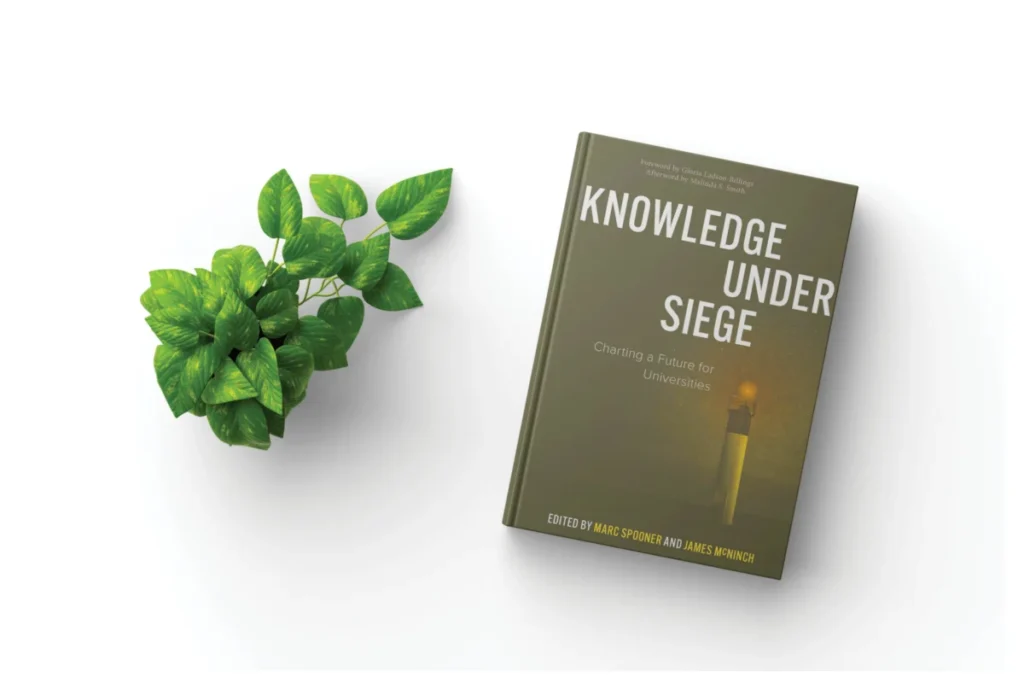
In a period defined by mounting pressures on higher education globally, the recent release of Knowledge Under Siege: Charting a Future for Universities, edited by Marc Spooner and James McNinch, arrives at a critical juncture. This collection, featuring contributions from a distinguished array of scholars, confronts the fundamental question of the purpose of universities in an era marked by heightened political scrutiny, significant budget constraints, widespread layoffs, public skepticism regarding the value of advanced learning, and increasingly assertive legislative attempts to undermine curricular autonomy and academic freedom. The volume argues that universities are not merely experiencing financial or reputational challenges; they are contending with sustained political and epistemic assaults that strike at their very core.
The Multifaceted Siege on Higher Education
The book’s central thesis posits that universities are facing a confluence of challenges, extending beyond mere financial or reputational strain. Contributors meticulously document, across diverse global contexts, concerted efforts to curtail academic freedom, restrict curricular authority, erode tenure protections, and suppress critical scholarship. These developments are intricately linked to long-standing neoliberal reforms that have reshaped academic institutions over decades. The implementation of managerial governance structures, the pervasive influence of audit cultures and performance metrics, and the pervasive infiltration of market logics have rendered universities more susceptible to overt political control and have reoriented their purpose towards serving as instruments of economic productivity and ideological conformity. Through rigorous analysis of policy discourse, the contributors demonstrate how appeals to accountability and efficiency have reconfigured intellectual inquiry, transforming it from a democratic practice into a quantifiable output. Simultaneously, selectively deployed claims of free speech are being used to dismantle equity initiatives under the guise of neutrality.
This sustained pressure is not a recent phenomenon. The shift towards market-driven higher education gained significant momentum in the late 20th century, as governments worldwide began to view universities as economic engines rather than solely as public goods. In the United States, for instance, state funding for public universities has seen a dramatic decline since the 1980s, forcing institutions to rely more heavily on tuition revenue and private funding, thereby increasing their susceptibility to external pressures and market demands. This trend has been mirrored in many other developed nations, contributing to a global landscape where institutional priorities are increasingly shaped by economic considerations rather than purely academic ones.
Redefining the University’s Core Mission
What distinguishes Knowledge Under Siege is its deliberate departure from rehashing familiar concerns about budgets or public relations. Instead, it prompts academic leaders to articulate precisely what is at stake when the claim is made that the university is under siege. The collection unequivocally rejects narrow, market-driven conceptions that reduce universities to mere credentialing pipelines. Instead, the contributors advocate for a robust vision of the university as a public, democratic, and ethical institution—one fundamentally dedicated to fostering critical inquiry, nurturing diverse forms of knowledge, and facilitating collective reflection in the face of complex social and political crises.
Acknowledging Institutional Complicity and Historical Legacies
The volume prominently foregrounds the inherent political and ethical dimensions of higher education. Universities are presented not as neutral entities but as institutions that simultaneously enable critique and perpetuate inequality. They foster democratic capacities while remaining deeply entangled with colonial and racialized histories. This refusal to present an idealized or "innocent" view of the university is one of the book’s most significant strengths. Rather than solely defending universities as they currently exist, the contributors challenge readers to confront their historical trajectories and acknowledge the ongoing exclusion and marginalization that may persist within their structures.
This introspective approach is crucial for genuine progress. For example, in North America, the historical dispossession of Indigenous lands and peoples has had a profound and lasting impact on the very institutions of higher learning. Many universities are built on lands that were forcibly taken, and their founding principles often reflect the dominant colonial worldview. Recognizing this historical complicity is the first step towards building more equitable and inclusive academic environments.
Epistemic Authority and the Challenge of Indigenous Knowledge Systems
Several chapters within Knowledge Under Siege directly engage with critical questions surrounding epistemic authority and knowledge production. They challenge Western assumptions about knowledge, hierarchy, and institutional purpose by highlighting Indigenous models that prioritize relationality, land, language, communal flourishing, and collective self-determination. The contributors issue a powerful call for the creation of ethical spaces where Indigenous knowledge can thrive on its own terms. They advocate for pedagogies grounded in relational accountability, trauma-informed practices, and solidarity, thereby shifting the fundamental debate. The university, they argue, is not only under external pressure but is also implicated in enduring histories of colonialism and exclusion. Consequently, the imperative is not merely to defend academic freedom but to dismantle the epistemic hierarchies that dictate whose knowledge is considered valid and whose is marginalized.
The integration of Indigenous knowledge systems into university curricula and research methodologies is a growing area of focus. Initiatives like the establishment of Indigenous studies programs, the commitment to land acknowledgments, and the development of culturally relevant research protocols are steps in this direction. However, the contributors to Knowledge Under Siege emphasize that these efforts must go beyond symbolic gestures to effect fundamental structural and epistemic change.
Navigating Neutrality and Moral Responsibility
The collection also grapples with the complex tension between institutional neutrality and moral responsibility. In an increasingly polarized climate, universities are frequently urged to remain detached from political discourse. However, numerous contributors argue persuasively that such neutrality can easily devolve into acquiescence when fundamental commitments to academic freedom, equity, and democratic participation are under threat. The core issue is not whether universities are inherently political—they invariably are—but rather how they can act responsibly and courageously in transparent ways that align with their educational missions and governance processes. Retreating from this responsibility, or drifting further from the concept of education as a public good in deference to powerful minority interests, poses a significant risk to any meaningful vision of a democratic and egalitarian future.
The debate over academic neutrality has intensified in recent years. For example, controversies surrounding the "boycott, divestment, and sanctions" (BDS) movement on university campuses have highlighted the challenges institutions face in balancing freedom of expression with concerns about institutional values and the potential for harassment. Critics of neutrality argue that taking a stance against injustice is not a departure from academic principles but an embodiment of them.
A Defiant Hope and Concrete Forms of Resistance
Despite the gravity of its analysis, Knowledge Under Siege offers a message of defiant hope. The contributors highlight concrete forms of resistance that are already underway. These include faculty unions mobilizing against legislative overreach, student movements contesting austerity measures, Indigenous models promoting collective well-being, community partnerships reasserting the public purpose of higher education, and classrooms being restructured as sites of critical dialogue rather than passive consumption. These accounts do not present a singular blueprint for reform. Instead, they showcase a diverse array of engagement strategies—legal, pedagogical, ethical, relational, and structural. These strategies are anchored in a willingness to confront institutional complicity and a steadfast commitment to prioritizing the non-monetary purposes that define the core mission of higher education. The book envisions universities as generative spaces where uncertainty, play, curiosity, and creativity blur the boundaries between academic and public life, fostering critical shifts in perspective, transforming individual lives, and thereby opening possibilities for more humane, joyful, and decolonized futures.
Recent years have seen a surge in organized faculty efforts. For instance, the unionization drives at various universities, from large public institutions to smaller private colleges, demonstrate a growing faculty desire for greater collective bargaining power and a stronger voice in institutional governance. Similarly, student activism, often galvanized by issues of social justice and environmental sustainability, continues to be a potent force for change within higher education.
A Dialogical Approach to a Complex Future
The editors have meticulously curated a collection that is dialogical rather than doctrinaire. Tensions among the chapters—for example, the inherent friction between reform and rupture, or between protection and transformation—are not glossed over. This deliberate refusal of facile closure is a significant strength, inviting readers to engage in an ongoing, critical conversation about the kinds of universities that democratic societies require and the risks we are collectively willing to undertake in their defense.
The underlying message of Knowledge Under Siege is clear: the future of higher education is a matter of profound concern for everyone. This exceptionally well-edited collection offers both a penetrating diagnosis of the challenges facing universities and a powerful provocation to action. It affirms that universities remain vital public institutions, while simultaneously insisting that their vitality cannot be taken for granted. At a time when retreating into institutional defensiveness might seem like the safer option, the book serves as a potent reminder that universities, as cradles and sponsors of critique, are fundamentally meant to be unsettling. Democracy, as the contributors compellingly articulate, depends upon our collective willingness to ensure that universities continue to fulfill this essential role. The ongoing dialogue initiated by this book is not merely an academic exercise but a necessary undertaking for the health and future of democratic societies worldwide.