



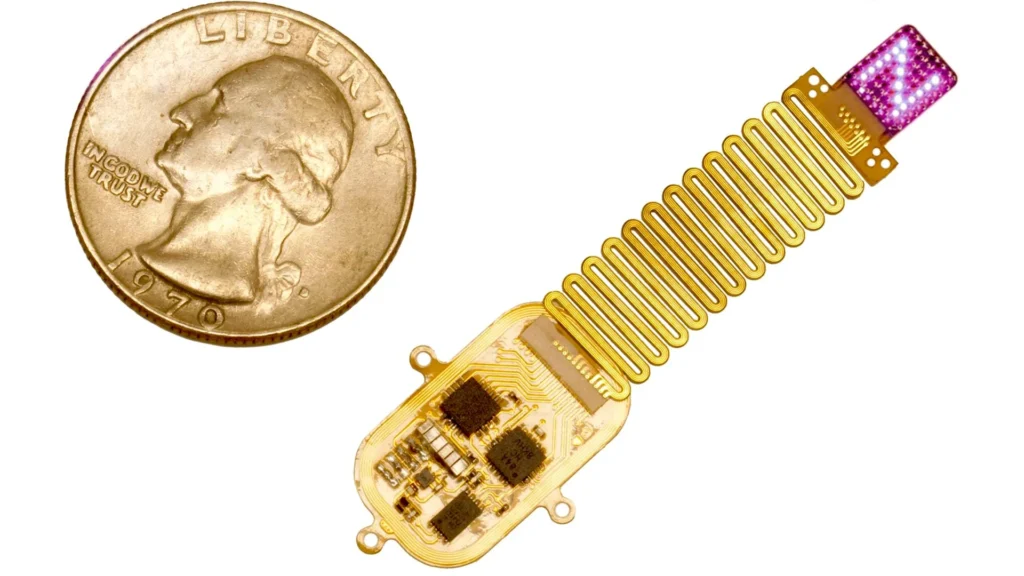
In a major step forward for neurobiology and bioelectronics, scientists at Northwestern University have created a wireless device that uses light to transmit information directly into the brain, bypassing traditional sensory routes in the body and instead delivering signals straight to neurons. This groundbreaking technology, detailed in a forthcoming publication in Nature Neuroscience, represents a significant leap in our ability to communicate with the brain, offering unprecedented opportunities for both fundamental research and a wide array of future medical applications. The device, designed to be soft and flexible, is engineered to fit discreetly beneath the scalp, resting gently on the skull. From this position, it emits carefully controlled patterns of light that penetrate the bone to activate specific groups of neurons across the cerebral cortex, establishing a novel pathway for direct brain input.
The Device: A Closer Look at Transcranial Optogenetics
The core innovation of this new device lies in its ability to deliver patterned light stimulation transcranially – through the skull – without invasive probes penetrating brain tissue. Unlike earlier optogenetic approaches that often required direct implantation into the brain, this less invasive design marks a crucial advancement for potential human applications. The device itself is remarkably compact, approximately the size of a postage stamp and thinner than a standard credit card, yet it houses an array of up to 64 programmable micro-LEDs. Each individual micro-LED is no larger than a single strand of human hair, enabling precise, localized light delivery. This array can be controlled independently in real-time, allowing researchers to generate complex sequences of light patterns that closely mimic the distributed activity patterns naturally produced by the brain during sensory experiences.
The choice of red light for stimulation is strategic. Red light possesses superior tissue penetration capabilities compared to other wavelengths in the visible spectrum. As Northwestern neurobiologist Yevgenia Kozorovitskiy explained, "Red light penetrates tissues quite well. It reaches deep enough to activate neurons through the skull." This property is critical for the device’s transcranial functionality, ensuring that the light signals can effectively reach and activate target neurons in the cortex without requiring direct contact with brain tissue. The wireless power module further enhances its practicality, eliminating the need for bulky batteries or external wiring that could restrict movement or introduce infection risks, making the system fully implantable and unobtrusive.
Evolution of Brain Interface Technology: A Timeline of Progress
This latest breakthrough from Northwestern University builds upon a rich history of scientific advancements in neurobiology and bioelectronics, particularly in the field of optogenetics. Optogenetics, a revolutionary technique developed in the early 2000s by pioneers like Karl Deisseroth and Gero Miesenböck, involves genetically engineering specific neurons to express light-sensitive proteins (opsins), typically derived from microbes. These opsins act as molecular switches, causing neurons to fire or silence in response to specific wavelengths of light. The advent of optogenetics provided neuroscientists with unprecedented precision in controlling neural activity, allowing them to investigate the causal roles of specific neural circuits in behavior.
However, early optogenetic systems predominantly relied on fiber optic wires physically inserted into the brain, which, while effective for research, were inherently invasive and restrictive, limiting the natural movement and social interactions of animal models. Recognizing these limitations, the team at Northwestern University, led by Dr. John A. Rogers in bioelectronics and Dr. Yevgenia Kozorovitskiy in neurobiology, began to push the boundaries of wireless brain interfaces.
Their journey saw a significant milestone in 2021 when they reported the development of the first fully implantable, programmable, wireless, and battery-free device capable of controlling neurons with light. That earlier system utilized a single micro-LED probe and demonstrated its efficacy in influencing social behavior in mice. The key advantage was the wireless design, which allowed mice to behave normally within their social environments, overcoming the tethering constraints of traditional fiber optics. This foundational work proved the feasibility of wireless optogenetics for behavioral studies.
The current device represents a substantial expansion of this capability. Instead of a single micro-LED stimulating one small region, the updated system integrates an array of up to 64 independently controllable micro-LEDs. This multi-site approach is crucial because real sensory experiences activate broad networks of neurons across the cortex, not just isolated cells. By enabling researchers to deliver complex, distributed patterns of stimulation, the new device more accurately mirrors how the cortex naturally functions during perception and learning, opening doors to more sophisticated brain communication. Mingzheng Wu, the study’s first author and a postdoctoral researcher, highlighted this exponential increase in capability: "In the first paper, we used a single micro-LED. Now we’re using an array of 64 micro-LEDs to control the pattern of cortical activity. The number of patterns we can generate with various combinations of LEDs — frequency, intensity, and temporal sequence — is nearly infinite."
Pioneering Artificial Perception in Animal Models
To rigorously evaluate the efficacy and potential of this new system, the research team conducted a series of sophisticated experiments using genetically engineered mouse models. These mice were specifically modified to express light-responsive neurons within their cerebral cortex, a prerequisite for optogenetic manipulation. The experimental design focused on training these animals to interpret the artificial light patterns as meaningful cues, demonstrating the brain’s remarkable capacity for plasticity and learning.
During the training phase, the implant delivered a defined pattern of light across four distinct cortical regions. This process was akin to tapping a coded message directly into the brain, bypassing the animal’s natural senses. The mice were trained to associate a particular pattern of stimulation with a reward, which was consistently located at a specific port within a specialized testing chamber. The animals were presented with various light patterns, and their task was to identify the correct target pattern among several alternatives. Upon detecting the appropriate artificial signal, they were required to navigate to the designated port to receive a reward, typically a small amount of water or food.
The results were compelling. The mice quickly learned to interpret these precisely timed bursts of light as meaningful cues. Even in the absence of any traditional sensory input—no sound, sight, or touch—the animals consistently used the incoming artificial information to make accurate decisions and successfully complete the behavioral tasks. As Wu explained, "By consistently selecting the correct port, the animal showed that it received the message. They can’t use language to tell us what they sense, so they communicate through their behavior." This demonstrated that the brain not only registered the light signals but actively processed and integrated them into their decision-making framework, effectively creating an "artificial perception."
Expert Perspectives on a Groundbreaking Advance
The development of this wireless brain interface has elicited significant enthusiasm from the lead researchers, who emphasize both its immediate impact on neuroscience and its long-term potential for human health.
Dr. Yevgenia Kozorovitskiy, the Irving M. Klotz Professor of Neurobiology at Northwestern’s Weinberg College of Arts and Sciences and a member of the Chemistry of Life Processes Institute, spearheaded the experimental portion of the study. She articulated the profound implications of this technology for understanding the fundamental workings of the brain: "Our brains are constantly turning electrical activity into experiences, and this technology gives us a way to tap into that process directly. This platform lets us create entirely new signals and see how the brain learns to use them. It brings us just a little bit closer to restoring lost senses after injuries or disease while offering a window into the basic principles that allow us to perceive the world." Her statements underscore the dual benefit: a tool for therapeutic intervention and a powerful instrument for basic scientific inquiry into perception and learning.
Dr. John A. Rogers, a leading figure in bioelectronics who holds appointments in materials science and engineering, biomedical engineering, and neurological surgery, and directs the Querrey Simpson Institute for Bioelectronics, led the technological development. His comments highlighted the intricate engineering challenges overcome to realize this device: "Developing this device required rethinking how to deliver patterned stimulation to the brain in a format that is both minimally invasive and fully implantable. By integrating a soft, conformable array of micro-LEDs — each as small as a single strand of human hair — with a wirelessly powered control module, we created a system that can be programmed in real time while remaining completely beneath the skin, without any measurable effect on natural behaviors of the animals. It represents a significant step forward in building devices that can interface with the brain without the need for burdensome wires or bulky external hardware. It’s valuable both in the immediate term for basic neuroscience research and in the longer term for addressing health challenges in humans." Dr. Rogers’ insights illuminate the blend of materials science, electrical engineering, and biological compatibility that defines this interdisciplinary achievement.
Unlocking New Possibilities: Medical and Research Implications
The potential applications stemming from this technology are vast and transformative, spanning both clinical medicine and fundamental neuroscience. The ability to directly deliver information to the brain without relying on traditional sensory pathways opens up entirely new avenues for intervention and research.
In the realm of medical applications, the device could revolutionize the field of prosthetics. Imagine a prosthetic limb that not only moves in response to a user’s thoughts but also provides tactile feedback directly to the brain. This technology could enable individuals with artificial limbs to "feel" pressure, texture, or temperature, restoring a sense of proprioception and interaction with their environment that is currently lacking. For future hearing or vision prostheses, the device could deliver artificial inputs directly to the auditory or visual cortices, potentially bypassing damaged sensory organs and providing a new form of sensory perception for those with severe hearing or vision loss.
Beyond sensory restoration, the technology holds promise for controlling robotic limbs with unprecedented precision, translating complex neural commands into fluid movements. It could also significantly improve rehabilitation outcomes for patients recovering from injury or stroke by stimulating specific brain regions to promote neural plasticity and motor recovery. Furthermore, by directly modulating neural circuits involved in pain processing, the device could offer a non-pharmacological approach to modifying chronic pain perception, providing relief without the side effects associated with traditional medications.
For basic neuroscience research, this device is a game-changer. It provides neuroscientists with an unparalleled tool to explore how the brain processes information, learns new associations, and forms perceptions. Researchers can now create novel sensory experiences and observe how the brain adapts and interprets these synthetic signals. This could lead to a deeper understanding of brain plasticity, memory formation, and the neural correlates of consciousness. The ability to generate a nearly infinite number of patterns allows for systematic investigation into the brain’s encoding and decoding mechanisms for complex information.
The Road Ahead: Future Enhancements and Challenges
While the current device represents a monumental achievement, the researchers are already looking towards its future development and expanded capabilities. Now that the team has definitively demonstrated that the brain can interpret patterned light stimulation as meaningful information, their immediate next steps involve testing more sophisticated patterns and rigorously determining the maximum number of distinct signals the brain can reliably learn and differentiate. This will be crucial for developing richer, more nuanced communication with the brain.
Future versions of the device are envisioned to incorporate an even greater number of LEDs, potentially with smaller spacing between them to achieve finer spatial resolution in cortical stimulation. Larger arrays could cover more extensive areas of the cortex, allowing for broader and more distributed neural engagement. Research will also focus on exploring different wavelengths of light that can penetrate deeper into brain tissue, expanding the reach of this transcranial optogenetic approach to subcortical structures.
The journey from animal models to human clinical trials is a long and meticulously regulated one, involving rigorous safety testing, biocompatibility assessments, and ethical considerations. However, the foundational work laid by Northwestern University brings the promise of direct brain communication closer to reality, paving the way for a future where technology can seamlessly augment or restore human sensory and motor functions.
The study, "Patterned wireless transcranial optogenetics generates artificial perception," underscores a collaborative and well-supported research endeavor. It received crucial financial backing from a consortium of prestigious institutions and awards, including the Querrey Simpson Institute for Bioelectronics, the NINDS/BRAIN Initiative, the National Institute of Mental Health, the One Mind Nick LeDeit Rising Star Research Award, the Kavli Exploration Award, the Shaw Family Pioneer Award, the Simons Foundation, the Alfred P. Sloan Foundation, and the Christina Enroth-Cugell and David Cugell Fellowship, highlighting the interdisciplinary commitment to advancing the frontiers of neurotechnology.