

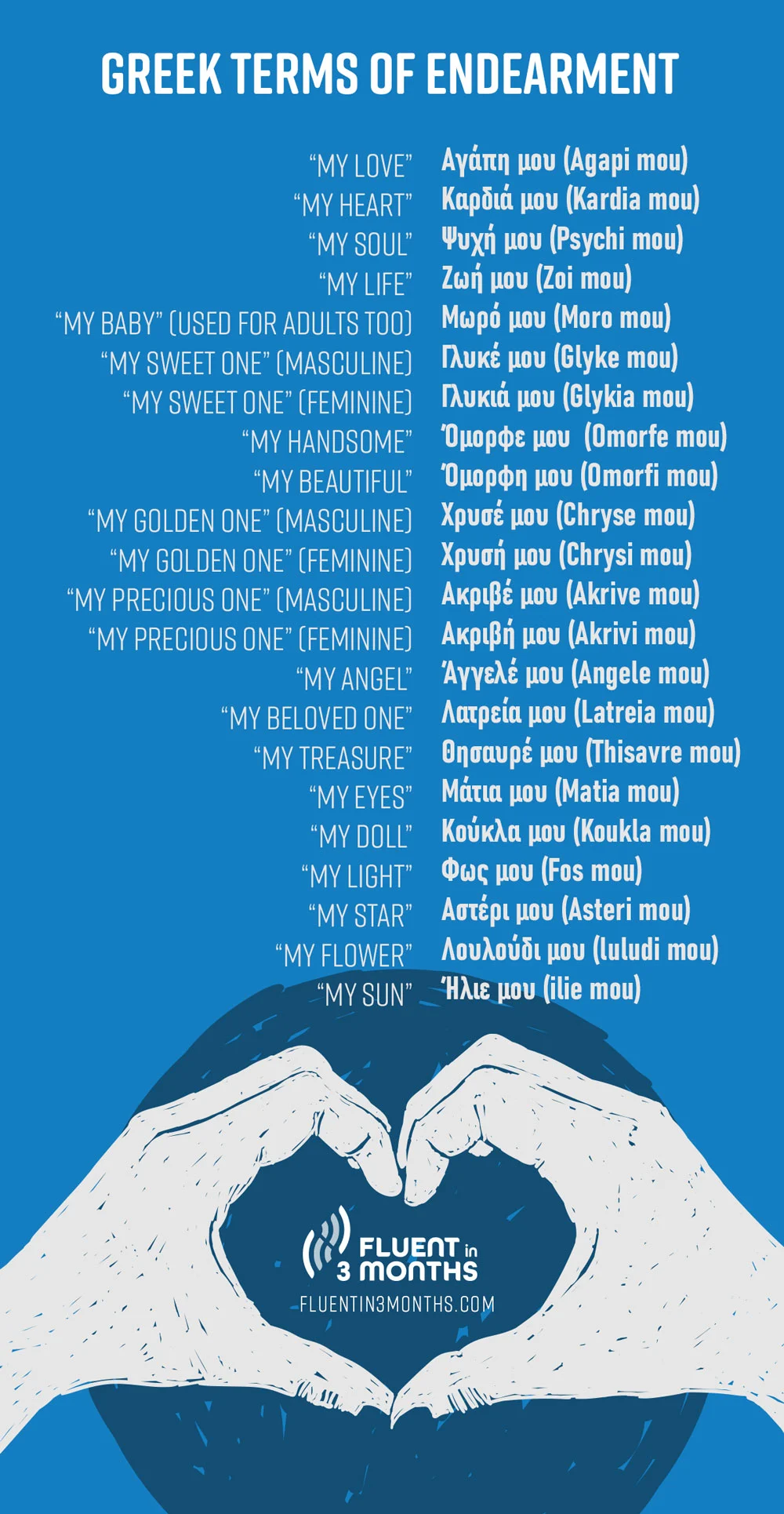
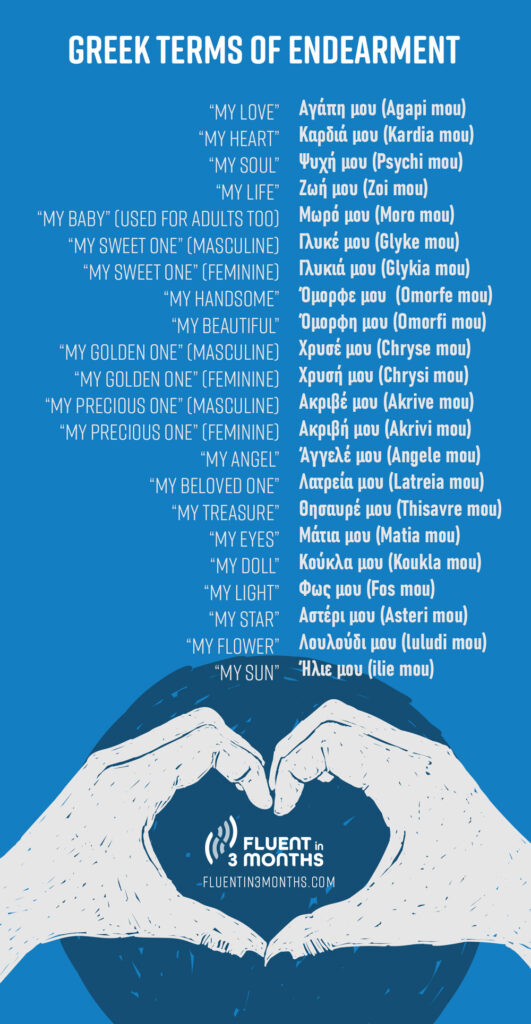
The Greek language, a cornerstone of Western civilization and a primary branch of the Indo-European language family, possesses a unique and intricate system of endearment that reflects the nation’s deep-rooted cultural emphasis on family, hospitality, and emotional expression. At the center of this linguistic framework is the phrase "S’agapo" (Σ’ αγαπώ), meaning "I love you," which serves as the foundation for a wide array of affectionate terms. These terms, ranging from "agapi mou" (my love) to "kardia mou" (my heart), are not merely casual interjections but are essential tools for navigating social hierarchies and reinforcing interpersonal bonds within Greek-speaking communities worldwide.
The use of endearment in Greek is characterized by the frequent addition of the possessive pronoun "mou" (μου), meaning "my." This grammatical structure personalizes the term, transforming a general noun into a direct expression of intimacy. For instance, while "agapi" refers to the abstract concept of love, "agapi mou" creates a specific connection between the speaker and the recipient. This linguistic habit is prevalent not only in mainland Greece but also across the Hellenic diaspora, including Cyprus, where local dialects often incorporate these standard forms alongside regional variations.
The Historical Evolution of Greek Affectionate Terminology
To understand the modern application of Greek endearments, one must examine the historical and philosophical evolution of the language. Ancient Greek famously distinguished between various types of love, a classification system that continues to influence how modern speakers perceive emotional connection. The "Eight Greek Love Names" provide a structural background for the vocabulary of affection used today.
- Eros: Romantic, passionate love, named after the Greek god of fertility.
- Philia: Deep friendship or "brotherly" love, valued highly in ancient philosophical circles.
- Storge: Familial love, specifically the instinctual bond between parents and children.
- Agape: Unconditional, selfless love, often associated with spiritual or universal compassion.
- Ludus: Playful or uncommitted love, common in the early stages of a relationship.
- Pragma: Enduring, long-term love that matures over decades.
- Philautia: Self-love, which the Greeks divided into a healthy version and a hubristic version.
- Mania: Obsessive or possessive love, viewed as a clinical or destructive state.
Modern Greek terms of endearment often draw from these ancestral roots. The word "agapi mou," for example, stems directly from "agape," suggesting a love that is profound and sincere. This historical continuity allows the Greek language to maintain a level of emotional nuance that is often lost in translation when compared to English.
Categorization of Common Endearments
The application of endearment in Greek society is highly contextual, with specific terms reserved for romantic partners, family members, and friends. Understanding these distinctions is vital for linguistic fluency and cultural integration.
Romantic Expressions
In romantic contexts, Greek speakers often employ metaphors involving vital organs or celestial bodies. "Kardia mou" (my heart) and "psychi mou" (my soul) are among the most common, signifying that the partner is essential to the speaker’s existence. Other frequently used terms include:
- Zoi mou (My life): Indicating that the person is the center of the speaker’s world.
- Moro mou (My baby): Used frequently between adults to denote tenderness.
- Matia mou (My eyes): A term suggesting that the loved one is as precious as the speaker’s sight.
Familial Bonds
Greek culture is traditionally "high-context" and family-oriented. The language reflects this through the use of "diminutives"—suffixes added to words to make them sound smaller, cuter, or more affectionate. For example, "mitera" (mother) becomes "manoula" (mommy), and "pateras" (father) becomes "pateroulis" (daddy). These terms are almost always accompanied by "mou" to signify the familial link.
Social and Friendly Endearments
Between friends, endearments serve as "social lubricants," easing interactions and establishing a sense of "parea"—a group of friends who meet regularly to share ideas and life experiences. Common terms include "koukla mou" (my doll, usually for women) and "glike mou" (my sweet one). In casual settings among males, "agori mou" (my boy) or "file mou" (my friend) are standard, though the latter is often used even with acquaintances to foster a welcoming atmosphere.
The Mechanics of Diminutives and Name Formation
A significant portion of Greek affectionate language is governed by the rules of diminutives. By adding specific suffixes to the end of a name or a noun, the speaker conveys a sense of warmth or playfulness. This linguistic feature is one of the most distinctive aspects of the Modern Greek language.
The most common suffixes include:
- -aki (neutral): Used for children, objects, or as a general endearing term (e.g., "paidaki" for a small child).
- -itsa (feminine): Often added to female names (e.g., "Elenitsa" for Elena).
- -oulis (masculine): Used for male names or terms (e.g., "pateroulis").
- -akis (masculine): A frequent suffix for male names, particularly in certain regions like Crete.
When these suffixes are applied to names, they often undergo a phonetic transformation. For instance, the name "Yiorgos" becomes "Yiorgaki," and "Maria" becomes "Marioula." This practice is so widespread that in many Greek families, individuals are rarely called by their formal given names, but rather by their diminutive forms throughout their entire lives.
Grammatical Precision and Pronunciation
For non-native speakers, the correct usage of these terms requires attention to both grammar and phonology. A primary rule is the placement of the possessive "mou." In Greek, "mou" always follows the noun it modifies. While an English speaker might say "my love," a Greek speaker must say "agapi mou" (love my). Reversing this order is a common error among learners and can disrupt the natural flow of the sentence.
Pronunciation also plays a critical role in how these endearments are received. The Greek alphabet contains several sounds that do not have direct equivalents in English:
- The letter "Gamma" (γ) is often pronounced as a soft, voiced velar fricative, similar to a "gh" sound, or a "y" sound when followed by "i" or "e."
- The letter "Delta" (δ) is pronounced like the "th" in "this."
- The letter "Theta" (θ) is pronounced like the "th" in "think."
Mastering these sounds is essential for words like "thisavre mou" (my treasure) or "agapi mou," where the "gamma" sound must be subtle rather than hard.
Sociological Impact and Expert Analysis
Linguists and sociologists have long noted that the abundance of endearment terms in Greek is a reflection of the Mediterranean "collectivist" culture. In contrast to more "individualist" Western cultures, where formal address is often maintained to respect personal space, Greek culture prioritizes "philoxenia"—the love of strangers—and close-knit social circles.
Dr. Eleni Papadopoulou, a researcher in Hellenic linguistics, notes that "the use of endearments in Greece functions as a method of social inclusion. By calling an acquaintance ‘matia mou’ or ‘pedi mou’ (my child), the speaker is effectively bringing that person into their inner circle, even if only for the duration of the conversation. It reduces social distance and builds immediate rapport."
Furthermore, data from language acquisition studies suggest that learners who utilize these endearment terms are perceived as more fluent and culturally empathetic. A 2022 survey of expatriates living in Athens revealed that those who incorporated diminutives and "mou" into their daily interactions reported higher levels of social integration and felt more welcomed by the local population.
Regional Variations: The Cypriot Perspective
The Greek spoken in Cyprus, known as the Cypriot dialect, offers another layer of complexity to these endearments. While the standard Modern Greek terms are understood and used, Cypriot Greek often employs unique phonetic shifts and specific local words. The frequent use of these terms in Cyprus reinforces a shared identity between the island and the mainland, while also preserving a distinct regional flavor. As noted by many residents of the region, the hearing of these terms is a daily occurrence, woven into the fabric of everything from marketplace transactions to formal family gatherings.
Broader Implications for the Future of the Language
As the world becomes increasingly digitized, there were concerns among linguists that the nuance of Greek endearments might fade in favor of more "globalized" or "simplified" communication. However, the opposite has occurred. On social media platforms and messaging apps, Greek speakers have adapted these terms into "Greeklish" (Greek written with Latin characters) and emojis, ensuring their survival among the younger generation.
The persistence of terms like "moro mou" and "kardia mou" in digital spaces suggests that the emotional core of the Greek language remains resilient. These expressions continue to serve as a vital link to the past while providing a necessary emotional outlet in the modern world.
In conclusion, the study of Greek terms of endearment is more than a lesson in vocabulary; it is an entry point into the Greek psyche. By combining the foundational "S’agapo" with a diverse array of nouns and diminutive suffixes, speakers can navigate the complex waters of human emotion with precision and warmth. Whether used in the bustling streets of Athens or the quiet villages of Cyprus, these words remain the heartbeat of the Hellenic world, proving that in Greek, love is not just a feeling, but a rich and ever-evolving language of its own.