


The acquisition of a new language is often viewed as a monumental task, yet linguistic research consistently demonstrates that a functional grasp of daily communication can be achieved by mastering a specific subset of high-frequency vocabulary. For the Turkish language—a member of the Turkic family spoken by approximately 88 million people globally—this strategic approach is particularly effective. By prioritizing common nouns, verbs, and social markers, learners can navigate a significant majority of daily interactions. This report provides a comprehensive analysis of the essential Turkish lexicon, the structural mechanics of the language, and the historical context that shaped modern Turkish discourse.
The Linguistic Architecture of Modern Turkish
Turkish is an agglutinative language, a characteristic that distinguishes it significantly from Indo-European languages like English or French. In an agglutinative system, grammatical relationships are expressed through the addition of suffixes to a root word rather than through separate words or complex internal changes. This structure means that a single word in Turkish can often convey the meaning of an entire sentence in English.
Furthermore, Turkish follows a Subject-Object-Verb (SOV) word order. For a learner, this requires a cognitive shift, as the action of the sentence (the verb) is reserved for the conclusion. Understanding this foundational logic is critical before memorizing individual words, as the placement of vocabulary determines the clarity of the message.
The Social Entry Point: Greetings and Polite Discourse
In Turkish culture, social etiquette and hospitality (misafirperverlik) are paramount. Consequently, the first tier of essential vocabulary involves greetings and honorifics. Turkish distinguishes strictly between formal and informal addresses, a reflection of the social hierarchy and respect for elders inherent in the culture.
The standard greeting, Merhaba (Hello), is universally applicable. For more casual settings, Selam (Hi) is preferred. Temporal greetings such as Günaydın (Good morning) and İyi akşamlar (Good evening) are standard in both professional and social environments.
A unique aspect of Turkish social interaction is the use of "welcoming" phrases. When a guest arrives, the host says Hoş geldin (singular/informal) or Hoş geldiniz (plural/formal). The standard response is Hoş bulduk, which literally translates to "We found it pleasant," acknowledging the welcome.
Politeness is further codified in phrases such as Lütfen (Please) and Teşekkür ederim (Thank you). For those seeking a more informal expression of gratitude, Sağ ol (literally "Stay healthy") is common. Turkish also employs highly specific well-wishing phrases that lack direct English equivalents, such as Kolay gelsin (May it be easy for you), used when someone is working, and Afiyet olsun (Enjoy your meal/May it be good for your health).
Categorical Nouns: Navigating the Physical World
To function in a Turkish-speaking environment, a learner must prioritize nouns related to food, family, and geography. These words act as the primary building blocks for descriptive communication.
Food and Essential Sustenance
Given Turkey’s global reputation for culinary excellence, food-related vocabulary is indispensable.
- Ekmek (Bread): A staple of every Turkish meal.
- Su (Water): Essential for navigation and dining.
- Çay (Tea) and Kahve (Coffee): Central to Turkish social life.
- Et (Meat), Balık (Fish), and Tavuk (Chicken): Primary proteins.
- Sebze (Vegetables): Including Domates (Tomato), Biber (Pepper), and Soğan (Onion).
A notable linguistic trap for English speakers is the word Pasta. In Turkish, Pasta refers exclusively to cake, while the Italian staple is known as Makarna.
Family Hierarchies and Social Respect
The Turkish vocabulary for family is more granular than its English counterpart, particularly concerning extended relatives. The language distinguishes between paternal and maternal sides:
- Amca (Paternal uncle) vs. Dayı (Maternal uncle).
- Hala (Paternal aunt) vs. Teyze (Maternal aunt).
Respect for seniority is embedded in the words Abla (Older sister) and Abi (Older brother). These terms are frequently used even for non-relatives as a sign of respect and familiarity in daily interactions.
Urban Navigation and Places
For travelers and expatriates, identifying key locations is a logistical necessity:
- Ev (House/Home)
- Okul (School)
- Hastane (Hospital)
- Eczane (Pharmacy)
- Havalimanı (Airport)
- Banka (Bank)
The Temporal Framework: Chronology and Time
Effective planning requires a command of time-related nouns. The Turkish system is logical and consistent.
- Bugün (Today)
- Dün (Yesterday)
- Yarın (Tomorrow)
- Şimdi (Now)
- Sonra (Later)
These words, combined with the days of the week and units of time—Gün (Day), Hafta (Week), Ay (Month), and Yıl (Year)—allow for the coordination of appointments and the description of events.
The Verbal Engine: Action and Existence
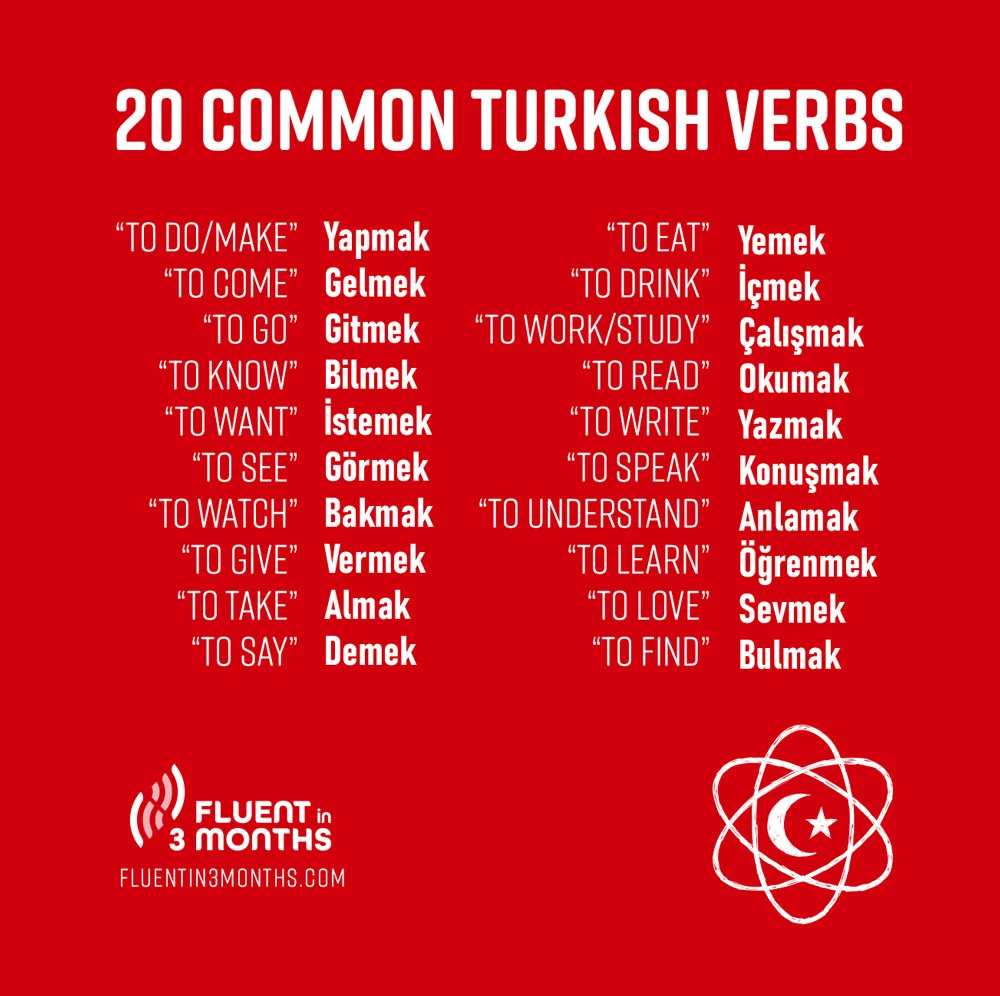
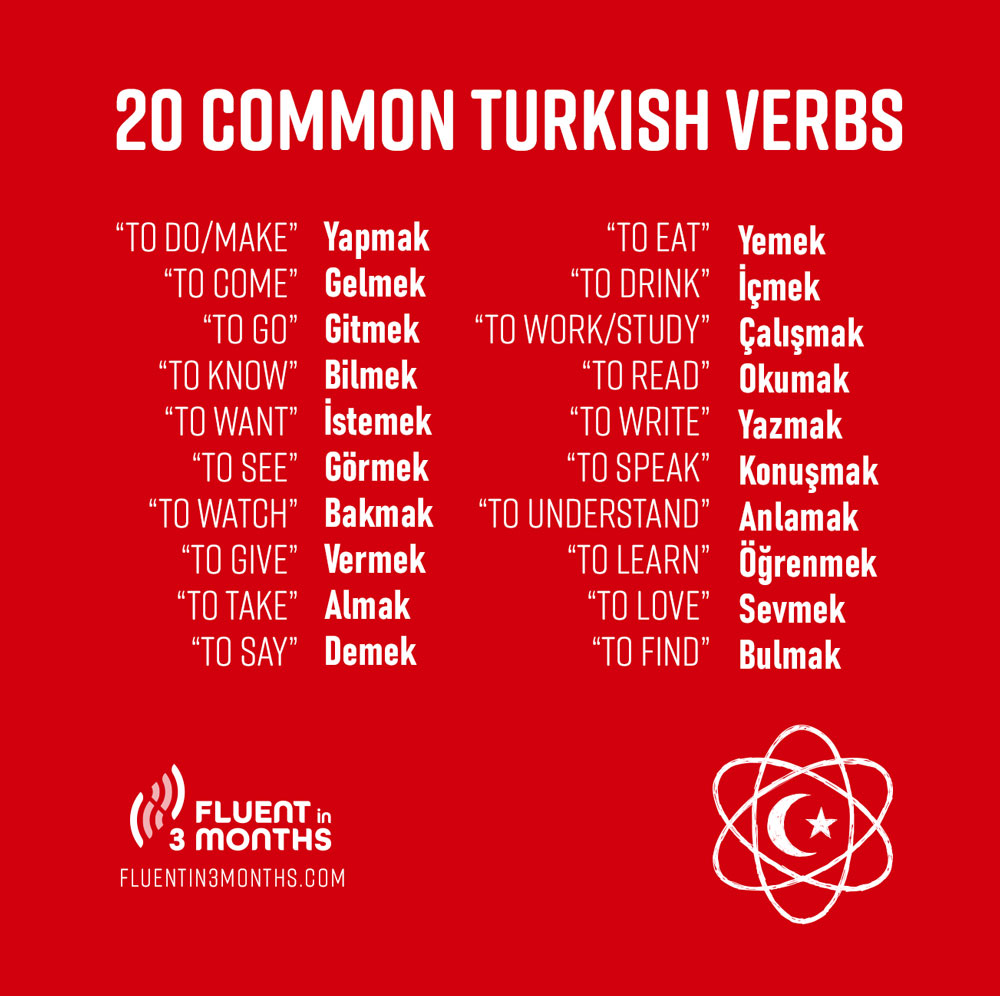
Verbs in Turkish are almost always placed at the end of the sentence. The infinitive form of a Turkish verb ends in either -mak or -mek, depending on vowel harmony.
Key high-frequency verbs include:
- Yapmak (To do/make)
- Gelmek (To come)
- Gitmek (To go)
- İstemek (To want)
- Almak (To take/buy)
- Vermek (To give)
- Konuşmak (To speak)
- Anlamak (To understand)
A critical distinction in Turkish grammar is the absence of standalone verbs for "to be" and "to have." These concepts are handled through suffixes and existential particles. For instance, to say "I have a cat," one says Benim bir kedim var (Literally: "My one cat-my exists"). The word Var indicates existence (there is), while Yok indicates non-existence (there is not).
Historical Context: The Language Reform of 1928
The modern Turkish lexicon is the result of one of the most radical linguistic engineering projects in history. Following the fall of the Ottoman Empire, Mustafa Kemal Atatürk, the founder of the Republic of Turkey, initiated a massive language reform in 1928.
The reform had two primary goals: the replacement of the Arabic-based script with a Latin-based alphabet and the "purification" of the vocabulary. During the Ottoman period, the written language was a complex blend of Turkish, Persian, and Arabic (Ottoman Turkish), which was largely unintelligible to the rural population. The reform sought to replace Persian and Arabic loanwords with Turkish roots or newly coined words based on Turkic origins. This historical shift explains why modern Turkish is highly phonetic and why many older generation speakers may use different synonyms than younger generations.
Data and Demographics: The Global Reach of Turkish
According to data from the Turkish Statistical Institute and Ethnologue, Turkish is the 13th most spoken first language in the world. Its importance is amplified by Turkey’s geopolitical position as a bridge between Europe and Asia.
Linguistic experts categorize Turkish as a "Category II" language for English speakers, meaning it is significantly different from English but not as difficult to learn as "Category IV" languages like Arabic or Mandarin. Data suggests that it takes approximately 1,100 class hours for a native English speaker to reach professional proficiency. However, mastering the "Core 1,000" words can cover approximately 75-80% of daily spoken content.
Cultural Nuance: The Influence of Media
In recent years, the global export of Turkish television dramas (known as Dizi) has led to a surge in interest in the Turkish language. These shows have introduced international audiences to colloquialisms and "filler" words that are essential for sounding like a native speaker.
- İnşallah (God willing): Used to express hope for a future event.
- Maalesef (Unfortunately): A formal way to deliver negative news.
- Valla (I swear): Used to emphasize the truth of a statement.
- Canım (My dear/My soul): A common term of endearment used among friends and family.
The popularity of these terms in international markets—particularly in the Balkans, the Middle East, and Latin America—has turned Turkish into a significant tool of cultural diplomacy.
Analysis of Implications for Learners
The transition from rote memorization to effective communication in Turkish requires an understanding of how these vocabulary categories intersect. For example, a learner who knows the noun Yemek (Food) and the verb Yemek (To eat) can navigate a restaurant, but without the polite suffix or the word Lütfen, the interaction may be perceived as blunt.
Furthermore, the "False Friend" phenomenon and the nuances of honorifics suggest that language learning is as much a study of sociology as it is of linguistics. The consistent use of Hoş geldiniz and Kolay gelsin identifies a speaker as someone who understands the social fabric of Turkish life, which is often more valued than perfect grammatical conjugation.
Conclusion: Strategic Mastery
Mastering Turkish does not require the immediate acquisition of its vast vocabulary. Instead, by focusing on the high-frequency nouns, verbs, and social markers outlined in this report, learners can build a functional framework. This foundation, supported by an understanding of the 1928 reforms and the agglutinative nature of the language, provides the necessary tools for both professional engagement and personal integration into the Turkish-speaking world. As Turkey continues to expand its economic and cultural footprint globally, the value of this linguistic proficiency is poised to increase significantly.