

The Turkish language, spoken by over 80 million native speakers and millions more as a second language, stands as a critical bridge between Europe and Asia. For linguists and students alike, the pursuit of Turkish proficiency is often driven by the nation’s growing geopolitical influence, a robust tourism sector, and the global export of Turkish media. Academic research in second-language acquisition suggests that focusing on high-frequency vocabulary—the "building blocks" of a language—is the most efficient method for achieving functional fluency. By mastering a core set of nouns, verbs, and adjectives, learners can navigate approximately 70% to 80% of daily interactions, providing a stable platform for more advanced grammatical study.
The Historical Context of Modern Turkish
To understand the current Turkish lexicon, one must look back to the early 20th century. Following the establishment of the Republic of Turkey in 1923, President Mustafa Kemal Atatürk initiated a series of sweeping linguistic reforms. In 1928, the "Alphabet Reform" replaced the Ottoman Turkish script—a complex version of Arabic script—with a modified Latin alphabet. This transition was designed to increase literacy rates and distance the new republic from the Ottoman past.
The Turkish Language Association (Türk Dil Kurumu) was subsequently established to "purify" the language by replacing Arabic and Persian loanwords with Turkic equivalents. This historical background explains the unique structure of modern Turkish: it is a highly logical, phonetic, and agglutinative language where meaning is built by adding suffixes to a root word.
Fundamental Greetings and Social Etiquette
In Turkish culture, social interactions are governed by a deep-seated tradition of hospitality and respect. Greetings are rarely just functional; they are essential for establishing rapport.
The standard greeting, Merhaba (Hello), is universally accepted in both formal and informal settings. However, nuances exist. Selam (Hi) is reserved for peers and casual environments, while Günaydın (Good morning) and İyi akşamlar (Good evening) follow the progression of the day.
The distinction between formal and informal address is a cornerstone of Turkish grammar. For instance, "How are you?" can be rendered as Nasılsın? (informal) or Nasılsınız? (formal/plural). This distinction extends to "Welcome," where Hoş geldin is used for friends and Hoş geldiniz for guests or superiors. Mastering these variations is critical for navigating Turkish social hierarchies.
The Architecture of Politeness and Cultural Values
Turkish politeness often utilizes phrases that have no direct equivalent in English, reflecting the country’s communal values. Teşekkür ederim (I thank you) is the standard formal expression, while Sağ ol (Stay healthy/Thanks) provides a more casual alternative.
Beyond simple gratitude, the Turkish lexicon includes "benevolent phrases" used to acknowledge specific efforts:
- Afiyet olsun: Translated as "May it be healthy for you," it is used before, during, or after a meal.
- Elinize sağlık: Literally "Health to your hands," this is used to compliment a cook or a craftsman.
- Kolay gelsin: "May it come easy to you," a phrase used when greeting someone who is working, whether they are a shopkeeper or a colleague.
- Geçmiş olsun: "May it be past," used when someone is ill or has experienced a misfortune.
These expressions are more than vocabulary; they are social lubricants that demonstrate the speaker’s cultural literacy and empathy.
Categorized Lexicon: The Daily Essentials
Food and Sustenance
Turkey’s culinary heritage is a significant draw for foreigners. Understanding basic food terminology is essential for navigating the Pazar (market) or a Restoran (restaurant). Common nouns include Su (Water), Ekmek (Bread), Et (Meat), and Süt (Milk).
A notable linguistic trap for English speakers is the "false friend" Pasta. In Turkish, Pasta refers to cake or pastry, while the Italian noodle dish is known as Makarna.
The Complexity of Kinship
The Turkish language features a highly specific vocabulary for family members, reflecting the historical importance of extended family structures. Unlike English, Turkish distinguishes between relatives on the father’s side and the mother’s side:
- Amca: Paternal uncle.
- Dayı: Maternal uncle.
- Hala: Paternal aunt.
- Teyze: Maternal aunt.
- Abi/Abla: Older brother and older sister, respectively. These are also used as respectful titles for slightly older strangers or acquaintances.
Spatial and Temporal Navigation
Effective communication requires the ability to discuss "when" and "where." Key temporal markers include Bugün (Today), Yarın (Tomorrow), and Şimdi (Now). Spatial nouns like Hastane (Hospital), Banka (Bank), and Havaalanı (Airport) are vital for travelers.
The Verb System and Sentence Structure
Turkish follows a Subject-Object-Verb (SOV) sentence structure, which differs significantly from the English Subject-Verb-Object (SVO) pattern. In a Turkish sentence, the action—the verb—is typically saved for the end.
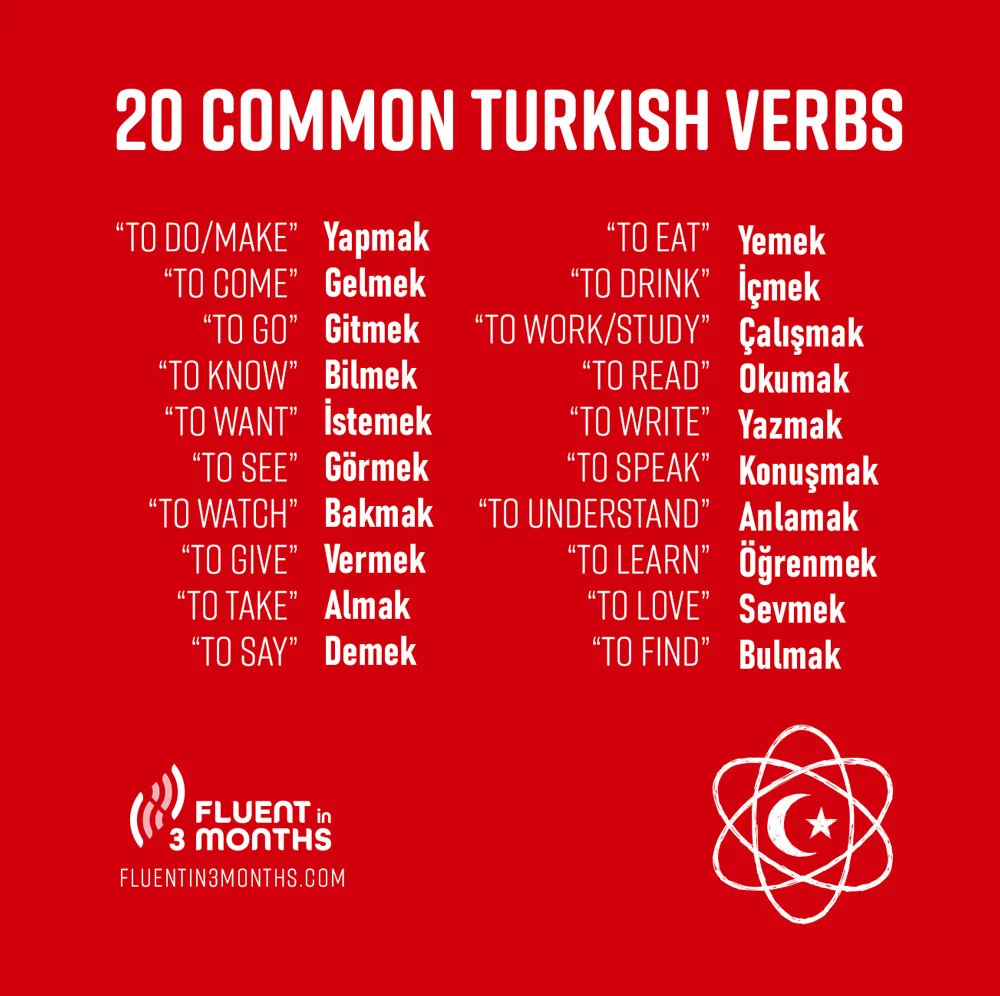
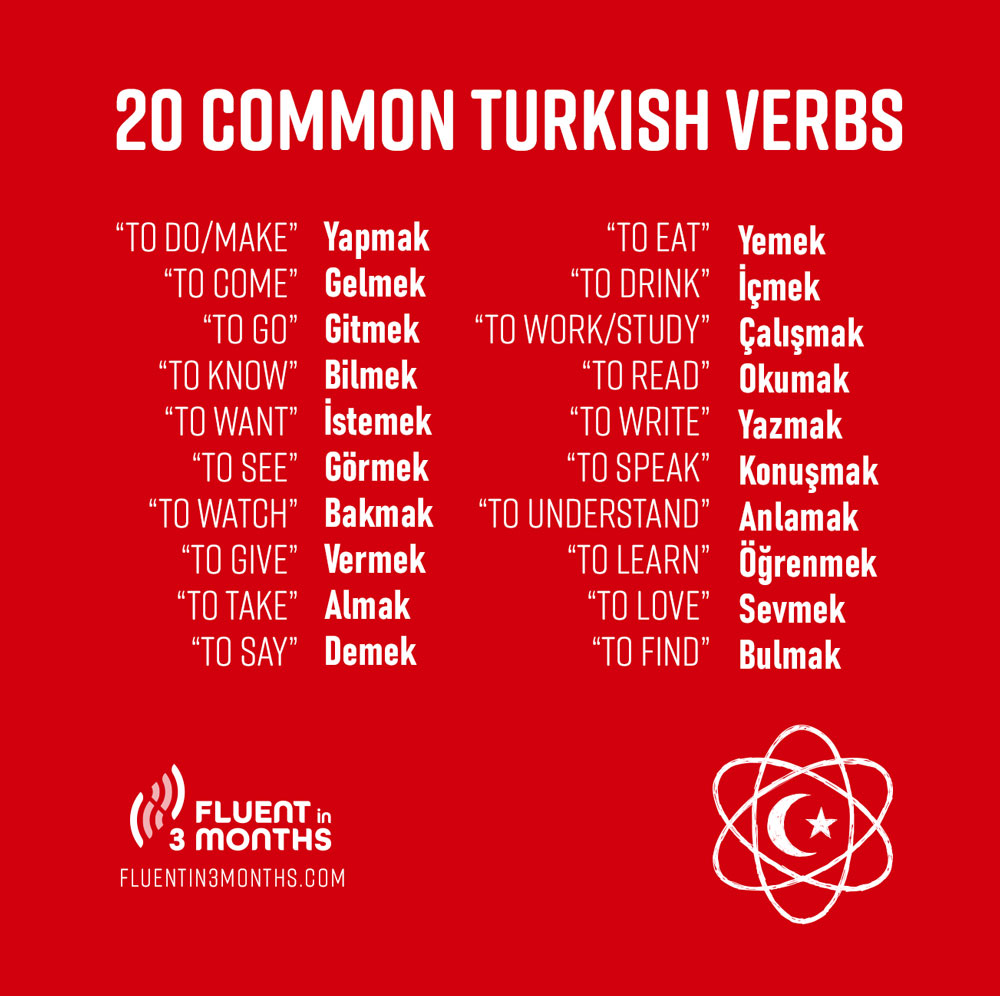
The most common verbs include:
- Yapmak: To do/make
- Gitmek: To go
- Gelmek: To come
- İstemek: To want
- Öğrenmek: To learn
The Suffix System
One of the most distinct features of Turkish is the absence of separate words for "to be" or "to have." These concepts are expressed through suffixes. For example, to say "I am a teacher," one adds the first-person suffix to the noun for teacher: Öğretmen + im = Öğretmenim. Possession is handled similarly; "I have a cat" is expressed as Benim bir kedim var (My one cat exists).
Descriptive Language: Adjectives and Colors
Adjectives in Turkish always precede the noun they modify, similar to English. Common descriptors include Büyük (Big), Küçük (Small), Güzel (Beautiful), and Yeni (New). Interestingly, Turkish has two words for "old": Eski is used for objects, while Yaşlı is used for people.
Color vocabulary is equally straightforward but essential for daily descriptions: Kırmızı (Red), Mavi (Blue), Yeşil (Green), Siyah (Black), and Beyaz (White).
The "Dizi" Influence and Modern Filler Words
The global rise of Turkish television dramas, known as Diziler, has introduced a new wave of learners to the language’s more emotive and colloquial side. According to the Turkish Ministry of Culture and Tourism, Turkey is now the second-highest exporter of TV series worldwide, trailing only the United States. This has led to the international recognition of specific "filler" and endearment words:
- Canım: "My soul" or "My dear," a common term of endearment.
- İnşallah: "God willing," used to express hope for the future.
- Valla: "I swear," used for emphasis.
- Yok artık: "No way," expressing shock or disbelief.
- Tabii ki: "Of course."
These words provide the "flavor" of the language, helping learners move from textbook speech to natural, conversational flow.
Supporting Data and Linguistic Analysis
Linguistic studies by the Foreign Service Institute (FSI) categorize Turkish as a "Category IV" language for English speakers. This means it is significantly more challenging than Romance languages like Spanish or French, requiring approximately 1,100 class hours to reach professional working proficiency.
The challenge lies not in the vocabulary—which is largely phonetic and consistent—but in the "agglutinative" nature of the grammar. However, the consistency of Turkish is its greatest advantage. Unlike English, Turkish has almost no irregular verbs and follows strict rules of vowel harmony, making once-learned patterns highly predictable.
Broader Impact and Implications
The acquisition of Turkish vocabulary serves as more than an academic exercise. Economically, Turkey remains a key member of the G20, and Istanbul continues to grow as a global hub for finance and logistics. Diplomatically, the language is a gateway to understanding the Turkic council nations, including Azerbaijan, Uzbekistan, and Kazakhstan.
For the individual learner, the "building block" approach—starting with high-frequency nouns, polite phrases, and core verbs—reduces the cognitive load of language learning. By focusing on these essential elements, students can engage with the culture more deeply, fostering cross-cultural understanding and opening doors to professional and personal opportunities in the Mediterranean and beyond. In an increasingly interconnected world, the ability to communicate in Turkish is a valuable asset, providing a unique lens into a culture that is both ancient in its traditions and modern in its aspirations.