



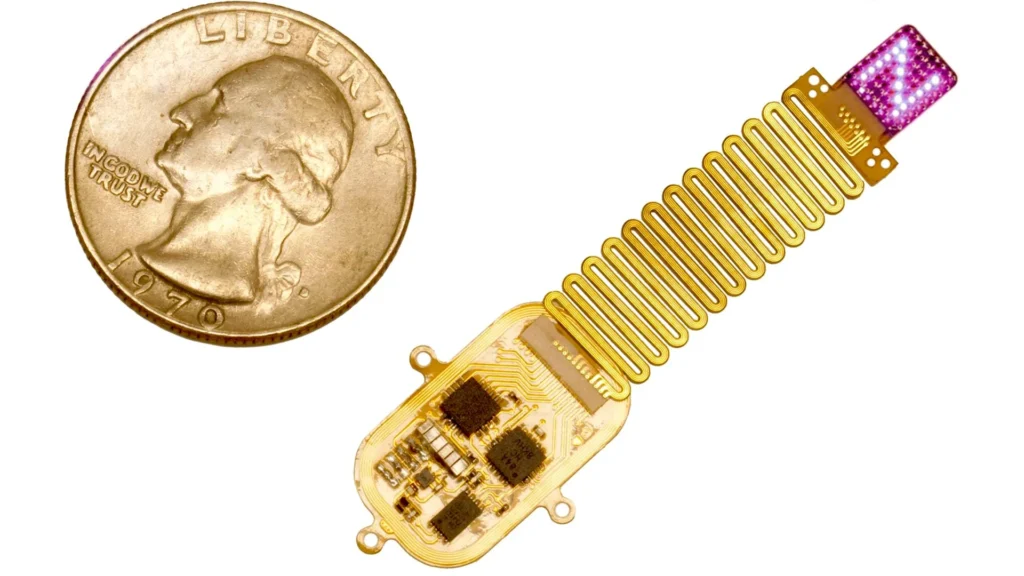
This groundbreaking technology represents a significant leap in the field of neuro-interfacing, offering a novel method to bypass the body’s traditional sensory pathways and deliver precise signals straight to neurons. Developed by a multidisciplinary team, the innovative system, described as soft and flexible, is designed to fit discreetly beneath the scalp, resting gently on the skull. From this non-invasive position, it projects carefully modulated light patterns through the bone, effectively activating specific groups of neurons across the brain’s cortex. This approach marks a crucial departure from more intrusive methods, paving the way for advanced therapeutic and research applications.
Unpacking the Technology: A New Paradigm for Brain-Computer Interface
The core of this breakthrough lies in its ability to create entirely new forms of sensory input for the brain. Unlike traditional brain-computer interfaces (BCIs) that often rely on electrical signals or require direct implantation into brain tissue, Northwestern’s device employs optogenetics, a technique that uses light to control genetically modified neurons. These neurons are engineered to express light-sensitive proteins, typically channelrhodopsins, which open ion channels in response to specific wavelengths of light, thereby exciting or inhibiting neuronal activity.
The device itself is a marvel of bioelectronic engineering. It comprises an array of up to 64 programmable micro-LEDs, each no larger than a single strand of human hair. These miniature light sources are integrated into a soft, conformable polymer substrate that can adapt to the curvature of the skull. The entire system is wirelessly powered and controlled, eliminating the need for bulky external hardware or cumbersome wires that could restrict movement or introduce infection risks. This wireless capability, coupled with its sub-dermal placement, ensures that the device operates seamlessly without any measurable impact on the natural behavior of the subjects. The use of red light is particularly strategic, as this wavelength has superior tissue penetration capabilities, allowing it to reach deeper cortical layers through the skull without significant energy loss or scattering.
Evolution of Optogenetics: From Wires to Wireless Freedom
To truly appreciate the significance of this Northwestern innovation, it’s essential to understand the journey of optogenetics. The field, largely pioneered by scientists like Karl Deisseroth and Edward Boyden at Stanford University in the early 2000s, revolutionized neuroscience by providing unprecedented control over neural circuits. Before optogenetics, researchers primarily relied on electrical stimulation or pharmacological interventions, which lacked the cell-type specificity and temporal precision now achievable with light.
Early optogenetic experiments, however, often involved implanting optical fibers directly into the brain to deliver light. While incredibly powerful for laboratory research, these fiber optic cables were inherently invasive, restricting the movement of animal models and posing challenges for chronic, untethered studies. The quest to overcome these limitations led to the development of wireless optogenetic devices. Northwestern’s team, led by John A. Rogers, a distinguished figure in bioelectronics, had already made significant strides in this area. In 2021, they reported the first fully implantable, programmable, wireless, and battery-free device capable of controlling neurons with light. That earlier system used a single micro-LED probe to influence social behavior in mice, demonstrating the feasibility of untethered optogenetic control and allowing mice to behave normally in complex social environments. The current device represents an exponential leap forward from that initial breakthrough, transitioning from single-point stimulation to a multi-site, high-resolution array.
The Northwestern Legacy in Bioelectronics
Northwestern University has established itself as a global leader in the development of soft, flexible, and transient bioelectronic devices, largely due to the pioneering work of Professor John A. Rogers. His laboratory, based at the Querrey Simpson Institute for Bioelectronics, has consistently pushed the boundaries of materials science and engineering to create electronics that can seamlessly integrate with biological tissues. Rogers’ research focuses on developing high-performance, miniaturized electronic systems that can stretch, bend, and dissolve, making them ideal for biomedical applications where rigid, bulky devices are often problematic.
This new brain interface is a testament to Northwestern’s expertise in this specialized field. The collaboration between Rogers’ engineering prowess and the neurobiological insights of Professor Yevgenia Kozorovitskiy exemplifies the interdisciplinary approach essential for such complex advancements. Their combined expertise has resulted in a device that not only demonstrates cutting-edge materials science but also addresses fundamental questions in neuroscience and offers tangible pathways toward clinical translation. The university’s sustained investment in bioelectronics and neurobiology infrastructure has fostered an environment where such ambitious projects can thrive, attracting top talent like postdoctoral researcher Mingzheng Wu, the study’s first author.
Rigorous Validation in Animal Models
The efficacy and functionality of this novel device were rigorously tested in mouse models. A critical prerequisite for these experiments was the genetic modification of specific neuron populations within the mouse brains, rendering them responsive to light. This involved introducing genes for light-sensitive proteins, ensuring that only the targeted neurons would activate upon receiving the transmitted light patterns.
During a series of meticulously designed experiments, researchers utilized tiny, precisely timed bursts of red light to stimulate these genetically modified neurons, often deep within the cortical layers. The objective was to determine if the animals could interpret these synthetic light patterns as meaningful cues, much like they would interpret natural sensory information. The results were compelling: the mice quickly learned to associate particular light patterns with specific outcomes or rewards. Even in the absence of traditional sensory inputs—such as sound, sight, or touch—the animals successfully used the incoming optogenetic information to make informed decisions and accurately complete complex behavioral tasks. For instance, mice were trained to navigate to a specific port within a testing chamber to receive a reward only when a particular pattern of light stimulation was delivered to their brains. Their consistent success in these tasks provided unequivocal evidence that their brains were not merely reacting to light, but actively interpreting it as information.
Expert Perspectives: Visionaries Behind the Breakthrough
"Our brains are constantly turning electrical activity into experiences, and this technology gives us a way to tap into that process directly," commented Northwestern neurobiologist Yevgenia Kozorovitskiy, who spearheaded the experimental portion of the study. Her insight underscores the profound implications of the device for fundamental neuroscience. "This platform lets us create entirely new signals and see how the brain learns to use them. It brings us just a little bit closer to restoring lost senses after injuries or disease while offering a window into the basic principles that allow us to perceive the world." Kozorovitskiy’s statement highlights the dual utility of the device: as a therapeutic tool for restoring function and as a research instrument for unraveling the mysteries of perception.
John A. Rogers, a leading figure in bioelectronics and the architect behind the technology development, elaborated on the engineering challenges and triumphs. "Developing this device required rethinking how to deliver patterned stimulation to the brain in a format that is both minimally invasive and fully implantable," Rogers explained. "By integrating a soft, conformable array of micro-LEDs—each as small as a single strand of human hair—with a wirelessly powered control module, we created a system that can be programmed in real time while remaining completely beneath the skin, without any measurable effect on natural behaviors of the animals. It represents a significant step forward in building devices that can interface with the brain without the need for burdensome wires or bulky external hardware. It’s valuable both in the immediate term for basic neuroscience research and in the longer term for addressing health challenges in humans." Rogers’ remarks emphasize the engineering elegance and practical advantages of the wireless, flexible design, distinguishing it from previous generations of neural interfaces.
Advancements from Previous Iterations: Scalability and Complexity
The current device significantly extends the capabilities demonstrated in the team’s earlier 2021 publication. While the prior system relied on a single micro-LED probe, the new iteration boasts an array of up to 64 independently programmable micro-LEDs. This dramatic increase in the number of light sources allows for vastly more complex and spatially distributed patterns of neural activation. Each light can be controlled independently in real time, enabling researchers to deliver sequences that more closely resemble the intricate, distributed activity patterns the brain naturally produces during sensory experiences.
"In the first paper, we used a single micro-LED," explained Mingzheng Wu, the study’s first author. "Now we’re using an array of 64 micro-LEDs to control the pattern of cortical activity. The number of patterns we can generate with various combinations of LEDs—frequency, intensity and temporal sequence—is nearly infinite." This scalability is critical because real sensations typically activate broad networks of neurons across multiple brain regions, rather than isolated cells. By mimicking this distributed activity, the multi-site approach of the new device more accurately reflects how the cortex normally functions and processes information, leading to more natural and interpretable brain signals.
Despite this added capability and complexity, the device maintains an impressively compact and non-invasive form factor. It is roughly the size of a postage stamp and thinner than a credit card. Crucially, it avoids the necessity of inserting probes directly into brain tissue. Instead, it gently conforms to the skull surface, transmitting light through the bone. "Red light penetrates tissues quite well," Kozorovitskiy confirmed. "It reaches deep enough to activate neurons through the skull." This less invasive design not only reduces surgical risks but also improves the long-term biocompatibility and stability of the implant, making it a more viable option for chronic applications.
Decoding Artificial Perception: How the Brain Learns
A central question addressed by the research was whether the brain could not only receive these artificial light signals but also learn to interpret them as meaningful information. To evaluate this, the team designed behavioral experiments where mice were trained to associate a particular pattern of optogenetic stimulation with a specific reward. The implant delivered defined light patterns across four cortical regions, essentially "tapping a coded message" directly into the brain.
The mice were presented with various light patterns, and their task was to identify the correct "target" pattern among several alternatives. When they successfully detected the correct artificial signal, they learned to navigate to a designated port within the testing chamber to receive a reward. "By consistently selecting the correct port, the animal showed that it received the message," Wu stated. "They can’t use language to tell us what they sense, so they communicate through their behavior." This behavioral validation is crucial, demonstrating that the light-induced neural activity translated into a conscious, actionable perception for the animals. The brain’s remarkable plasticity and ability to adapt to novel sensory inputs were clearly evident in these learning paradigms.
A Spectrum of Potential Applications: Revolutionizing Medical Care
The potential applications of this wireless, light-based brain interface span a wide range of medical fields, promising to revolutionize how we address neurological disorders and sensory deficits.
One of the most immediate and impactful uses could be in providing sensory feedback for prosthetic limbs. Current advanced prosthetics offer incredible dexterity, but often lack tactile or proprioceptive feedback, making them feel like tools rather than extensions of the body. By delivering artificial signals to the brain that mimic touch, pressure, or limb position, this technology could restore a sense of embodiment and significantly improve the functionality and acceptance of prosthetic devices, potentially even alleviating phantom limb pain.
The device also holds promise for delivering artificial inputs for future hearing or vision prostheses. For individuals with profound hearing loss, cochlear implants convert sound into electrical signals, stimulating the auditory nerve. Similarly, retinal prostheses aim to restore sight by stimulating the optic nerve or retina. This light-based approach could offer a more nuanced and direct way to stimulate the relevant cortical areas, potentially leading to more natural and higher-resolution sensory experiences than currently possible.
Beyond sensory restoration, the technology could facilitate the control of robotic limbs and exoskeletons. By interpreting motor intentions directly from brain signals and providing real-time feedback, individuals with paralysis could regain control over external devices with unprecedented precision and intuition.
Furthermore, the system could significantly improve rehabilitation after injury or stroke. By stimulating specific brain regions involved in motor control or cognitive function, therapists could accelerate neural plasticity and recovery processes. This targeted stimulation could help rewire damaged neural pathways and restore lost functions more effectively.
Finally, the ability to modify pain perception without medications offers a tantalizing prospect for millions suffering from chronic pain. By delivering specific light patterns to modulate neural circuits involved in pain processing, this technology could offer a non-pharmacological, non-addictive alternative to opioids and other pain management strategies, providing targeted relief with fewer side effects.
Broader Implications for Neuroscience Research
Beyond its immediate therapeutic potential, this wireless optogenetic platform serves as an invaluable tool for fundamental neuroscience research. It allows scientists to probe the brain’s intricate workings with unparalleled precision and control. Researchers can now systematically investigate how the brain encodes information, how it learns new associations, and how different neural circuits contribute to perception, decision-making, and behavior.
By generating novel, synthetic sensory experiences, the device provides a unique window into the brain’s plasticity and its capacity to adapt to new forms of input. This could lead to a deeper understanding of sensory processing, memory formation, and the neural basis of consciousness itself. The ability to precisely control distributed neural activity patterns will enable researchers to test hypotheses about brain function that were previously untestable, advancing our knowledge of both healthy brain function and the mechanisms underlying neurological and psychiatric disorders.
Future Trajectory and Remaining Challenges
Now that the team has definitively demonstrated the brain’s capacity to interpret patterned light stimulation as meaningful information, the next phase of research will focus on increasing the complexity and sophistication of these artificial signals. Researchers plan to test how many distinct patterns the brain can reliably learn and differentiate. Future iterations of the device are expected to incorporate an even greater number of LEDs, enabling finer spatial resolution with smaller spacing between light sources. Larger arrays covering more extensive cortical areas and the exploration of different wavelengths of light that penetrate deeper into brain tissue are also on the horizon.
While the progress is remarkable, the path to human application is long and complex. Ethical considerations surrounding brain-interfacing technologies, such as data privacy, potential for enhancement, and informed consent, will be paramount and require careful deliberation by scientists, ethicists, and policymakers. Rigorous long-term safety and efficacy studies in larger animal models, followed by extensive clinical trials, will be necessary before such a device can be considered for human use. However, the foundational work laid by Northwestern University represents a monumental step toward a future where the brain can communicate directly with external technologies, opening up unprecedented possibilities for health, rehabilitation, and our understanding of the mind.
Funding and Collaborative Effort
This pioneering study, titled "Patterned wireless transcranial optogenetics generates artificial perception," underscores the power of collaborative, interdisciplinary research, and received substantial support from a consortium of prestigious institutions and foundations. Key funding sources included the Querrey Simpson Institute for Bioelectronics, the NINDS/BRAIN Initiative, the National Institute of Mental Health, the One Mind Nick LeDeit Rising Star Research Award, the Kavli Exploration Award, the Shaw Family Pioneer Award, the Simons Foundation, the Alfred P. Sloan Foundation, and the Christina Enroth-Cugell and David Cugell Fellowship. This diverse backing highlights the broad recognition of the research’s potential impact across neuroscience, engineering, and clinical medicine.