


Microsoft has officially launched a comprehensive update to its Microsoft Education AI Toolkit, signaling a shift in the academic sector from experimental artificial intelligence pilots to broad-based, responsible implementation. The redesigned resource aims to provide primary schools, districts, and higher education institutions with a structured roadmap for scaling AI technologies while maintaining rigorous standards for security, equity, and pedagogical integrity. This update arrives at a critical juncture for the global education sector, as institutions move beyond the initial "shock" of generative AI toward a phase of operational integration and long-term strategic planning.
The updated toolkit reflects extensive feedback from global education leaders who have spent the past eighteen months navigating the complexities of large language models (LLMs) and automated instructional tools. As institutions transition from individual classroom experiments to department-wide and campus-wide deployments, the need for practical, assignable guidance has become paramount. The toolkit’s new landscape orientation and streamlined five-section layout—Overview, AI Navigators, Plan, Implement, and Research—are designed to facilitate navigation for diverse stakeholders, from IT administrators to curriculum directors.
A Strategic Framework for AI Transformation
The core of the updated Microsoft Education AI Toolkit is built upon three foundational pillars: Student Success, Institutional Innovation, and Simplified/Secure IT. These themes represent the "triple bottom line" of modern educational technology, ensuring that AI adoption serves the learner, the educator, and the infrastructure simultaneously.
In the realm of Student Success, the toolkit emphasizes the transition from passive AI consumption to active, AI-powered support. This includes the deployment of tutoring-style assistants that provide timely feedback and automated assessments. Beyond immediate academic support, the framework focuses on preparing students for an AI-integrated workforce through skills-based pathways and industry-recognized certifications. This proactive approach addresses a growing concern among education leaders regarding the "AI literacy gap," where students must not only know how to use AI but also understand its underlying mechanisms and ethical implications.

Institutional Innovation focuses on the administrative and operational side of education. By leveraging AI-powered insights and automation, universities and districts are modernizing their infrastructure to reduce the "drudgery" of administrative tasks. This allows faculty and staff to focus more on high-value interactions with students. Examples cited in the toolkit include the use of AI to analyze large datasets for student retention and the modernization of faculty workflows to enhance productivity.
The third pillar, Simplify and Secure IT, addresses the most significant barrier to AI adoption: safety and governance. The toolkit provides specific guidance on using tools like Microsoft Security Copilot for threat detection and implementing data governance practices that comply with privacy regulations such as FERPA and GDPR. This ensures that as schools adopt AI, they are not inadvertently compromising the privacy of student and staff data.
Chronology of AI Integration in the Education Sector
The release of this updated toolkit marks a significant milestone in a timeline that began in late 2022. To understand the importance of this release, one must look at the rapid evolution of the educational technology landscape over the past two years.
- Late 2022 – Early 2023: The public release of ChatGPT led to a period of disruption. Many school districts initially moved to ban AI tools due to concerns over plagiarism and data privacy.
- Mid-2023: The conversation shifted from "banning" to "literacy." Microsoft and other tech leaders began releasing initial guidance frameworks, and the first iteration of the AI Toolkit was introduced to help leaders understand the basic capabilities of generative AI.
- Late 2023: Schools began launching small-scale pilots. These were often isolated experiments—one teacher using AI to generate lesson plans or one IT department testing a chatbot.
- 2024: The "Pilot to Impact" phase began. Education leaders realized that isolated experiments were insufficient for institutional change. Demand grew for frameworks that could handle "systemic innovation."
- Early 2025 (Present): Microsoft responds with the current toolkit update, introducing concepts like "AI Sparks" and "Agentic AI" to move institutions toward coordinated, campus-wide transformation.
From Individual Use to Systemic Innovation: AI Sparks
One of the most significant additions to the toolkit is the distinction between "AI Snapshots" and "AI Sparks." While previous guidance focused on individual use cases, the new "Sparks" section is designed to drive department-level and institutional change.
An AI Snapshot might describe how an individual educator uses Microsoft 365 Copilot to create accessible classroom materials. In contrast, an AI Spark demonstrates how a district-wide literacy team can implement "Learning Accelerators" like Reading Coach and Reading Progress across every K-3 classroom. This shift from the individual to the collective allows for more equitable distribution of AI benefits, ensuring that innovative tools are not limited to the classrooms of "tech-savvy" early adopters but are integrated into the foundational curriculum.

In higher education, this systemic approach is exemplified by the transition from an IT specialist using AI for personal coding tasks to an entire department utilizing Microsoft Copilot Studio. By analyzing helpdesk analytics, a department can identify recurring issues and proactively update resources, leading to a measurable reduction in support tickets and improved student satisfaction.
The Rise of Agentic AI and Autonomous Workflows
The updated toolkit introduces the concept of "Agentic AI," a sophisticated evolution of the technology where AI systems move from being simple assistants to more autonomous agents. These tools are capable of handling multi-step tasks, such as routing complex administrative questions or managing intricate workflows, based on institutional design and review.
The toolkit highlights two distinct pathways for implementing agentic AI:
- Microsoft Copilot Studio: A low-code/no-code environment that allows staff members to create custom agents for specific tasks without requiring deep technical expertise.
- Microsoft Azure AI Foundry: A platform for developers and IT professionals to build more sophisticated, custom AI solutions that require deeper integration with existing institutional databases.
A featured case study from the University of Leicester illustrates the potential of this technology. The university implemented an AI-powered digital coach that provided students with on-demand access to information. This implementation not only reduced the workload for administrative staff but also ensured that students received consistent, accurate information at any time of day, bridging the gap between traditional office hours and the needs of a modern student body.
Supporting Data and the Research Foundation
To support the transition from pilot to scale, Microsoft has strengthened the research foundation of the toolkit. As school boards and university regents demand evidence-based justifications for AI investment, the Research section provides curated data to validate implementation strategies.

Recent industry data suggests that the stakes for AI integration are high. According to global surveys of educators, nearly 60% of teachers are already using some form of AI in their work, yet many report a lack of formal guidance from their institutions. Furthermore, data from the World Economic Forum indicates that "AI and big data" is the top priority for skills training in the next five years.
The toolkit’s research section is categorized to help leaders find specific evidence for:
- Learning Outcomes: Studies on how AI tutoring impacts student performance.
- Operational Efficiency: Data on time saved through administrative automation.
- Safety and Ethics: Frameworks for mitigating bias and ensuring transparency in AI models.
By grounding the toolkit in current research, Microsoft aims to help education leaders build stakeholder confidence. This is particularly important when addressing concerns from parents and faculty regarding the "black box" nature of some AI systems.
Global Community and Professional Development
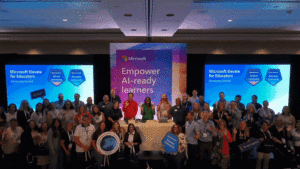
The updated toolkit also emphasizes the human element of technology through "Microsoft Elevate for Educators." This framework merges the Microsoft Showcase Schools and the Microsoft Innovative Educator Expert (MIEE) programs into a unified network. The goal is to create global pathways for leaders to share their AI experiences, troubleshoot challenges, and earn recognition for innovation.
In conjunction with this community focus, the toolkit highlights the "Hour of AI" initiative in partnership with Code.org. Launched in late 2025, this program builds on the "Hour of Code" legacy to promote foundational AI literacy. Using familiar platforms like Minecraft Education, the program introduces students to the mechanics of AI through activities like "Minecraft AI Foundations" and "Generation AI." This ensures that the next generation of learners is not just consuming AI, but understanding the logic and ethics behind the technology.

Broader Impact and Future Implications
The release of the redesigned Microsoft Education AI Toolkit reflects a broader trend in the technology sector: the professionalization of generative AI. As the initial novelty of AI wears off, the focus has shifted toward sustainability, reliability, and accountability.
For the education sector, the implications are profound. Systemic AI adoption has the potential to address long-standing challenges such as teacher burnout, administrative inefficiency, and the need for personalized learning at scale. However, it also presents risks related to the digital divide. If only well-funded institutions have the resources to implement these frameworks, the gap between "AI-rich" and "AI-poor" schools could widen.
Microsoft’s inclusion of no-code tools and action-ready checklists is a clear attempt to democratize access to these high-level strategies. By providing a "roadmap from planning to implementation," the toolkit lowers the barrier to entry for districts that may lack extensive IT departments.
As institutions move forward, the "Action-ready checklists" included in the toolkit will likely become the standard for governance. These checklists turn high-level guidance into assignable tasks, ensuring that when a school says they are "implementing AI," they have covered the necessary bases in security, pedagogy, and equity.
In conclusion, the updated Microsoft Education AI Toolkit is more than a technical manual; it is a strategic manifesto for the future of learning. By moving from "adoption to transformation," Microsoft is positioning itself as a central architect in the redesign of global education. The toolkit’s emphasis on responsible, sustainable, and student-centered AI provides a blueprint for an era where technology does not replace the educator, but rather empowers the entire educational ecosystem to achieve more.