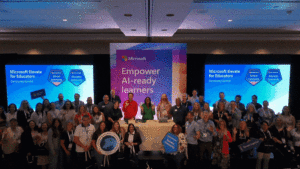



The global education community observed Safer Internet Day 2026 with a renewed focus on the transformative yet complex role of artificial intelligence in the lives of modern learners. This year’s theme, "AI Aware: Safe, Smart, In Control," reflects a pivotal shift in digital citizenship, moving beyond traditional internet safety toward a comprehensive understanding of AI-driven ecosystems. Microsoft Education has emerged as a central partner in this movement, unveiling a suite of resources designed to equip schools, families, and students with the critical thinking skills necessary to navigate an increasingly automated digital landscape.
As AI becomes deeply embedded in everything from personalized learning platforms to social media algorithms, the necessity for AI literacy has moved from an elective skill to a core competency. Safer Internet Day 2026 serves as a global call to action for educational institutions to integrate these competencies into their foundational curricula, ensuring that students are not merely passive users of technology but informed and empowered digital citizens.
The Evolution of Digital Safety: A Contextual Background
Safer Internet Day began in 2004 as an initiative of the EU SafeBorders project and has since expanded to more than 180 countries and territories. Over the last two decades, the focus of the event has evolved in tandem with technological advancements. In the early 2010s, the emphasis was largely on social media etiquette and cyberbullying prevention. By the early 2020s, the focus shifted toward data privacy and the risks of remote learning.
The 2026 iteration marks a significant milestone: the maturity of generative AI in the classroom. Since the explosion of large language models (LLMs) in 2023, educators have grappled with the dualities of AI—its ability to provide personalized tutoring versus its potential to facilitate academic dishonesty or disseminate sophisticated misinformation. The "AI Aware" theme of 2026 represents a formal recognition that the digital world is now permanently AI-shaped, requiring a new framework for safety and ethics.
Core Competencies of the AI-Aware Learner
To be "AI-aware" in 2026 involves more than just knowing how to use a chatbot. According to Microsoft Education’s latest framework, there are three pillars to this new digital literacy:
- Critical Evaluation of AI Outputs: Students must learn to verify information generated by AI, understanding that these systems can "hallucinate" or reflect ingrained biases. This involves cross-referencing AI-generated data with primary sources and recognizing the limitations of machine learning.
- Algorithmic Transparency: Understanding how AI influences online interactions—from the videos recommended on a feed to the search results at the top of a page—is essential for maintaining autonomy. Learners are encouraged to recognize the "persuasive design" elements used to keep users engaged.
- Ethical Interaction and Privacy: As students interact with AI, they must be cognizant of the data they provide. This includes understanding that prompts and personal information may be used to further train models, necessitating a high level of discretion regarding personal and institutional data.
The Microsoft Education Security Toolkit: A New Standard for Schools
Recognizing that individual awareness must be supported by institutional strength, Microsoft has released the updated Education Security Toolkit for 2026. This resource is designed to reframe cybersecurity not as a restrictive barrier, but as the "sustainable foundation" of innovation.

The toolkit provides a roadmap for school IT departments and administrators to secure their digital learning ecosystems. It emphasizes that the "open campus" philosophy—where collaboration and inquiry are prioritized—creates unique vulnerabilities. Educational institutions manage vast repositories of sensitive data, including:
- Personally Identifiable Information (PII) of students and staff.
- Financial records and tuition data.
- Proprietary research and intellectual property.
- Health records and counseling logs.
A single breach can do more than just leak data; it can halt essential services, erode the trust of the community, and cause long-term psychological distress for students. The 2026 toolkit introduces advanced guidance on securing AI deployments, ensuring that as schools adopt new tools, they do so within a framework that protects user privacy and prevents unauthorized access to school networks.
Gamified Safety: Minecraft Education’s CyberSafe Series
One of the most notable developments for Safer Internet Day 2026 is the expansion of the Minecraft Education CyberSafe series. Recognizing that digital citizenship begins at an early age, Microsoft collaborated with experts from the Xbox Trust and Safety team and the Microsoft Digital Safety Unit to create an immersive K-12 curriculum.
The newest module, titled Bad Connection?, is specifically tailored for students aged 11 to 14. This age group is often the most vulnerable as they begin to explore independent online spaces. The game-based learning environment provides a "safe rehearsal space" where students encounter simulated risks, such as:
- Manipulative Interactions: Recognizing "grooming" behaviors or predatory tactics in online gaming and social spaces.
- Suspicious Messaging: Identifying phishing attempts or malicious links disguised as rewards.
- Peer Pressure and Ethics: Navigating the social complexities of digital communication, including the pressure to share inappropriate content or participate in online harassment.
By aligning these lessons with Computer Science Teacher Association (CSTA) and Cyber.org standards, Microsoft ensures that the gameplay has rigorous pedagogical backing. The goal is to normalize conversations about online safety, reducing the stigma that often prevents young people from reporting unsafe interactions to trusted adults.
Data Analysis: The Growing Necessity of Cybersecurity in Education
The urgency of these initiatives is underscored by recent data. In the 2024-2025 academic year, the education sector remained one of the most targeted industries for cyberattacks globally. According to industry reports, ransomware attacks on K-12 and higher education institutions increased by 18% year-over-year. The shift toward AI-powered phishing—where attackers use LLMs to create highly convincing and personalized messages—has made traditional "spot the typo" training obsolete.
Furthermore, a 2025 survey of educators revealed that while 85% of teachers believe AI is essential for future job readiness, only 40% felt they had the resources to teach students how to use it safely. This "readiness gap" is precisely what Safer Internet Day 2026 and Microsoft’s new resources aim to close.

Official Responses and Global Impact
Educational leaders have welcomed the 2026 initiatives. Dr. Elena Rodriguez, a digital literacy advocate and educational consultant, stated, "We are past the point of debating whether AI belongs in schools. The focus now must be on how we empower the next generation to be the masters of these tools rather than their subjects. Microsoft’s focus on ‘AI Awareness’ provides a much-needed vocabulary for this transition."
Microsoft’s leadership has also emphasized the collective responsibility of the tech industry. In a statement regarding the release of the CyberSafe series, Microsoft Education highlighted that "strong security does not restrict innovation; it enables it." The company asserts that by providing free, high-quality resources, they are helping to ensure that the benefits of AI are accessible to all learners, regardless of their school’s budget or location.
A Chronology of Action for Stakeholders
As Safer Internet Day 2026 concludes, the focus shifts to long-term implementation. Microsoft has outlined specific steps for different members of the educational community:
- For School Leaders: The priority is the integration of digital citizenship into the core curriculum, rather than treating it as a once-a-year event. Professional development (PD) sessions are recommended to help staff stay ahead of AI trends.
- For IT and Safety Teams: The focus is on technical "hygiene"—adopting multi-factor authentication (MFA), securing cloud environments, and conducting regular vulnerability assessments as part of a "Zero Trust" security posture.
- For Families: Caregivers are encouraged to use the CyberSafe resources at home, fostering an environment where children feel comfortable discussing their digital lives without fear of losing their device privileges.
Conclusion: Building a Resilient Digital Future
Safer Internet Day 2026 serves as a reminder that the digital landscape is not static. The emergence of AI has brought about a paradigm shift that requires a fundamental rethinking of what it means to be safe online. By combining technical safeguards with robust educational programs, the goal is to create a generation of learners who are not only "AI aware" but are also capable of steering the future of technology toward more ethical and secure horizons.
As institutions adopt the Microsoft Education Security Toolkit and students engage with the CyberSafe series, the focus remains on the ultimate goal: a digital world where curiosity is not stifled by risk, and where every learner has the confidence and control to explore the vast possibilities of the AI-powered age.