



As global tourism to the Hellenic Republic reaches record-breaking heights, with the Greek Ministry of Tourism reporting over 32 million international arrivals in recent fiscal cycles, the demand for linguistic integration has never been higher. While English proficiency is relatively high in major urban centers like Athens and Thessaloniki, the ability to navigate the Greek language remains a cornerstone of successful cultural immersion and logistical ease. Modern Greek, a descendant of the Hellenic branch of the Indo-European language family, carries a 3,500-year history, making it one of the oldest recorded living languages. For the modern traveler, expatriate, or business professional, mastering a core set of phrases is not merely a courtesy but a strategic necessity for navigating the country’s socio-economic landscape.
The Linguistic Landscape of Modern Greece
The transition from Ancient Greek to the "Demotic" or "Dimotiki" Greek spoken today was codified in 1976 when the Greek government officially moved away from the formal "Katharevousa" variant. This shift simplified the language for the general populace but retained the complex phonetic and grammatical structures that define Hellenic identity. Linguistic experts suggest that even a rudimentary grasp of the contemporary lexicon can significantly alter the "Philoxenia"—the traditional Greek concept of hospitality—offered to visitors. Data from travel associations indicate that tourists who utilize basic Greek phrases report a 40% higher satisfaction rate regarding their interpersonal interactions with locals.
Essential Greetings and the Etiquette of Formality
In Greek culture, social hierarchy and familiarity are reflected in the choice of address. The distinction between formal and informal communication is paramount. The phrase "Yassas" (Γεια σας) serves as a versatile greeting used for formal situations or when addressing a group. Conversely, "Ya sou" (Γεια σου) is reserved for friends, family, and informal acquaintances.
Professional communication typically begins with time-specific greetings. "Kalimera" (Καλημέρα), meaning "Good morning," is generally used until midday. As the afternoon progresses, "Kalispera" (Καλησπέρα) becomes the standard for "Good evening." For departures, "Adio" (Αντίο) serves as a formal goodbye, while the more colloquial "Ta leme" (Τα λέμε) translates to "See you later" or "We’ll talk soon." These linguistic markers are essential for establishing rapport in both commercial and social environments.
The Core Lexicon: Affirmations and Social Graces
Navigating daily life in Greece requires a mastery of basic affirmations and polite interjections. A common point of confusion for Western travelers is the word for "Yes," which is "Nai" (Ναι), phonetically similar to the English "Nay" but serving the opposite function. The word for "No" is "Ochi" (Όχι).
Civility in Greece is centered around the phrases "Parakalo" (Παρακαλώ) and "Efcharisto" (Ευχαριστώ). "Parakalo" is a multi-functional term meaning "Please," but it is also used as a response to "Thank you" (meaning "You’re welcome") or as an invitation for someone to speak. "Efcharisto" is the standard expression of gratitude. When errors occur, "Signomi" (Συγγνώμη) is used for "Sorry" or "Excuse me," providing a vital tool for navigating crowded public spaces or correcting social faux pas.
Survival Phrases for Travel and Logistics
The Greek tourism sector contributes approximately 20% to the national GDP, and as such, the infrastructure for travelers is robust. However, in rural areas or the smaller islands of the Cyclades and Dodecanese, English signage may be limited. Understanding logistical inquiries is critical for "Survival Greek."
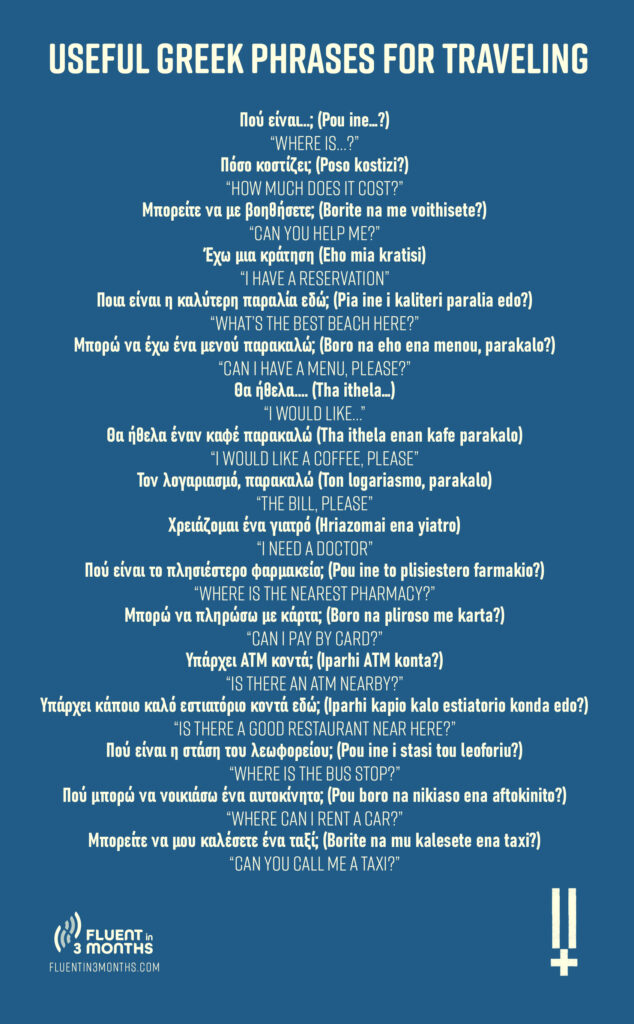
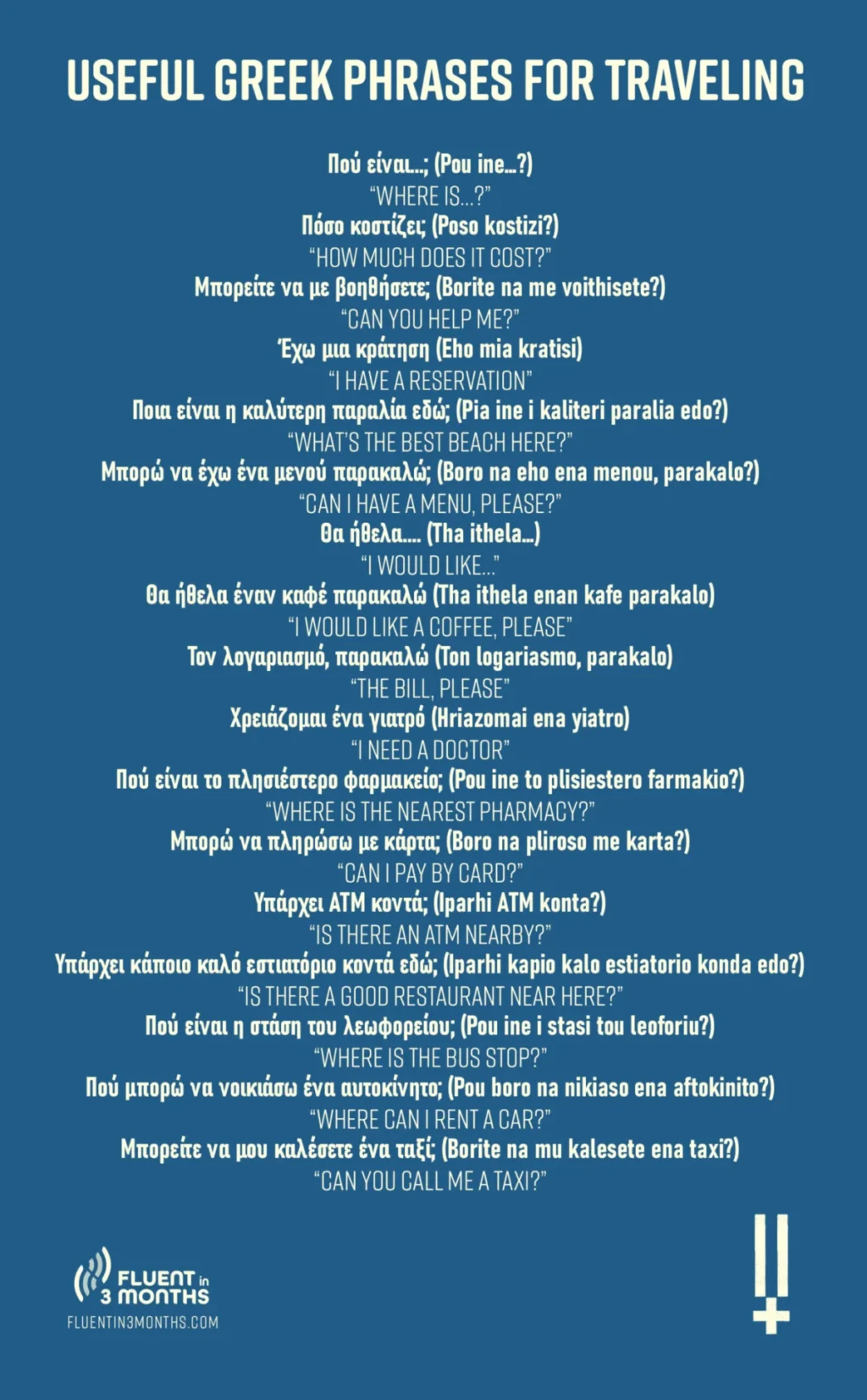
Inquiries regarding location often begin with "Pou ine…?" (Πού είναι…?), meaning "Where is…?". This is frequently followed by "i tualeta" (the bathroom) or "i stasi tou leoforiu" (the bus stop). For those navigating the Greek culinary scene—a major draw for international visitors—knowing how to request "ton logariasmo" (the bill) or asking "Poso kani?" (How much is it?) is essential for financial transactions.
The Greek healthcare system and emergency services also require specific terminology. "Hriazomai ena yiatro" (I need a doctor) and "Pou ine to plisiestero farmakio?" (Where is the nearest pharmacy?) are phrases that can prove lifesaving in remote regions. Furthermore, as Greece continues to modernize its payment systems, the question "Boro na pliroso me karta?" (Can I pay by card?) has become increasingly relevant, despite the traditional Greek preference for cash in smaller "tavernas."
Vernacular and the Social Dynamics of Slang
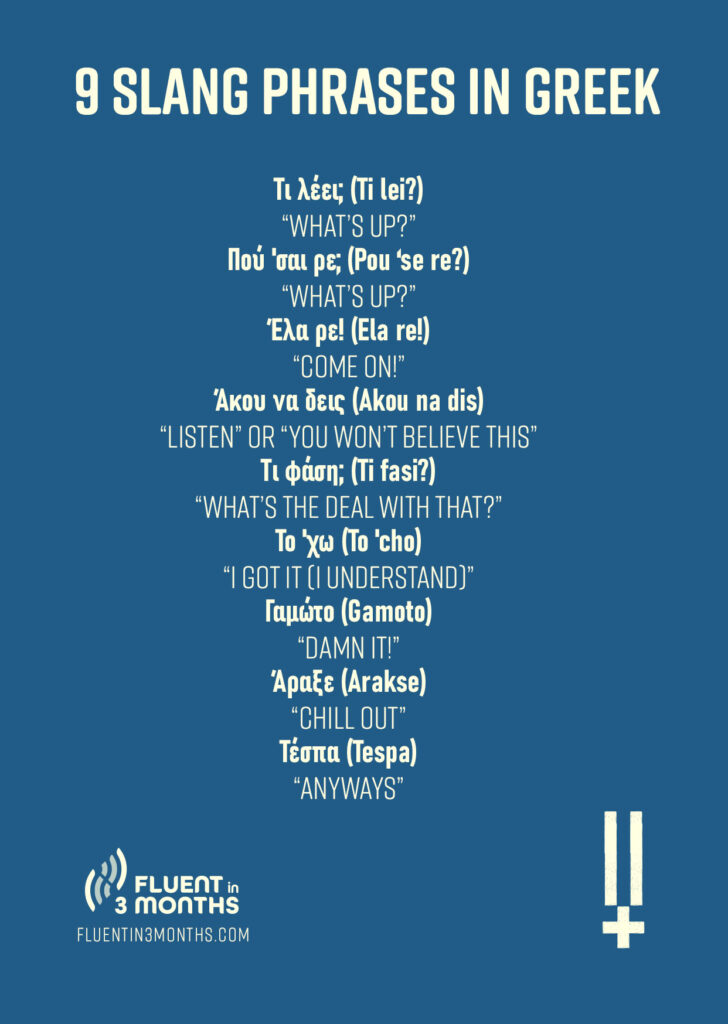
To truly integrate into Greek social circles, one must understand the informal "slang" that permeates daily conversation. Perhaps the most famous—and controversial—term is "malaka" (μαλάκα). While technically a swear word, it is used ubiquitously among friends as a term of endearment or a casual filler, similar to "dude" or "mate" in English. However, linguistic experts warn that its use by foreigners can be misinterpreted if the tone and relationship are not appropriate.
Other informal markers include "Ela re!" (Έλα ρε!), an exclamation of surprise or disbelief similar to "Come on!", and "Ti fasi?" (Τι φάση?), which translates to "What’s the deal?" or "What’s going on?". The phrase "To ‘cho" (Το ‘χω) is a modern contraction meaning "I got it" or "I understand," reflecting the rapid evolution of the language among the youth in urban centers like Exarcheia and Psirri.
The Cultural Weight of Greek Proverbs
Greek communication is often layered with historical and philosophical references. Proverbs, or "paroimies," offer insight into the national psyche. For instance, the phrase "Το ράσο δεν κάνει τον παπά" (The habit does not make the priest) serves as a reminder that appearances can be deceiving—a sentiment rooted in the country’s deep Orthodox Christian heritage.
Another common proverb, "Κάλλιο αργά παρά ποτέ" (Better late than never), reflects a more relaxed Mediterranean approach to time, often referred to as "Greek time." These expressions are not merely linguistic artifacts; they are active components of the Greek worldview, emphasizing resilience, skepticism of surface-level beauty, and the value of patience.
Chronology of Language Evolution and Modern Impact
The timeline of the Greek language is a testament to its endurance:
- 1450 BCE: Earliest records of Mycenaean Greek (Linear B).
- 800 BCE – 300 BCE: The Classical period, giving rise to the works of Homer, Plato, and Aristotle.
- 300 BCE – 600 CE: Koine Greek becomes the lingua franca of the Mediterranean and the language of the New Testament.
- 1821 – 1976: The "Language Question" (Glossiko Zitima) pits Katharevousa (purist) against Dimotiki (popular) Greek.
- 1976 – Present: Dimotiki is established as the official language, leading to the simplified "Monotonic" system of accents in 1982.
In the digital age, the impact of the Greek language is seen in the "Greeklish" phenomenon—the practice of writing Greek using the Latin alphabet in digital communications. While some purists argue this erodes linguistic integrity, it demonstrates the language’s adaptability to global technological trends.
Broader Implications for Global Communicators
For the international community, the study of Greek phrases is an exercise in cognitive flexibility. Because the Greek alphabet differs from the Latin one, learners must engage with new phonetic rules and a three-gender system (masculine, feminine, and neuter). This challenge, however, is met with significant rewards. In the professional sphere, particularly in shipping, tourism, and archaeology—industries where Greece holds a competitive global advantage—linguistic competence is a major asset.
Furthermore, the "Hellenization" of scientific and medical terminology means that English speakers already possess a subconscious vocabulary of Greek roots (e.g., bio, geo, tele). By learning modern phrases, speakers bridge the gap between ancient etymology and contemporary life.
As Greece continues to solidify its position as a top-tier destination for digital nomads and retirees, the integration of these basic linguistic tools will play a pivotal role in social cohesion. The ability to say "Kali tihi" (Good luck) or "Yamas!" (Cheers!) is more than a linguistic feat; it is an act of cultural respect that opens doors to the rich, multifaceted world of the Hellenic people. In an increasingly homogenized global culture, the preservation and use of the Greek language remain a vibrant middle ground between the glory of the past and the dynamism of the future.