



The Greek language, with a history spanning over 3,400 years, remains one of the most influential and emotionally expressive systems of communication in the Western world. Beyond its foundational role in philosophy, science, and literature, Modern Greek possesses a sophisticated lexicon for expressing affection and intimacy. These terms of endearment, ranging from the widely recognized "agapi mou" (my love) to more nuanced diminutive forms, serve as essential tools for social cohesion within Greek-speaking communities. For linguists and language learners alike, mastering these expressions is not merely an exercise in vocabulary but a gateway into the deeply relational nature of Hellenic culture.
The Linguistic Framework of Affection
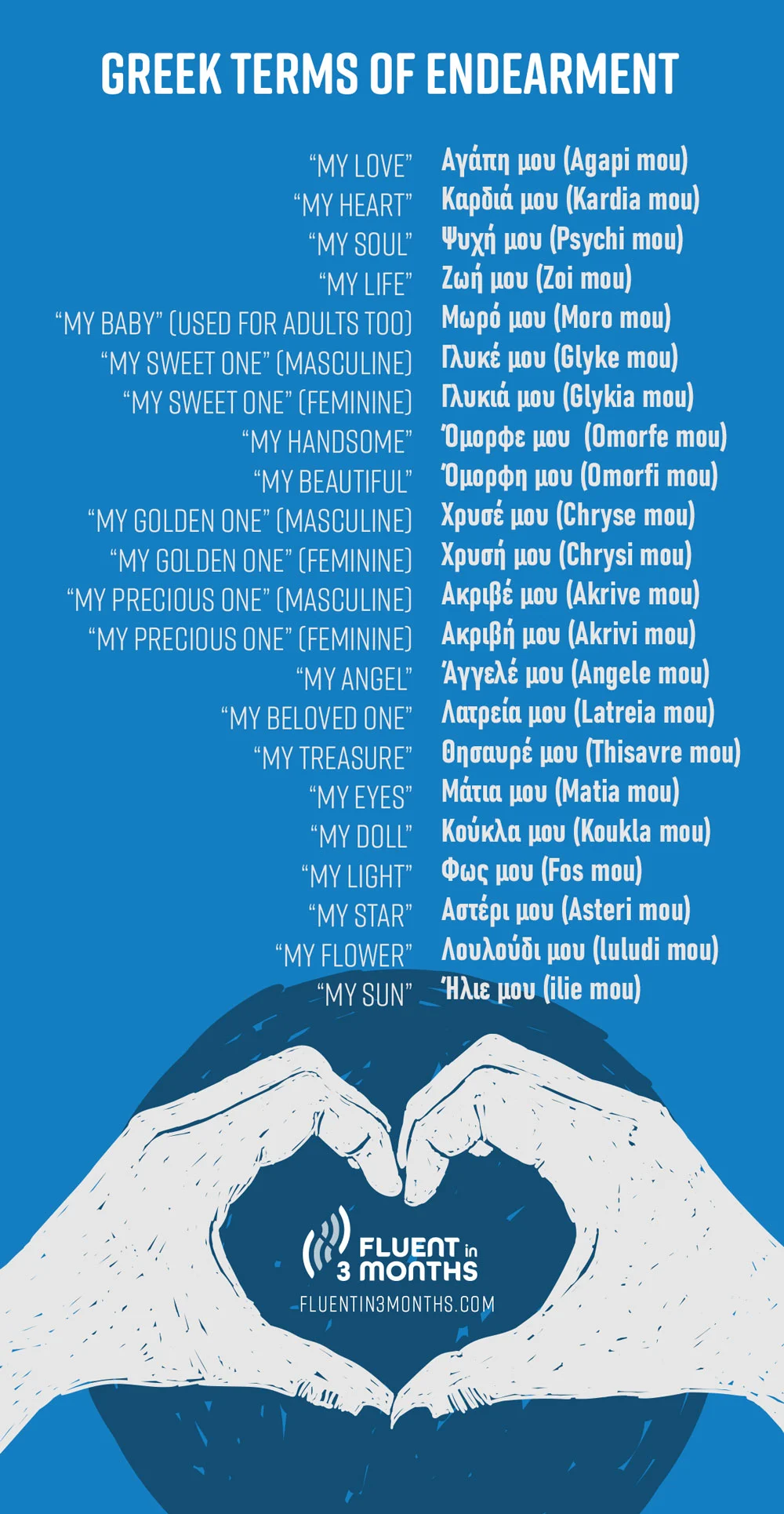
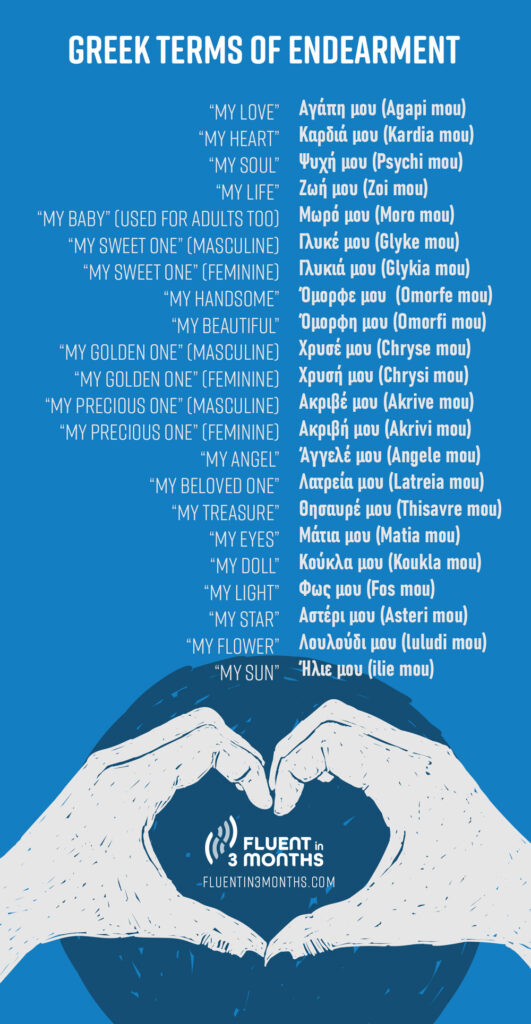
In Modern Greek, terms of endearment are characterized by a specific grammatical structure that emphasizes personal connection. A primary feature is the consistent use of the enclitic possessive pronoun "mou" (μου), meaning "my." Unlike English, where "my" precedes the noun, the Greek "mou" follows it, creating a rhythmic and intimate cadence. For instance, "agapi" (love) becomes "agapi mou" (my love). This structure is applied across various categories of relationship, including romantic, familial, and platonic.
The vocabulary of Greek endearment is often rooted in vitalism, utilizing words for organs and life forces to signify the depth of a bond. Common examples include "kardia mou" (my heart), "psychi mou" (my soul), and "zoi mou" (my life). These terms are not reserved for hyperbolic romantic gestures but are frequently used in everyday interactions, reflecting a cultural tendency toward emotional transparency.
A Chronology of Expression: From Ancient Roots to Modern Suffixes
The evolution of Greek endearments can be traced back to the Homeric and Classical periods, where the concept of love was categorized into distinct philosophical frameworks. The ancient Greeks identified several types of love, which continue to inform modern linguistic choices:
- Eros: Passionate, romantic love.
- Philia: Deep friendship and loyalty.
- Storge: Familial love and the bond between parents and children.
- Agape: Unconditional, selfless love.
- Ludus: Playful, flirtatious love.
- Pragma: Long-standing, enduring love.
- Philautia: Self-love.
- Mania: Obsessive or possessive love.
In the transition from Ancient to Modern Greek, the language developed a highly productive system of diminutives. This linguistic evolution allowed speakers to soften names and nouns, adding a layer of "cuteness" or affection. By adding suffixes such as -aki (-άκι), -itsa (-ίτσα), or -oulis (-ούλης), a standard name or object is transformed into an endearing nickname. This morphological flexibility is a hallmark of the modern tongue, allowing for a level of personalization that many other languages lack.
The Mechanics of Diminutives and Nicknames
The creation of nicknames in Greek follows specific phonetic and gender-based rules. These suffixes act as "endearment markers" that signal closeness.
- For Female Names: The suffixes -aki or -itsa are most prevalent. For example, the name "Eleni" may become "Elenaki," and "Maria" may become "Maritsa."
- For Male Names: The suffixes -akis or -oulis are common. "Yiorgos" (George) is frequently shortened to "Yiorgaki," while "Kostas" might become "Kostoulis."
- For Common Nouns: The diminutive is also applied to objects or general terms of endearment. "Moro" (baby) becomes "moraki," and "poulaki" (little bird) is often used as a term of affection for children.
Linguists note that the use of these diminutives is a form of "social indexing," where the speaker establishes a non-threatening, intimate, and affectionate stance toward the listener.
Categorization of Endearment by Social Context
The application of these terms varies significantly depending on the social setting and the nature of the relationship.
Romantic Contexts
In romantic relationships, terms often focus on beauty and preciousness. "Omorfe mou" (my handsome) and "omorfi mou" (my beautiful) are staples of romantic discourse. More intense expressions include "latreia mou" (my worship/my beloved) and "thisavre mou" (my treasure). The term "moro mou" (my baby) is also ubiquitous among adult couples, mirroring the English "baby" or "babe" but often carrying a more tender connotation in the Greek context.
Familial Bonds
Greek culture is historically and sociologically centered on the family unit (storge). Consequently, familial endearments are rich and varied. Standard titles for parents are often replaced with affectionate versions: "mitera" (mother) becomes "manoula" (mommy), and "pateras" (father) becomes "bambaka" (daddy). Grandparents are almost exclusively referred to by their endearing forms, "yiayia" (grandma) and "pappou" (grandpa), which are themselves considered terms of affection.
Platonic and Social Interactions
In friendship, Greeks use endearments to signal warmth and hospitality. It is common for friends to address one another as "glyke mou" (my sweet one, masculine) or "glykia mou" (my sweet one, feminine). Among younger generations and in informal settings, the term "re" is often used as a particle of familiarity, though it must be used carefully as it can sound abrasive if the relationship is not sufficiently close.
Supporting Data and Global Usage
The Greek language is spoken by approximately 13.5 million people worldwide, with significant populations in Greece, Cyprus, and the global diaspora (including the United States, Australia, Germany, and Canada). According to data from language learning platforms, interest in Modern Greek has seen a steady increase, partly driven by the "Mediterranean lifestyle" trend and a resurgence in heritage language learning among the Greek diaspora.
Surveys of language learners indicate that "terms of endearment" are among the most sought-after categories of vocabulary, as they allow non-native speakers to integrate more effectively into Greek social circles. In Cyprus, where a distinct dialect of Greek is spoken, these terms are used with even higher frequency, often blending standard Greek with local phonetic variations.
Expert Analysis: The Psychological Impact of Endearment
Psycholinguists suggest that the frequent use of endearments in Greek communication contributes to a "high-context" culture, where the emotional tone of an interaction is as important as the literal meaning of the words. Dr. Elena Papadopoulos, a specialist in Hellenic linguistics, notes that "the Greek language is designed for connection. When a speaker uses a term like ‘matia mou’ (my eyes), they are not just using a metaphor; they are placing the listener at the center of their own perception. It is a linguistic act of intimacy."
Furthermore, the use of these terms has been shown to reduce social distance. In a professional or semi-formal setting in Greece, moving from formal address to the use of a diminutive or a term like "paidi mou" (my child, often used by elders for younger people regardless of relation) signals a transition to a relationship based on trust and mutual respect.
Broader Implications and Cultural Preservation
As globalization continues to influence local dialects, the preservation of traditional Greek endearments remains a point of cultural pride. While English loanwords have entered the Greek vocabulary, the core terms of affection remain stubbornly Hellenic. This resilience is seen as a defense mechanism against the homogenization of language, ensuring that the unique "emotional temperature" of Greek life is maintained.
For the international community, understanding these terms provides a more nuanced view of Greek society, moving beyond the stereotypes of "Zorba-esque" exuberance to a more sophisticated understanding of how Greeks build and maintain their most important relationships. Whether it is a mother calling to her "angel" (angele mou) or a friend greeting their "star" (asteri mou), these words are the threads that weave the fabric of Greek social life.
Conclusion
The study of Greek terms of endearment reveals a language that is as much about feeling as it is about meaning. From the grammatical placement of "mou" to the complex history of "agape," these expressions represent a continuous line of human connection stretching from antiquity to the digital age. For anyone seeking to truly understand the Greek people, the journey begins not with a dictionary, but with the heart—or, as they would say in Athens or Nicosia, with "kardia mou."