
The widespread apprehension surrounding artificial intelligence’s potential to decimate the global workforce, once a dominant narrative propagated by some of the technology’s most prominent architects, is undergoing a significant recalibration. Initial pronouncements from influential figures in the AI industry painted a stark picture of impending job displacement, drawing parallels to the industrial revolutions that rendered human brawn obsolete. However, as AI systems mature and their real-world integration progresses, a more nuanced, and notably less dire, understanding of their impact on employment is emerging.
The Genesis of the "Jobs Apocalypse" Narrative
The early 2020s saw a surge in public and expert discourse predicting mass unemployment driven by AI. This era was marked by powerful language from industry leaders who envisioned AI replicating the profound societal shifts brought about by industrial automation. Dario Amodei, CEO of Anthropic, was a notable voice, suggesting on multiple occasions that AI-based tools could automate "half" of entry-level white-collar jobs. This assertion resonated deeply, particularly within sectors traditionally considered safe from automation, such as finance, legal, and administrative roles.
Similarly, Mustafa Suleyman, CEO of Microsoft AI, projected an even more ambitious timeline, predicting in February that AI would achieve "human-level performance on most if not all professional tasks" within a mere twelve to eighteen months. These forecasts, often delivered with an air of inevitability, fueled widespread anxieties about a future workforce hollowed out by intelligent machines capable of performing complex cognitive tasks with unprecedented speed and accuracy. The underlying assumption was that AI, much like machinery replaced manual labor in factories, would systematically replace human intellect in offices, leading to a "jobs apocalypse." Economic models and reports from consulting firms like McKinsey and PwC, while often more cautious, also highlighted a significant percentage of tasks that could be automated, further contributing to the narrative of widespread job loss. For instance, some reports indicated that up to 45% of current work activities could be automated using existing technologies, with AI poised to accelerate this trend.
A Crucial Shift in Perspective
Yet, in a remarkably swift pivot, some of these same AI pioneers have begun to retract or significantly qualify their initial, more alarmist predictions. This evolving discourse signals a maturation in understanding how AI interacts with human labor, moving away from a simplistic automation-as-replacement model.
Just weeks ago, during a conference in Australia, Sam Altman, CEO of OpenAI, expressed his "delight" at being proven wrong about the impending "jobs apocalypse." This statement, from the leader of the company behind ChatGPT, a technology often cited as a prime example of AI’s disruptive potential, marked a significant turning point in the public conversation. Altman’s shift suggests that the initial fears, while understandable, may have oversimplified the complex interplay between advanced technology and human employment.
Concurrently, Dario Amodei has also refined his outlook. He is now articulating a perspective where AI does not outright replace entire jobs but rather supplants significant parts of existing roles. This distinction is critical: instead of eliminating positions, AI is increasingly seen as transforming the nature of work within those positions, changing the daily tasks and responsibilities of employees. This paradigm shift suggests augmentation, where AI assists and enhances human capabilities, rather than pure substitution.
This recalibration is not merely a public relations exercise; it reflects real-world observations and a deeper comprehension of AI’s current capabilities and limitations. Early adopters of AI technologies are discovering that while AI excels at specific, well-defined tasks, the holistic complexity of most professional roles—which often involve intricate problem-solving, nuanced human interaction, ethical judgment, and creative synthesis—remains firmly in the human domain.
The "Quick-and-Dirty Tools" Analogy: Cal Newport’s Insight
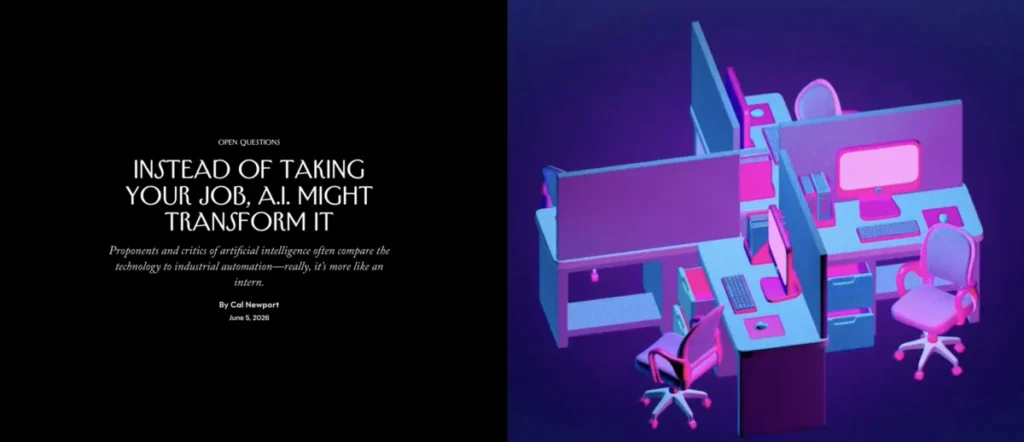
To better understand this evolving dynamic, one must move beyond the industrial automation analogy. Cal Newport, a prominent author and computer science professor, offers a more insightful framework in his recent New Yorker article, "Instead of Taking Your Job, A.I. Might Transform It." Newport suggests that the true impact of AI on knowledge work might be better understood through a different lens: that of bespoke, "quick-and-dirty tools."
Newport draws on a personal anecdote from his high school years, recalling a summer job at a corporate office park. His task involved programming custom, web-based applications for internal use at a management consulting firm. These weren’t polished, enterprise-grade software solutions; rather, they were rapidly developed, utilitarian tools designed to solve specific, often annoying, operational problems. One application streamlined timesheet management, another tracked IT department inventory. These programs, though rudimentary, significantly simplified daily operations for the consultants, making their work more efficient without displacing any personnel.
Applying this historical parallel to the present, Newport recounts his interviews with small business owners who are actively integrating AI into their operations. His findings mirrored his high school experience: these businesses weren’t deploying AI to automate entire departments or eliminate job functions. Instead, they were leveraging AI to "vibe code" – a term he uses to describe the rapid, iterative development of highly customized, often unrefined, tools to simplify various facets of their work. These AI-powered solutions, much like Newport’s teenage creations, were designed to address specific pain points, streamline workflows, and enhance productivity in a targeted manner.
As Newport eloquently articulated, "These examples were not the digital equivalent of a power loom, making large numbers of human jobs superfluous. Turns out, A.I. was assisting these small businesses in roughly the same way that my teen-age self had helped that consulting company—by hacking together whatever was useful." This analogy is potent because it shifts the focus from grand-scale job replacement to pervasive, granular assistance. AI, in this view, becomes a versatile toolkit enabling individuals and small teams to build customized solutions that make their existing efforts "a little deeper" and more effective, rather than rendering them obsolete.
The Emergence of "Freestyle Work"
This model of AI integration gives rise to what Newport refers to as "freestyle work." Freestyle work describes an operational strategy where employees, armed with accessible AI tools, are empowered to rapidly prototype and deploy custom solutions to immediate problems. It stands in contrast to traditional, top-down technology adoption strategies where large, standardized software packages are rolled out across an organization.
In a freestyle work environment, an accountant might use an AI large language model to quickly generate custom report templates or analyze complex datasets for anomalies, rather than waiting for IT to develop a specific software module. A marketing specialist might leverage AI to draft personalized email campaigns or analyze market trends in real-time, tailoring the output to specific client needs without requiring a dedicated data scientist. This approach fosters agility, innovation, and problem-solving at the individual or team level, democratizing access to sophisticated analytical and generative capabilities.
The benefits of freestyle work are manifold:
- Increased Agility: Businesses can respond to challenges and opportunities more quickly.
- Enhanced Problem-Solving: Employees can tackle specific issues that might not warrant a large-scale software development project.
- Personalized Efficiency: Tools are tailored to individual or team needs, maximizing relevance and impact.
- Empowerment: Employees gain agency in shaping their workflows and improving productivity.
This strategy suggests a future where the value of human workers is amplified by their ability to intelligently direct and integrate AI tools, rather than being diminished by AI’s capabilities. It emphasizes human ingenuity in identifying problems and creatively deploying AI to solve them.
Economic Theories and Historical Context
The shift from widespread job displacement predictions to a focus on augmentation aligns with historical economic patterns and established theories regarding technological advancement. The "Luddite fallacy," for instance, refers to the mistaken belief that technological unemployment will lead to permanent joblessness. While new technologies invariably disrupt existing job categories, history shows that they also create new industries, new roles, and often, a net increase in overall employment, albeit with significant shifts in required skills. The agricultural and industrial revolutions, the advent of computers, and the internet all caused significant upheaval but ultimately led to unprecedented economic growth and new forms of employment.
Furthermore, the concept of the "Jevons Paradox" is relevant. This paradox posits that as technological efficiency increases the speed or ease of producing a good or service, the demand for that good or service can increase so much that it leads to an increase in consumption, not a decrease. Applied to labor, if AI makes certain tasks more efficient, it might not reduce the need for human labor but instead enable the completion of more complex projects, expand service offerings, or increase the overall volume of work that can be undertaken, thereby creating new demands for human oversight, creativity, and strategic input.
Economists also differentiate between task-level automation and job-level automation. Current AI excels at automating specific tasks within a job. However, most jobs are a composite of many diverse tasks, some routine, some highly complex, some requiring social intelligence or creative problem-solving. While AI can take over the routine tasks, humans remain essential for the non-routine, higher-order functions, and for integrating the outputs of AI. This "task-based automation" is precisely what Amodei now describes, leading to job transformation rather than elimination.
Supporting Data and Emerging Trends
Recent reports from leading economic bodies corroborate this evolving perspective. The World Economic Forum’s "Future of Jobs Report 2023" indicated that while AI and automation would displace some roles, they are also projected to create a significant number of new jobs, with a net positive outlook in many sectors. The report highlighted a surge in demand for roles such as AI and Machine Learning Specialists, Data Analysts, and Digital Transformation Specialists, alongside a growing need for "human-centric" skills like creativity, analytical thinking, and emotional intelligence.
Data from organizations like the OECD and the Bureau of Labor Statistics (BLS) in various developed economies suggests that while certain sectors are experiencing shifts, widespread technological unemployment has not materialized. Instead, what is observed is a growing demand for skills that complement AI, such as prompt engineering, AI system oversight, ethical AI development, and the ability to interpret and act upon AI-generated insights. Companies adopting AI are reporting productivity gains, improved decision-making, and the ability to innovate faster, rather than simply cutting staff. For example, a 2024 PwC study indicated that companies effectively integrating AI could see a 1.5% to 2% boost in annual GDP growth, largely driven by productivity enhancements.
Implications for the Future Workforce and Education
The implications of this shift from automation to augmentation are profound for the future workforce and educational systems. The emphasis must move away from preparing individuals for specific, static job roles towards cultivating adaptable, lifelong learners capable of navigating a dynamic technological landscape.
Key skills for the AI-augmented future include:
- AI Literacy: Understanding how AI works, its capabilities, and its limitations.
- Critical Thinking and Problem-Solving: The ability to identify complex problems and devise creative solutions, often leveraging AI as a tool.
- Creativity and Innovation: AI can generate ideas, but humans remain essential for novel conceptualization and strategic direction.
- Emotional Intelligence and Collaboration: Many professional tasks require nuanced human interaction, empathy, and effective teamwork.
- Data Interpretation and Ethical Reasoning: Understanding the implications of AI outputs and making responsible decisions.
- Adaptability and Resilience: The capacity to continuously learn new tools and adjust to evolving job requirements.
Educational institutions, from K-12 to higher education and vocational training centers, must adapt their curricula to foster these competencies. This involves not just teaching about AI, but teaching with AI, integrating AI tools into learning processes, and emphasizing interdisciplinary approaches that combine technical skills with humanistic understanding. Corporate training programs will also play a crucial role in reskilling and upskilling existing employees, ensuring they remain relevant and productive in an AI-infused workplace.
Broader Societal and Policy Considerations
The nuanced understanding of AI’s impact also carries significant broader societal and policy considerations. Governments and policymakers must move beyond reactive fear-mongering and engage in proactive strategic planning. This includes:
- Investing in Lifelong Learning: Creating accessible and affordable opportunities for individuals to acquire new skills throughout their careers.
- Developing Robust Social Safety Nets: While mass unemployment may be less likely, job transitions can still be challenging, requiring support for workers in flux.
- Fostering Responsible AI Development: Ensuring ethical guidelines, transparency, and accountability in AI systems to prevent bias and misuse.
- Promoting Equitable Access: Addressing potential disparities in access to AI tools, training, and the new opportunities they create, to avoid exacerbating existing inequalities.
- Rethinking Work Models: Exploring flexible work arrangements and new ways of structuring work that capitalize on human-AI collaboration.
The narrative around AI and employment is indeed becoming "weirder and less dire" than initially predicted. It is a story not of machines replacing humans en masse, but of a sophisticated new set of tools profoundly transforming how humans work. The future of work, it appears, will be defined not by the absence of human labor, but by its intelligent augmentation, leading to deeper engagement, greater efficiency, and potentially, entirely new realms of human endeavor. As Cal Newport concluded in his article, the aim is not to put consultants out of work, but to make their efforts "a little deeper," a sentiment that now seems to encapsulate the evolving consensus among those at the forefront of the AI revolution.