


The resurgence of international tourism in the Mediterranean basin has placed a renewed spotlight on the linguistic barriers and opportunities facing travelers to the Hellenic Republic. As Greece continues to break records in visitor arrivals—surpassing 32 million in recent annual cycles—the demand for accessible language education has shifted from academic fluency toward functional, "survival-based" communication. Understanding the foundational elements of Modern Greek is no longer merely a hobby for philhellenes but a strategic necessity for those navigating the country’s diverse landscape, from the metropolitan bustle of Athens to the remote villages of the Peloponnese.
The Historical and Statistical Context of Modern Greek
To understand the current state of the Greek language, one must acknowledge its unique position in the Indo-European family. Modern Greek (Demotiki) is the result of millennia of evolution, surviving the transition from Ancient Greek through the Koine period and the Byzantine era. According to the Foreign Service Institute (FSI) of the United States Department of State, Greek is classified as a Category IV language for English speakers. This designation implies that it is significantly more difficult to master than Romance languages like Spanish or French, requiring approximately 1,100 hours of class time to reach professional working proficiency.
This difficulty stems largely from a unique 24-letter alphabet and a complex grammatical structure involving three genders and four cases. However, linguistic experts suggest that for the average traveler or expatriate, the mastery of a core "lexical set" of approximately 50 to 100 phrases can bridge the gap between being a passive observer and an active participant in Greek society. Data from language learning platforms indicates a 25% year-over-year increase in users seeking Greek modules, a trend heavily correlated with the "Work from Greece" digital nomad visa programs launched by the Hellenic Ministry of Migration and Asylum.
The Foundational Lexicon: Essential Greetings and Formalities
The entry point for any meaningful interaction in Greece is the greeting. Unlike many Western languages where a single "hello" suffices, Greek social etiquette places a high premium on the distinction between formal and informal addresses. This distinction is rooted in the concept of proskinesis or social deference.
The term "Yassas" (Γεια σας) serves as the formal or plural greeting. It is used when addressing elders, professionals, or groups of people. Conversely, "Ya sou" (Γεια σου) is the informal variant reserved for friends, children, and peers. These phrases are contractions of the phrase "health to you," highlighting the cultural emphasis on well-being.
Supporting data from sociological studies on Greek hospitality—known as philotimo—suggests that even a minimal attempt to use these greetings can significantly alter the quality of service and social reception. Other essential foundational words include "Ne" (Ναι) for yes and "Ochi" (Όχι) for no. For English speakers, "Ne" often presents a phonetic hurdle, as it sounds like the English word "nay" or "no," leading to frequent initial misunderstandings. "Parakalo" (Παρακαλώ), meaning please, and "Efcharisto" (Ευχαριστώ), meaning thank you, complete the basic polite repertoire.
Navigating Daily Life: Commerce and Social Interaction
As the Greek economy continues its post-pandemic recovery, local commerce—particularly in the food and beverage sector—remains the primary theater for language application. The phrase "Poso kani?" (Πόσο κάνει?), meaning "How much is it?", is the standard inquiry for transactions in the traditional laiki agora (open-air markets).
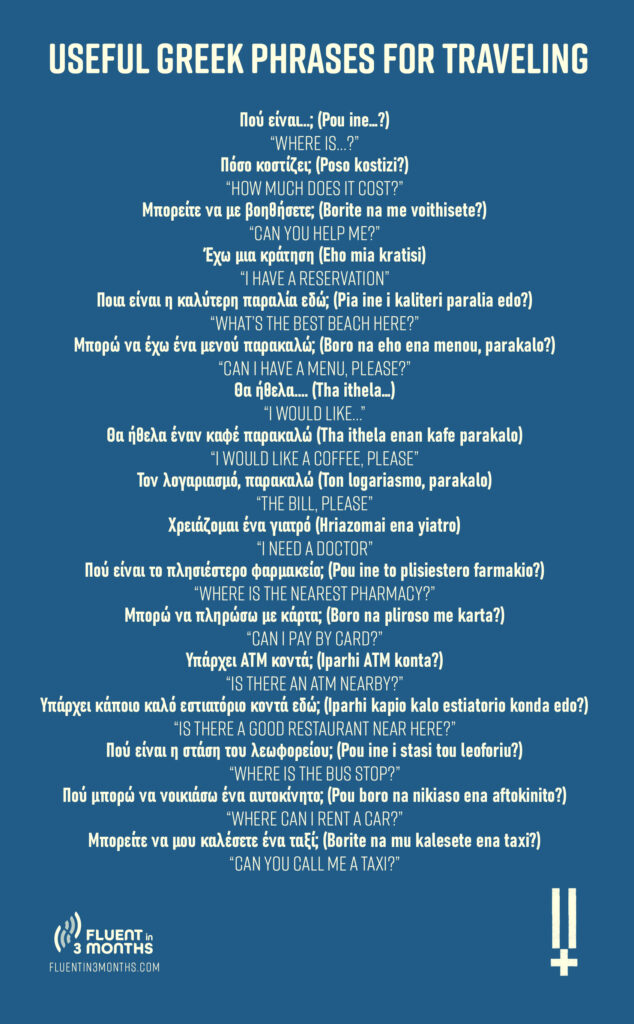
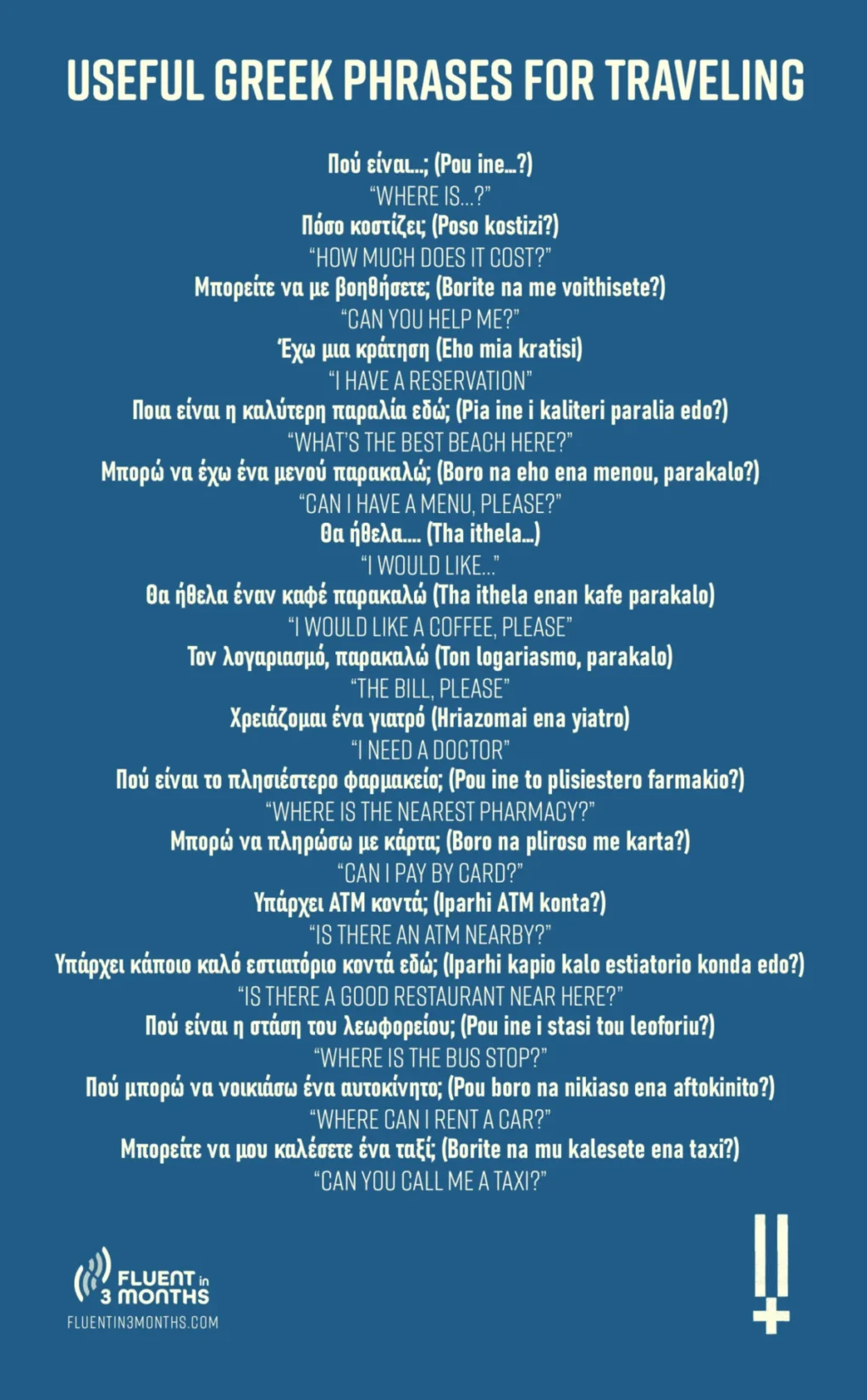
In the context of the Greek dining culture, which contributes nearly 7% to the national GDP, specific phrases carry heavy social weight. "Kali orexi" (Καλή όρεξη), or "enjoy your meal," is an ubiquitous preamble to dining. When the bill is required, the phrase "Ton logariasmo, parakalo" (Τον λογαριασμό, παρακαλώ) is the formal request.
One of the most culturally significant phrases in the Greek social lexicon is "Yamas!" (Γεια μας!), used when drinking. It is a shortened form of "to our health." Unlike the perfunctory "cheers" in English, "Yamas" is often accompanied by direct eye contact, a practice that linguists identify as a key marker of Mediterranean social bonding.
Survival Greek: Strategic Phrases for International Travelers
For the international traveler, linguistic needs often center on logistics and emergency management. The phrase "Pou ine…?" (Πού είναι…?), meaning "Where is…?", is the most critical tool for navigation. Whether seeking the "tualeta" (bathroom), the "stasi tou leoforiu" (bus stop), or the "plisiestero farmakio" (nearest pharmacy), this simple interrogative structure allows for basic spatial orientation.
Economic data indicates that while credit card penetration in Greece has increased significantly due to EU mandates, small-scale vendors in rural areas still prefer cash. Therefore, the question "Boro na pliroso me karta?" (Μπορώ να πληρώσω με κάρτα?), or "Can I pay by card?", is a vital modern addition to the traveler’s toolkit. Furthermore, in the event of medical necessity, "Hriazomai ena yiatro" (Χρειάζομαι ένα γιατρό), meaning "I need a doctor," remains the standard emergency summons.
The Sociolinguistics of Personal Introduction and Identity
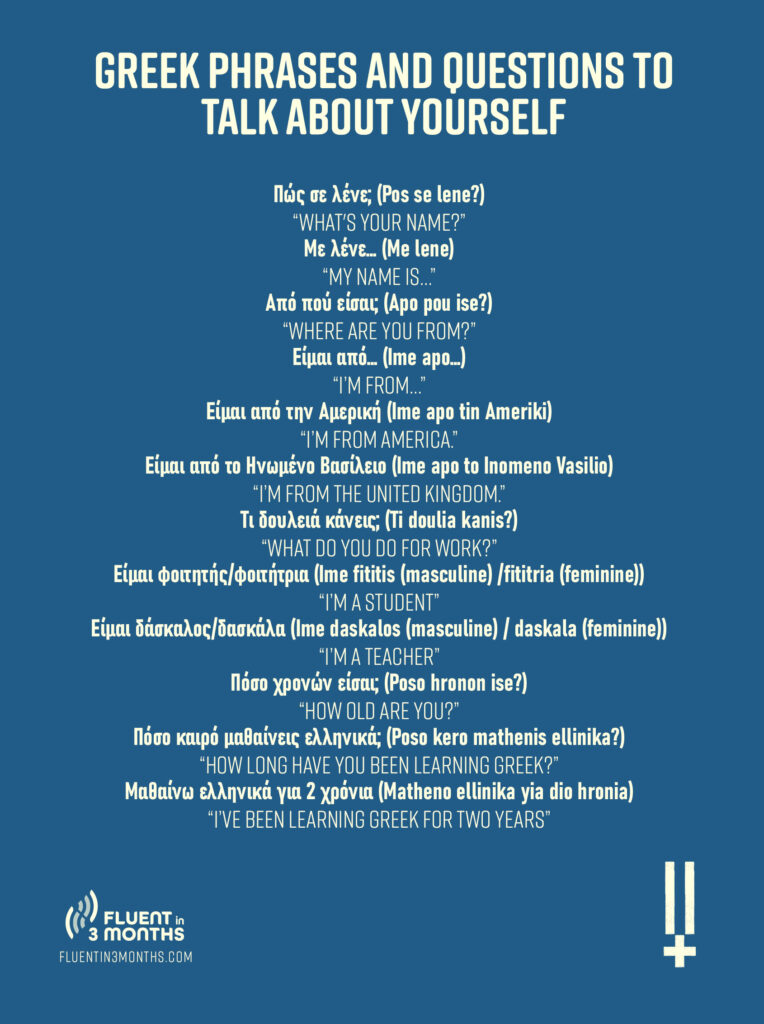
With the rise of the digital nomad culture, interactions are becoming more than just transactional. The ability to introduce oneself—"Me lene…" (Με λένε…)—and state one’s origin—"Ime apo…" (Είμαι από…)—is essential for the burgeoning community of long-term residents.
Linguistic analysis of these introductory phrases reveals the gendered nature of the Greek language. For example, a male student identifies as "fititis," while a female student is "fititria." This binary extends to most professions, such as "daskalos" and "daskala" for teachers. Understanding these suffixes is a key step toward the intermediate level of language acquisition, reflecting a deeper engagement with the internal logic of Greek grammar.
The Nuances of Informal Vernacular and Modern Slang
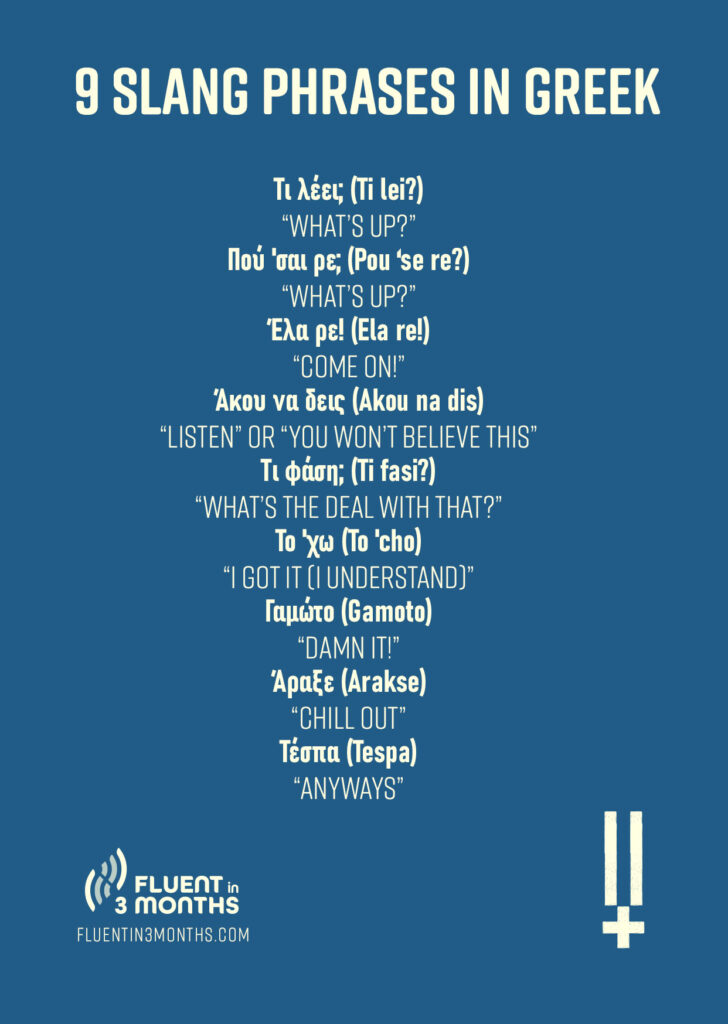
A significant aspect of contemporary Greek communication is the use of slang, which often bypasses the rigid rules of formal grammar. The word "Malaka" (μαλάκα) is perhaps the most famous example. While technically a profanity, its usage has evolved into a versatile filler word among friends, similar to "dude" or "mate" in English. However, sociolinguists warn that its misapplication in formal settings can lead to severe social friction.
Other informal phrases like "Ela re!" (Έλα ρε!), which translates roughly to "Come on!" or "No way!", and "Ti fasi?" (Τι φάση?), meaning "What’s the deal?", reflect the energetic and emotive nature of modern Greek discourse. These phrases are highly dependent on tone and context, serving as linguistic "shorthand" in the urban centers of Athens and Thessaloniki.
Philosophical Underpinnings: Analyzing Traditional Greek Proverbs
To truly grasp the Greek worldview, one must look toward its proverbs. These idiomatic expressions offer a window into the national psyche, which has been shaped by centuries of resilience and philosophical inquiry.
- "Kathe empodio gia kalo" (Κάθε εμπόδιο για καλό): Translating to "Every obstacle is for the best," this proverb reflects a stoic optimism deeply rooted in the Greek character. It is frequently used in business and personal setbacks to encourage perseverance.
- "I kali mera apo to proi fenetai" (Η καλή μέρα από το πρωί φαίνεται): Meaning "A good day is visible from the morning," this suggests that the beginning of an endeavor dictates its outcome.
- "Oson zeis, matheneis" (Όσον ζεις, μαθαίνεις): "As long as you live, you learn." This emphasizes the value of lifelong education, a core tenet of Greek culture since the classical era.
- "Kallio arga para pote" (Κάλλιο αργά παρά ποτέ): The Greek equivalent of "Better late than never," used commonly in social and professional contexts.
- "Ta polla logia einai ftochia" (Τα πολλά λόγια είναι φτώχεια): Translating to "Many words are poverty," this proverb ironically encourages brevity and action over excessive rhetoric.
Broader Implications: Language as a Catalyst for Sustainable Tourism
The Hellenic Ministry of Tourism has recently emphasized "quality over quantity," seeking to attract visitors who engage more deeply with local culture. Language is the primary vehicle for this engagement. When travelers move beyond English, they contribute to the preservation of local traditions and the decentralization of tourism. By being able to communicate in smaller villages, visitors can support local economies that are often bypassed by major tour operators.
Furthermore, the psychological impact of language attempts cannot be overstated. "Philoxenia," the ancient Greek concept of hospitality toward strangers, is often "unlocked" when a guest demonstrates respect for the local tongue. This creates a feedback loop of positive reinforcement that enhances the travel experience and fosters international goodwill.
In conclusion, while the Greek language presents a formidable challenge to the uninitiated, the rewards of mastering even a basic set of phrases are substantial. As Greece navigates its role in the 21st-century global economy, the bridge between its ancient heritage and its modern reality is built upon these daily exchanges. For the traveler, student, or professional, these phrases are not merely words; they are the keys to a deeper, more authentic experience in the cradle of Western civilization. Through continued practice and a willingness to embrace the inevitable errors of learning, the contemporary speaker can find a voice within the vibrant, enduring tapestry of the Greek language.