


A recent report from an AI Task Force convened by the prestigious journal Organization Science has cast a stark light on the evolving landscape of academic publishing, revealing a concerning paradox: the proliferation of generative artificial intelligence tools, while ostensibly designed to enhance productivity, appears to be correlating with a decline in research paper quality and readability. This phenomenon, which began manifesting prominently in 2023 following the widespread availability of AI platforms like ChatGPT, poses significant challenges for the integrity of scholarly communication and the sustainability of the peer-review system.
The Shifting Tides of Academic Submissions
The alarm was first raised by seasoned editors and reviewers who observed a subtle yet pervasive change in incoming manuscripts. Described as a "particular feel that is hard to pin down," the writing in many submissions seemed "weightless," lacking the depth, precision, and intellectual rigor traditionally expected in academic prose. Despite surface-level adherence to structural norms, the underlying meaning often proved elusive, leaving reviewers and editors scratching their heads. This qualitative observation prompted Organization Science to establish an AI Task Force dedicated to quantifying and understanding this perceived shift.
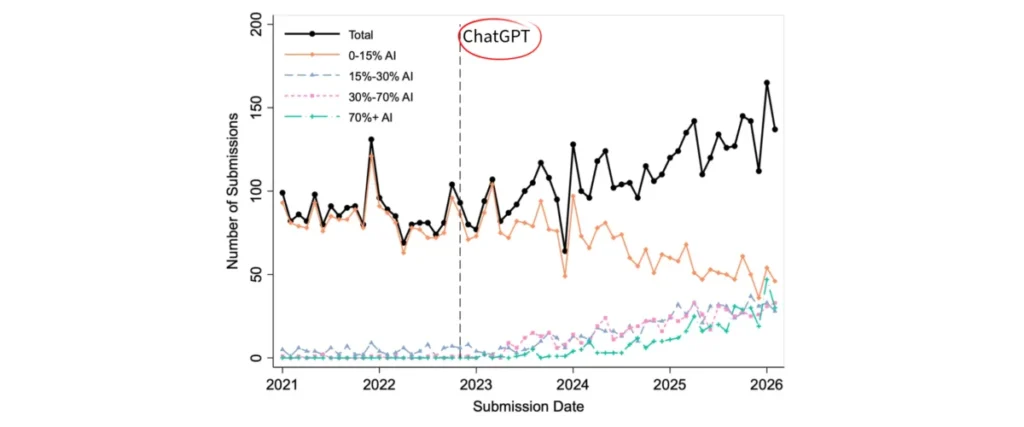
The task force’s subsequent investigation produced compelling statistical evidence. Their analysis revealed a sharp increase in submission volume to Organization Science starting in 2023, coinciding directly with the public launch of ChatGPT. While the exact percentage increase was not publicly detailed, internal data suggested a surge that placed an immediate strain on editorial processes. More critically, the percentage of submissions classified as utilizing minimal AI plummeted dramatically during the same period. Prior to 2023, nearly 100% of submissions were assessed as having minimal AI involvement. By early 2024, this figure had dropped closer to 30%, indicating a widespread and rapid adoption of AI tools in manuscript preparation across the research community.
Declining Readability and the Paradox of AI-Generated Text
One of the most striking findings concerned the measurable decline in readability. Utilizing a standard "reading ease" metric, the task force tracked scores of submitted manuscripts, observing a significant drop of 1.28 standard deviations between January 2021 and January 2026. This metric, often based on factors such as average sentence length and the number of syllables per word (like the Flesch-Kincaid scale), objectively quantifies how easy a text is to comprehend. The implication was clear: academic submissions had become demonstrably harder to read and process.
This finding challenges a common assumption that AI-generated text is inherently "cleaner" or "more polished." While AI can indeed produce grammatically correct and stylistically consistent prose, the task force elaborated that "on the measures that capture whether a reader can actually parse and absorb the prose, AI writing is worse." The AI-assisted papers tended to employ "longer words, more complex sentence structures, more jargon, and more nominalizations." This suggests that while AI excels at generating syntactically correct sentences, it often lacks the nuanced understanding of context, conceptual clarity, and economy of expression that characterizes truly effective academic writing. The result is often verbose, convoluted text that obscures rather than illuminates the underlying research.
Quality Control Under Strain: Desk Rejections and Acceptance Rates
The implications of this shift extended beyond mere readability to the fundamental quality of the research itself. The journal’s editorial process, which relies on rigorous peer review, faced an unprecedented challenge. Organization Science reported a significantly higher desk-rejection rate for manuscripts identified as making heavy use of AI. Approximately 70% of high-AI papers were rejected at the desk stage, meaning they were deemed unsuitable for peer review and returned to the authors without further evaluation. This contrasts sharply with the 44% desk-rejection rate for papers written with minimal or no AI assistance.
For those papers that did advance beyond the desk-rejection stage, the disparity in ultimate acceptance rates was even more pronounced. Only a meager 3.2% of high-AI papers were eventually accepted for publication, compared to a substantially higher 12% of low-AI papers. It is crucial to note that these assessments were made retrospectively; the editors responsible for making desk-rejection and acceptance decisions were not aware of the level of AI involvement in the papers at the time of their evaluation. This blind assessment underscores the objective nature of the observed quality differences, suggesting that the issues are inherent to the manuscripts themselves, irrespective of their AI provenance.
A Chronology of Disruption and Discovery
The timeline of these developments paints a clear picture of rapid change within the academic ecosystem:
- Pre-2022: Academic writing, while challenging, followed established norms. Researchers grappled with complex ideas, honed their arguments, and meticulously crafted their prose, often through multiple drafts and human feedback. The peer-review system, though imperfect, functioned as the primary gatekeeper of quality.
- Late 2022: OpenAI’s ChatGPT is publicly released, quickly gaining widespread attention for its ability to generate human-like text across various domains. Researchers, facing intense pressure to publish, begin exploring its potential for drafting, summarizing, and even generating sections of manuscripts.
- Early 2023: Organization Science editors and reviewers begin to notice an uptick in submission volume and a subtle, indefinable shift in the quality and style of writing in many papers. Initial discussions circulate among editorial boards about this emerging trend.
- Mid-2023: The observations become more consistent and widespread. The "weightless" prose and difficulty in discerning meaning become a recurrent theme in editorial discussions. The journal formally convenes an AI Task Force to investigate these anecdotal reports with empirical data.
- Late 2023 – Early 2024: The AI Task Force gathers data, analyzing submission volumes, AI usage patterns (retrospectively identified through various linguistic and stylistic markers), readability scores, and editorial decisions (desk rejections, acceptance rates). The correlations become strikingly clear.
- Mid-2024: The Task Force finalizes its report, presenting a comprehensive, data-driven assessment of AI’s impact on submission quality at Organization Science, confirming the initial qualitative observations with hard numbers.
Voices from the Academic Community: Reactions and Concerns
The findings from Organization Science resonate deeply within the broader academic community, prompting a wave of concern and introspection. Journal editors, academic institutions, and researchers themselves are grappling with the implications.
Dr. Eleanor Vance, Editor-in-Chief of a leading humanities journal (not Organization Science), commented on the findings, stating, "This report validates many of the anecdotal experiences we’ve been sharing amongst ourselves. The sheer volume of submissions has indeed increased, but the intellectual ‘signal-to-noise’ ratio seems to have diminished. The burden on our reviewers, who volunteer their time, is becoming unsustainable as they wade through papers that lack original thought or clear argumentation."
From the perspective of academic integrity, Professor Alistair Finch, Dean of Research Ethics at a major European university, emphasized the need for clear institutional guidelines. "Our role is to foster original scholarship and critical thinking. While AI can be a powerful assistant, it must not become a substitute for the hard intellectual work that defines research. We are currently developing updated policies to guide our faculty and students on the ethical and responsible use of generative AI in all stages of the research and publication process, stressing that the ultimate intellectual responsibility always rests with the human author."
Some researchers, particularly early-career academics facing immense pressure to publish, acknowledge the temptation to use AI for efficiency. Dr. Maya Sharma, a postdoctoral researcher in social sciences, shared her perspective: "AI tools can be incredibly helpful for overcoming writer’s block, rephrasing sentences, or even structuring an initial draft, especially for non-native English speakers. However, the report highlights a critical distinction: using AI as a sophisticated editing tool is very different from delegating the core intellectual work of synthesizing ideas and crafting arguments. There’s a fine line, and it seems many are crossing it inadvertently."
Conversely, critics voice concerns about the potential for deskilling and intellectual laziness. Dr. Chen Li, a veteran professor of management studies, expressed skepticism: "The essence of academic writing is the struggle to articulate complex thoughts precisely. It’s in that struggle that clarity emerges and ideas are refined. If we bypass that cognitive effort with AI, we risk producing generations of scholars who are proficient at generating text but less capable of generating original thought. This isn’t just about publication numbers; it’s about the future of critical inquiry."
Broader Implications and the Future of Scholarship
The findings from Organization Science extend far beyond a single journal, serving as a cautionary tale for the entire academic publishing ecosystem. The implications are multifaceted:
- Sustainability of Peer Review: The increased volume of lower-quality submissions places an unprecedented strain on the volunteer peer-review system. Reviewer fatigue and burnout are significant concerns, potentially leading to longer review times, a shortage of willing reviewers, and even a decline in the quality of reviews themselves.
- Erosion of Trust: If the academic literature becomes increasingly saturated with superficially coherent but substantively weak papers, the overall credibility and trustworthiness of published research could be undermined. This has profound implications for public trust in science and evidence-based decision-making.
- The "Faster vs. Better" Conundrum: The report vividly illustrates that making tasks "faster" or "easier" does not equate to making them "better," especially in intellectually demanding fields. The very friction and cognitive effort involved in academic writing are integral to the process of developing clear, rigorous arguments.
- Need for Detection and Education: The academic community faces an urgent need to develop more sophisticated tools for detecting AI-generated content, though the efficacy and ethical implications of such tools are still debated. More importantly, there is a critical need for comprehensive education for researchers on the ethical, effective, and responsible use of AI, emphasizing that AI should augment, not replace, human intellect.
- Rethinking Academic Training: Universities and research institutions may need to re-evaluate how they train future scholars, placing renewed emphasis on original thought, critical analysis, and the fundamental skills of scholarly writing, ensuring that AI is understood as a tool to be mastered, not a shortcut to be exploited.
- Evolving Publishing Policies: Publishers and journals will need to continue refining their policies regarding AI usage, moving beyond simple declarations to more nuanced guidelines that address attribution, transparency, and the potential for AI-induced plagiarism or intellectual dilution.
In conclusion, the Organization Science report serves as a crucial wake-up call for the academic world. While generative AI holds immense promise for enhancing various aspects of research, its uncritical and widespread adoption in manuscript generation appears to be introducing significant challenges to the quality, readability, and integrity of scholarly output. The core message is clear: there are no true shortcuts to the rigorous, time-intensive process of producing high-quality academic research. The future of scholarship hinges on the academic community’s ability to navigate this technological disruption wisely, safeguarding the foundational principles of intellectual rigor and genuine contribution that define academic excellence.