

Microsoft has unveiled a comprehensive suite of new artificial intelligence tools and training initiatives designed to pivot the role of generative technology in the classroom from a mere productivity aid to a sophisticated pedagogical partner. According to the company’s latest "AI in Education Special Report," released in 2026, the integration of AI within academic environments has reached a critical mass, with 92% of students and education leaders and 88% of educators reporting active use of AI for school-related tasks. However, as the novelty of these tools transitions into standard practice, the technological giant is shifting its focus toward ensuring that AI supports deep learning and critical thinking rather than simply facilitating the rapid completion of assignments.
The announcement marks a significant milestone in the evolution of educational technology, moving beyond the experimental phase that characterized the early 2020s. The new capabilities, integrated directly into Microsoft 365 Education, are built upon the principles of learning science and are intended to provide secure, student-centered experiences. This rollout comes at a time when the demand for formal guidance is surging; the report indicates that 66% of educators and 52% of students are seeking monthly or quarterly training to navigate the complexities of AI responsibly.
A Chronology of AI Integration in the Classroom
The journey toward the current state of AI in education has been marked by rapid shifts in policy and perception. In late 2022 and throughout 2023, the emergence of large language models (LLMs) initially triggered a wave of concern among academic institutions, leading to widespread bans in several major school districts due to fears of plagiarism and the erosion of critical thinking skills.
By 2024, the narrative began to shift toward "AI literacy," as educators realized that students would require these skills for the future workforce. This period saw the development of the first institutional frameworks for responsible use. In 2025, technology providers began embedding AI directly into productivity software, making it a background feature of daily academic life. The 2026 Microsoft report confirms that we have entered a "second wave" of integration, where the focus is no longer on access to AI, but on the quality of the interaction and the measurable impact on learning outcomes.

From Answer Engines to Interactive Learning Coaches
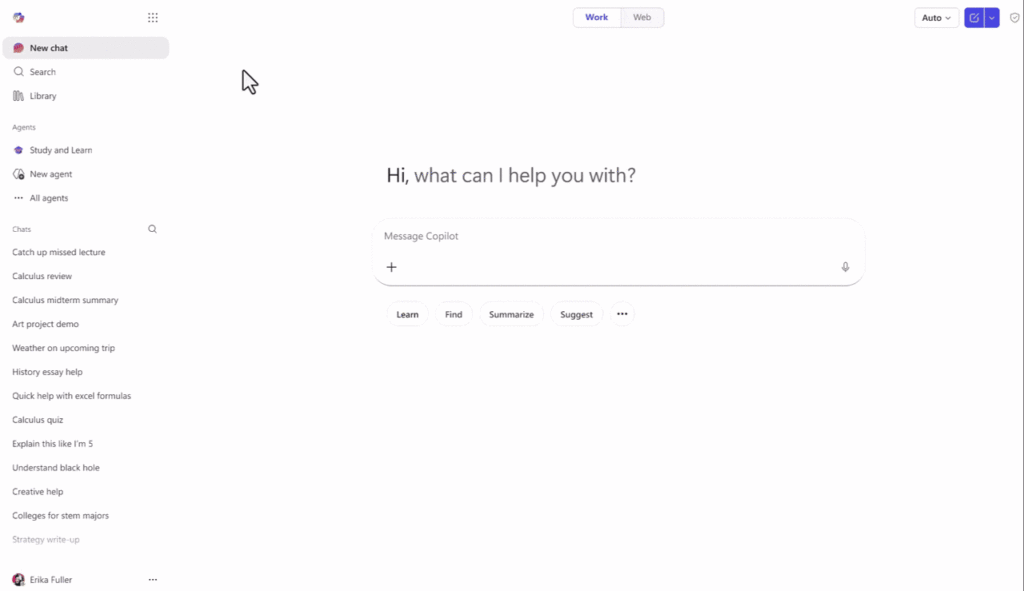
The centerpiece of Microsoft’s latest update is the "Study and Learn Agent," a specialized experience within Copilot Chat designed for students aged 13 and older. Unlike standard chatbots that frequently provide direct answers to queries, the Study and Learn Agent is optimized to function as an interactive coach. It utilizes research-based "scaffolding" techniques—a pedagogical method where the instructor (or in this case, the AI) provides temporary support to help students reach a higher level of understanding.
The agent encourages independent thought by asking leading questions, offering interactive practice through flashcards and quizzes, and providing immediate feedback on student work. This approach is designed to ensure that the student remains the primary driver of the cognitive process. For example, rather than writing an essay for a student, the agent might analyze a student’s draft and suggest areas where the argument could be strengthened or where more evidence is required.
In addition to the coaching agent, Microsoft has launched "Copilot Notebooks." This tool allows students to create an AI-powered workspace grounded specifically in their own course materials, such as lecture slides, handouts, and personal notes. By restricting the AI’s data source to these specific documents, the tool minimizes the risk of "hallucinations" (the generation of false information) and ensures that the assistance provided is directly relevant to the student’s specific curriculum.
Data-Driven Insights: The Global Demand for Training
The Microsoft AI in Education Special Report provides a granular look at the state of technology in schools today. The study, conducted by PSB Insights, surveyed 3,345 respondents across six diverse markets: the United States, the United Kingdom, Australia, Brazil, Japan, and Saudi Arabia. The findings highlight a significant gap between the usage of AI and the formal support available to those using it.
Key data points from the report include:

- Widespread Adoption: 92% of education leaders and 88% of teachers are already using AI, suggesting that the technology is no longer a peripheral tool but a core component of the educational infrastructure.
- Future Readiness: 87% of educators and 79% of students agree that effective and responsible AI use is essential for future career success.
- The Training Deficit: Despite high adoption rates, a majority of users feel under-equipped. 66% of educators want frequent, structured training sessions to keep pace with technological advancements.
- Governance Concerns: Both students and faculty expressed a desire for clearer institutional guidelines regarding the ethical use of AI, particularly concerning data privacy and academic integrity.
These statistics suggest that while the hardware and software are in place, the "human layer" of education—training and policy—is still catching up to the speed of technological innovation.
Empowering Educators and Standardizing Literacy
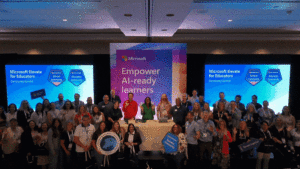
To address the training gap, Microsoft has introduced "Elevate for Educators," a platform dedicated to community building, professional credentials, and capacity building. This initiative is designed to help school leaders and teachers transform their instructional methods to better incorporate AI.
A critical component of this effort is the collaboration with international bodies and educational organizations. Microsoft has supported the "AI Literacy Framework," a project developed by the European Commission and the OECD in conjunction with CodeAI. This framework provides a standardized playbook for what students should understand about AI at various stages of their education, covering topics from the mechanics of machine learning to the ethical implications of algorithmic bias.
Furthermore, in partnership with ISTE (International Society for Technology in Education) and ASCD, Microsoft has released an "AI Literacy for Educators" credential pathway. This program allows teachers to earn recognized certifications that validate their ability to use AI effectively in the classroom, ensuring that professional development is both measurable and aligned with global standards.
Security, Governance, and the Role of IT Administration
A recurring theme in the rollout of these new tools is the emphasis on institutional control and data security. Unlike consumer-grade AI tools, the Microsoft 365 Education features are built with enterprise-level privacy protections. IT administrators serve as the gatekeepers for these technologies; for instance, the Study and Learn Agent is not available by default but must be enabled by the institution’s IT department.

This "admin-first" approach is intended to provide school districts and universities with the oversight necessary to comply with regional data protection laws, such as GDPR in Europe or FERPA in the United States. By integrating AI into the existing Microsoft 365 ecosystem, institutions can maintain a consistent security posture, ensuring that student data is not used to train public AI models and that interactions remain within a "walled garden" controlled by the school.
Analysis of Implications: The Future of the Classroom
The shift toward "AI as a coach" represents a significant pedagogical pivot. If successful, these tools could help address one of the most persistent challenges in education: the need for differentiated instruction. In a traditional classroom, a single teacher often struggles to provide personalized feedback to 30 or more students simultaneously. AI coaches could potentially fill this gap, providing every student with a personalized tutor that understands their specific strengths and weaknesses.
However, the implications are not without risk. Experts in educational psychology warn that over-reliance on AI, even in a coaching capacity, could lead to "cognitive offloading," where students stop engaging in the difficult mental labor required for long-term retention. The success of Microsoft’s new tools will likely depend on how well they are integrated into a holistic teaching strategy where human educators remain the primary mentors.
Furthermore, there is the ongoing concern of the "digital divide." While the 2026 report shows high adoption in six major markets, schools in lower-income regions or developing nations may lack the infrastructure—high-speed internet and modern hardware—required to run these advanced AI models. This could lead to an "intelligence gap" where students in well-funded districts have access to sophisticated AI tutors while others are left behind.
Official Responses and Industry Outlook
Industry analysts view Microsoft’s latest move as a strategic attempt to solidify its dominance in the educational software market against competitors like Google and specialized EdTech startups. By embedding AI into the tools that schools already pay for—Word, Teams, and OneNote—Microsoft is creating a "frictionless" path to adoption.

Educational leaders have generally responded with cautious optimism. "The move toward scaffolded learning rather than simple answer generation is a step in the right direction," noted one educational consultant familiar with the rollout. "But the real test will be in the professional development. A tool is only as good as the teacher’s ability to weave it into a lesson plan."
As the next academic year approaches, the focus for Microsoft and the broader education community will remain on the intersection of technology and human instruction. The goal, as stated by Microsoft, is to ensure that AI does not replace the learning process, but rather enhances it, preparing a new generation of students for a future where AI literacy is as fundamental as reading and writing.