

The relentless pursuit of effective environmental monitoring tools has led engineers to push the boundaries of bio-inspired robotics, culminating in a novel creation that blurs the lines between air and sea. Researchers at the Singapore University of Technology and Design (SUTD) have unveiled ALBATROSS, an acronym for Airborne Lander with Buoyant AuToROtating Sailing Sensor. Weighing just over two pounds, this multi-formed chimera machine is engineered to be dropped from high altitudes, slow its descent through autorotation, land safely on water, and instantly morph into an autonomous sailing vessel equipped with a fish-inspired rudder. Published in the journal Science Robotics, the breakthrough demonstrates a philosophical shift in bio-inspired engineering: treating nature not as a rigid blueprint to be copied, but as a modular garage filled with interchangeable functional parts.
The Evolution of Bio-Inspired Engineering
For decades, roboticists have looked to the natural world for design inspiration, yielding machines that mimic the echolocation of bats, the click-mechanism of beetles, and the propulsion of long-extinct marine creatures. However, engineers Raphael Zufferey and Andre Farinha noted in a related editorial that evolution never forced organisms to face specific human-made challenges, such as monitoring chemical spills, responding to underwater earthquakes, or tracking localized marine pollution.
Consequently, mimicking a single animal is often insufficient for complex, cross-domain missions. Traditional remote ocean monitoring requires either crewed vessels deploying localized sensors or aerial drones trying to capture data from above. These methods are frequently expensive, time-consuming, and dangerous during emergency scenarios. To bridge this gap, the SUTD research team conceptualized a hybrid machine capable of aerial deployment and aquatic navigation without the mechanical complexity and financial overhead that typically plague multi-domain robotics.
Deconstructing the Chimera: Nature as a Parts Factory
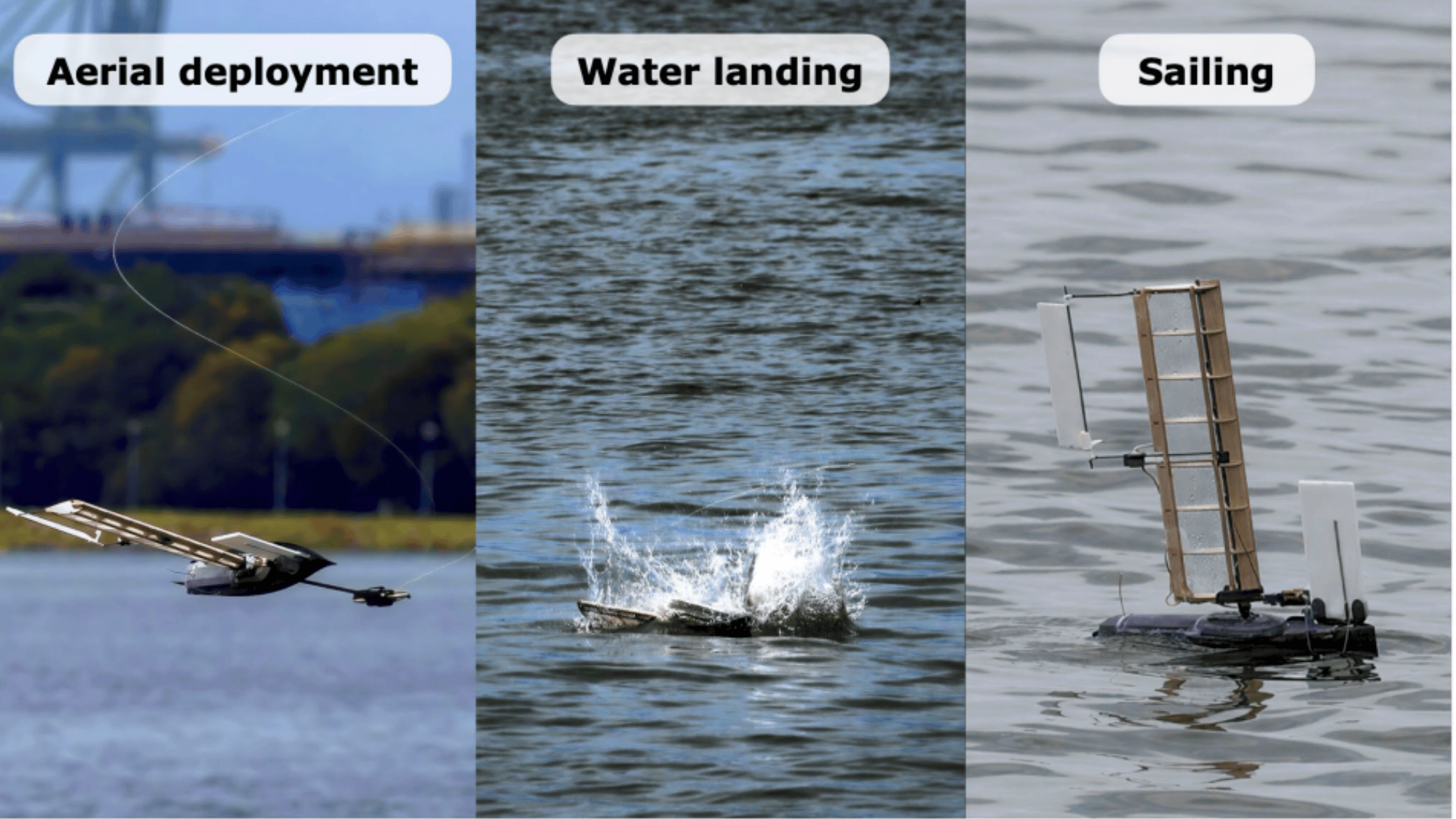
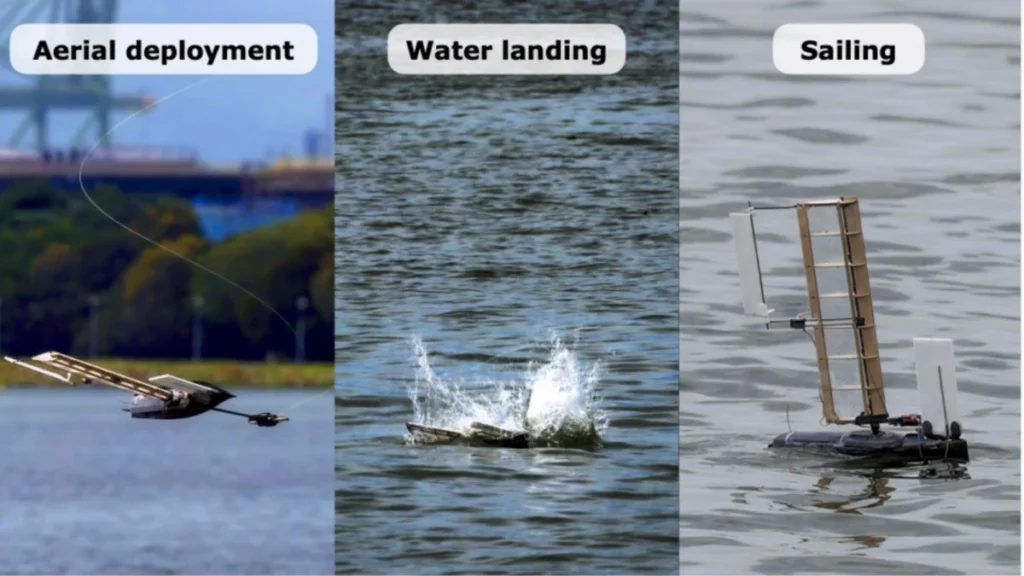
To achieve this cross-domain functionality, the engineers selectively borrowed mechanical traits from three distinct biological organisms. For the aerial deployment phase, the robot utilizes principles derived from the spinning descent of maple seeds. When released from a high-altitude drone, ALBATROSS deploys outstretched rigid limbs that twirl rapidly, creating drag and acting as a passive autorotating parachute. This mechanism reduces the robot’s descent speed from roughly 69 miles per hour to a manageable 15 miles per hour, diminishing impact forces upon water entry by an impressive factor of 18.
Once the robot makes contact with the water surface, its design shifts dramatically. The rigid limbs that served as aerodynamic wings in the sky seamlessly double as sails, drawing inspiration from the anatomy and posture of mute swans. Furthermore, to aid in propulsion—particularly when navigating against the wind or in low-wind conditions—the team integrated a caudal back rudder modeled after the fin anatomy of various fish species.
This multi-use component strategy is central to the robot’s efficiency. By employing the same physical structures for both aerial deceleration and marine propulsion, the engineers avoided adding extra actuators, hinges, or motors that could introduce points of failure or increase manufacturing costs. Ultimately, the entire system relies on just three actuators and three primary sensors, maintaining a lightweight profile of slightly over two pounds.
Rigorous Testing and Field Deployment Chronology
The development and validation of ALBATROSS involved a systematic series of engineering milestones and rigorous field trials conducted over designated reservoirs in Singapore.
In the initial prototyping phase, the team focused heavily on the physics of the aerial transition. Computational fluid dynamics and wind-tunnel testing allowed the engineers to refine the shape and weight distribution of the autorotating limbs, ensuring the device would consistently right itself upon hitting the water.

During the subsequent field test phase, the deployment mechanism was put to the test. ALBATROSS was suspended beneath a remotely operated aerial drone, which ascended to an altitude of approximately 490 feet. Upon release, the robot entered a high-speed free fall, rapidly transitioning into its spinning descent phase. High-speed cameras and onboard telemetry confirmed that the autorotating wings successfully decelerated the vehicle to a safe landing velocity, after which the robot righted itself within seconds and assumed its sailboat configuration.
In endurance and navigation trials, the robot operated autonomously without human intervention. Equipped with basic meteorological and hydrological sensors, ALBATROSS continuously recorded environmental parameters such as local temperature fluctuations and ambient humidity levels. During a continuous three-hour test run, the vessel demonstrated exceptional energy efficiency, consuming only half of its primary battery capacity by the conclusion of the experiment.
Technical Insights and Energy Efficiency Analysis
The engineering success of ALBATROSS lies in its minimalist approach to mechatronics. Many amphibious or multi-domain robots suffer from high energy consumption and structural bulk due to the redundant systems required to operate in distinct environments. By leveraging passive dynamics—such as the aerodynamic autorotation of maple seeds—the SUTD team eliminated the need for complex, heavy parachutes or power-hungry retro-rockets during the descent phase.
In their published paper, the authors emphasized the broader applicability of their findings: “By integrating minimal actuation, bioinspired structures, and passive dynamics across aerial and marine operating regimes, this work extracts generalizable design principles for lightweight, aerially deployable sailing robots capable of robust, energy efficient marine sensing.”
This design philosophy highlights a growing trend in robotics research: prioritizing functional minimalism. By reducing the number of moving parts to a bare minimum—utilizing only three actuators—the robot minimizes maintenance requirements and reduces the likelihood of mechanical jams caused by saltwater corrosion or marine biofouling.

Broader Implications and Practical Limitations
While the engineering achievement is significant, the research team is transparent regarding the current limitations of the technology. ALBATROSS is purposefully lightweight and structurally minimalist, meaning it is unequipped to withstand extreme weather events. The creators explicitly note that the robot could not survive the violent, chaotic wave action found in the eye of a major hurricane or severe open-ocean storm. Deploying the current prototype in such environments would result in structural failure.
Nevertheless, the implications of the ALBATROSS project extend far beyond marine data collection. By demonstrating that functional mechanisms can be successfully borrowed, recombined, and engineered toward objectives that evolution never directly addressed, the project provides a new framework for robotic design. It encourages engineers to view the natural world not as a strict template to be slavishly replicated, but as a diverse repository of physical properties that can be creatively remixed to solve complex contemporary problems.
As research into multi-domain robotics progresses, systems like ALBATROSS pave the way for cost-effective, rapidly deployable sensor networks capable of monitoring fragile aquatic ecosystems, tracking localized industrial runoff, and providing rapid-response data streams following environmental accidents.