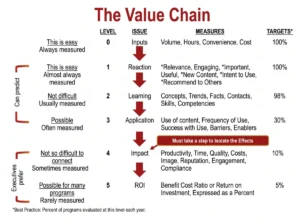




For decades, the standard for measuring the success of corporate learning and development (L&D) initiatives has remained stagnant, relying heavily on completion rates, satisfaction surveys, and self-reported knowledge gains. While these metrics provide a veneer of accountability, they frequently fail to withstand rigorous executive scrutiny. The fundamental flaw in this traditional model is that it measures activity—the act of taking a course—rather than impact—the tangible change in business outcomes. As modern organizations face increasing pressure to demonstrate a return on investment for training budgets, the industry is at a critical juncture where the focus must shift from how many employees clicked "finish" to how those employees are actually performing on the job.
The shift toward measuring observable behavior is not merely a preference; it is a strategic necessity. Leading indicators, such as changes in decision-making speed, interpersonal communication, and workflow efficiency, often provide early warnings of future business success long before lagging financial metrics, such as quarterly profit margins or long-term retention rates, are ever calculated.
The Measurement Gap: Why Behavior Remains Elusive
The current landscape of L&D measurement is often governed by frameworks like Kirkpatrick, Phillips, TDRp, or LTEM. Despite their differences, these models share a common hierarchy: basic utilization is the most accessible metric, followed by reaction and knowledge retention. Behavior change, however, occupies a higher, more difficult tier. It requires human observation, contextual validation, and a significant time investment, factors that lead most organizations to abandon formal tracking once a training program is launched.
This reliance on completion rates as a proxy for success creates a dangerous blind spot. A 100% completion rate may confirm that employees finished a module, but it fails to answer whether they possess the skill, the desire, or the organizational environment required to apply that learning. True behavior change is a four-part equation: the learner must have the knowledge, the will to apply it, the skill to execute it, and an organizational environment—complete with the necessary tools, processes, and reinforcement—that allows the behavior to take root. When results fail to materialize, organizations often erroneously blame the training, ignoring the reality that the surrounding ecosystem may have failed to support the new behavior.
Recent data from the 2025 Measuring the Business Impact of Learning Report underscores this disconnect. In a series of industry-wide polls, over 50% of L&D professionals admitted that their primary reporting metrics remain tethered to participation and completion. This systemic inertia is largely driven by a lack of mature infrastructure. Many organizations lack the data-integrated systems required to bridge the gap between classroom theory and real-world application, leaving them stuck in an "emerging" phase of measurement maturity.
A Maturing Model for Corporate Education
To overcome these barriers, experts propose a transition from an emerging to a mature measurement model. In an emerging model, organizations typically track manual, disconnected data points, often relying on retrospective surveys. In contrast, a mature model integrates automated data streams, real-time feedback loops, and alignment with the specific "rhythm of the business" (ROB).
The transition requires assessing three distinct categories: people, technology, and process. On the people front, organizations must move from passive content delivery to active performance coaching. Regarding technology, the goal is to shift from standalone Learning Management Systems (LMS) toward integrated ecosystems that feed data back into business performance tools. Finally, the process must evolve from scheduled, time-bound training cycles to continuous, iterative learning that occurs in the flow of work.
This evolution is urgent. As noted in a recent Chief Learning Officer webinar, the modern obsession with "learning velocity"—often interpreted as the speed of content rollout—can be counterproductive. When learning is deployed too rapidly, it can lead to cognitive overload and decision paralysis. True velocity is not measured by how fast content is pushed to employees, but by how quickly the organization becomes measurably better at its core functions.
The Role of Artificial Intelligence as a Catalyst
The emergence of artificial intelligence (AI) is transforming the measurement of behavior from a theoretical exercise into a scalable reality. Historically, observing behavior required a manager or coach to manually supervise meetings or review workflows, a process that is inherently inconsistent and expensive to scale. AI removes this bottleneck by enabling the analysis of interactions at a granular level without the limitations of human bandwidth.
Consider the application of AI in improving executive presence. Rather than relying on a manager’s subjective review, project managers can now feed transcripts of their meetings into an AI tool, paired with a rubric designed to measure communication style, clarity, and audience engagement. The AI provides an objective analysis, offering the learner an opportunity to iterate, ask follow-up questions, and refine their approach in real-time. This creates a feedback loop that is both personalized and immediate.
This approach offers two distinct advantages. First, it provides data that is grounded in actual performance rather than self-reported confidence, which is notoriously susceptible to "halo bias"—the tendency for individuals to rate their own performance more favorably than objective reality warrants. Second, it creates a repository of leading-indicator data that organizations can analyze to identify systemic gaps in communication or leadership across the enterprise.
Integrating Learning into the Rhythm of the Business
The most advanced applications of this technology are found in programs that integrate directly with the organizational cadence. For example, some large enterprises have begun deploying AI-enabled facilitators that assist managers through their first 18 months. By connecting to internal HR data, these facilitators are aware of key business milestones—such as annual reviews, budget planning cycles, and team expansion phases—and can provide just-in-time training and role-play simulations that align with the specific challenges a manager faces at that moment.
By mapping learning reinforcement to the rhythm of the business, organizations can track multiple signals simultaneously:
- Engagement Rate: How often the manager interacts with the AI tool in anticipation of a high-stakes conversation.
- Preparedness Score: The quality of the manager’s outputs, such as draft budgets or communication plans, analyzed against company standards.
- Outcome Correlation: Whether the manager successfully navigates specific milestones, such as lower-than-average attrition during the first year of their tenure.
- Confidence Trajectory: A measurement of how the manager’s approach to complex tasks evolves as they move through different cycles of the fiscal year.
- Reduced Hesitation: A tracking of the time between a business requirement (e.g., a performance review) and the manager initiating the process.
Addressing the Attribution Challenge
Despite the promise of AI-driven analytics, significant challenges remain. The primary hurdle is the "attribution gap." In a complex corporate environment, it is difficult to determine whether a successful business outcome resulted from a specific training module or from a combination of unrelated factors like mentorship, team culture, or external market conditions.
Critics and industry analysts alike argue that while AI can observe behaviors, it cannot fully account for the nuance of human experience or the impact of soft-skills coaching. There is also the risk that reliance on automated metrics could incentivize employees to "game the system" by performing in a way that satisfies the algorithm rather than the business.
However, the consensus among forward-thinking L&D leaders is that the benefits of moving away from self-reported data outweigh these risks. By shifting the focus to observable actions—such as how a manager handles a promotion conversation or how a sales representative structures a pitch—AI provides a level of clarity that was previously impossible to achieve. While this does not solve the attribution gap entirely, it narrows it significantly. It moves the conversation from "did they take the training?" to "did they change their behavior, and what was the observable impact of that change?"
As organizations look toward the future, the integration of behavioral analytics will likely become the standard for assessing L&D efficacy. Those that continue to rely on the comfort of completion rates will find themselves increasingly disconnected from the realities of business performance. Conversely, those that embrace the rigor of behavioral measurement—supported by the speed and scale of AI—will be better positioned to justify their investments and demonstrate the true, quantifiable value of their human capital.