



Research commissioned by the Association for Talent Development (ATD) has revealed a significant shift in corporate priorities, with 96 percent of Fortune 500 CEOs identifying business impact as the primary metric for evaluating talent development initiatives. Following closely behind, return on investment (ROI) has emerged as the second most critical benchmark. This alignment of leadership expectations suggests that the era of treating training and development as an isolated human resources function is effectively over. Instead, executives are increasingly viewing learning programs as strategic levers that must directly influence organizational output, quality, cost-efficiency, and time management.
This mandate for accountability is not limited to the private sector. Nonprofit organizations, faced with shrinking budgets and increasing calls for transparency, are adopting similar methodologies. The fundamental question posed to organizational leaders—"Would you like talent development programs to connect to the business?"—rarely yields a negative response. Yet, the challenge remains in operationalizing this connection. To succeed, organizations must pivot from a model of "training for training’s sake" to a results-based framework where impact is the central "why" of every initiative.
The Evolution of Evaluation Logic
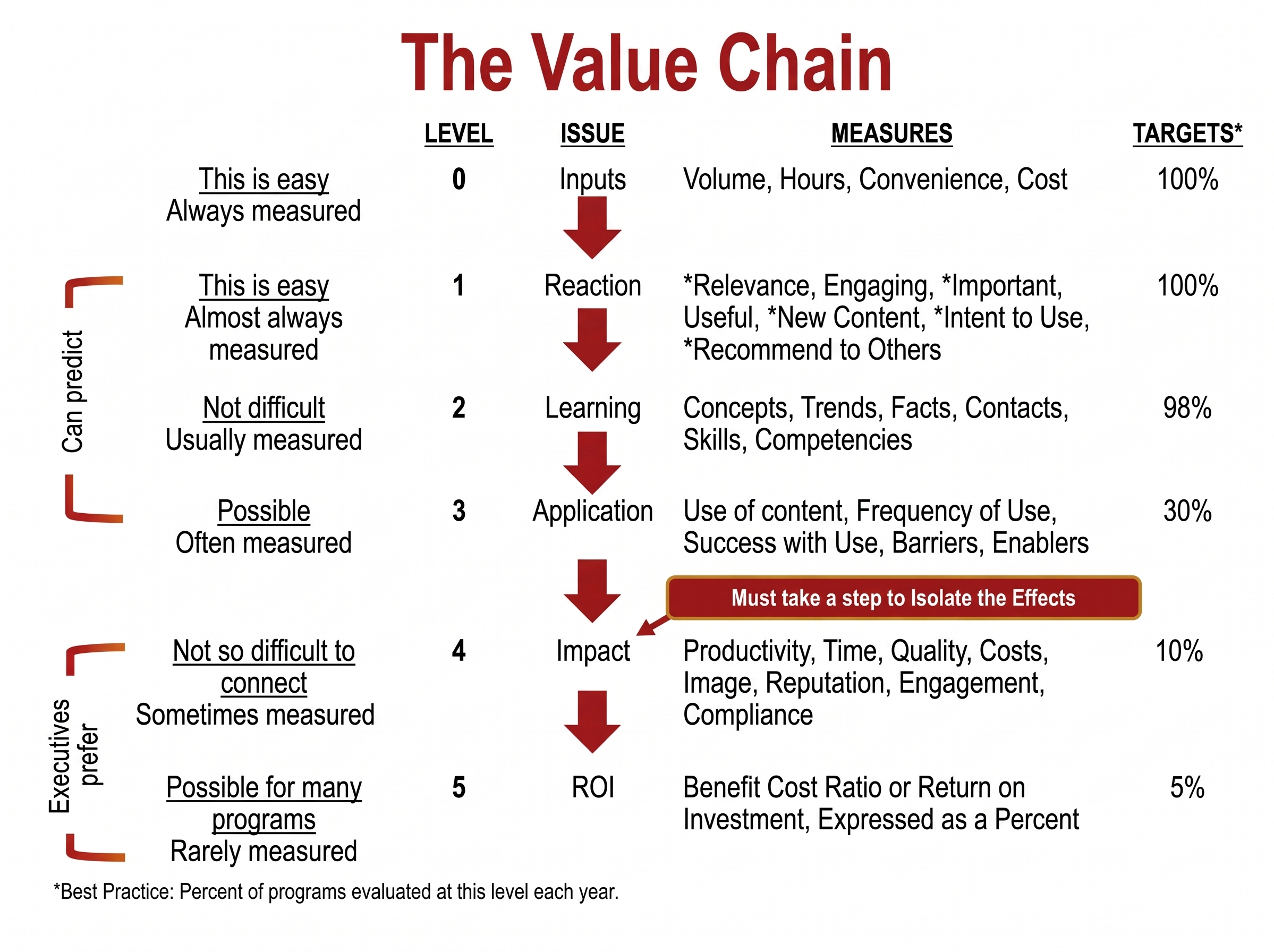
The methodology gaining traction in the global marketplace traces its roots to 19th-century logic models, which were refined for the modern corporate era by Raymond Katzell in 1952. While the late Don Kirkpatrick famously popularized these steps—creating the well-known Four Levels of Evaluation—contemporary practices have expanded the scope to include a fifth level: the financial ROI.

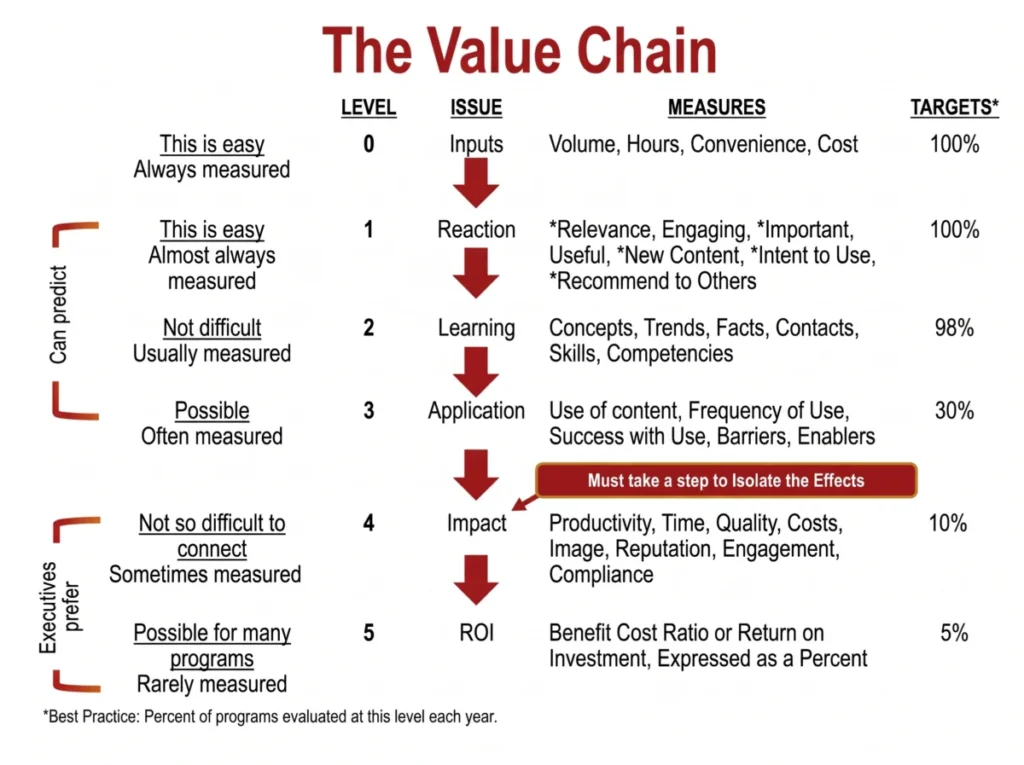
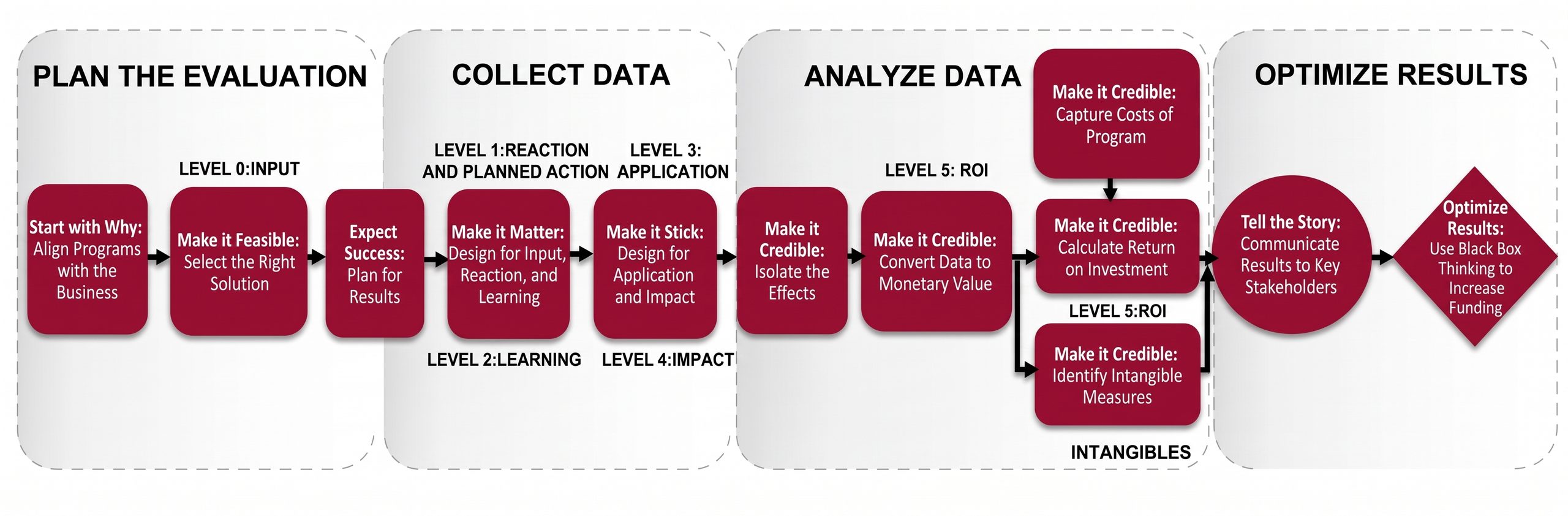
This modern value chain is structured as a series of cascading data types. Level 0 represents the baseline "Input," capturing participant numbers, time investments, and operational costs. From there, the framework ascends through five progressive outcomes:
- Level 1: Reaction: Assessing whether participants find the program relevant, engaging, and worthy of commitment. A negative reception at this stage can effectively neutralize the program’s potential before it begins.
- Level 2: Learning: Measuring the tangible acquisition or enhancement of skills and knowledge.
- Level 3: Application: Tracking how these skills are deployed in the workplace. This stage monitors frequency of use, success rates, and the identification of organizational barriers or enablers.
- Level 4: Impact: Measuring the consequences of that application on business metrics such as output, quality, and time.
- Level 5: ROI: The final conversion of these impacts into monetary benefits, compared against the total direct and indirect program costs.
A Twelve-Step Blueprint for Strategic Delivery
The ROI Methodology, now utilized by over 10,000 organizations worldwide, operates as a comprehensive 12-step process. It functions not merely as an after-the-fact evaluation tool, but as a design framework that influences how programs are conceived and delivered from day one.
The process begins with planning, where the program is rigorously aligned with specific business measures. During these initial phases, practitioners must determine if the proposed intervention is the correct solution to a genuine business problem. This phase demands deep collaboration with stakeholders to ensure that the "why" of the program is tied to a measurable organizational goal.
Data collection follows, utilizing both traditional methods and action planning to capture shifts in participant behavior. The most rigorous phase of this methodology, however, lies in the analysis. To remain credible in the eyes of a CFO, the ROI Methodology mandates the isolation of the program’s effects from other external influences—a process often referred to as "the credibility challenge." Whether through control groups or conservative estimation techniques, practitioners must be able to defend their findings against scrutiny.
Economic Rigor and Financial Credibility
The transition from impact to monetary value requires a disciplined approach. If an impact, such as a reduction in cycle time, cannot be credibly converted into a financial figure, it is categorized as an intangible measure. This practice of "when in doubt, leave it out" is central to maintaining the methodology’s reputation for integrity. Conversely, when calculating costs, the philosophy shifts to "when in doubt, leave it in," ensuring that all direct and indirect expenses—including the value of time spent by participants—are accounted for.
The result is a Benefit-Cost Ratio (BCR) and a final ROI percentage. The ROI formula—(Benefits minus Costs) divided by Costs, multiplied by 100—provides a clear answer to the fundamental question: "Was it worth it?"
Broader Implications for Talent Management
The implications of this shift are profound for the professional development industry. By adopting a standard of fiscal accountability, talent development professionals are securing their seat at the executive table. This transition away from vanity metrics—such as "number of hours trained" or "participant satisfaction scores"—toward bottom-line impact is forcing a re-evaluation of how budgets are allocated and how success is defined.
Historically, learning and development (L&D) departments were often the first to face budget cuts during periods of economic contraction because their value was viewed as indirect or "soft." By quantifying impact and ROI, L&D leaders are transforming their departments into value-generating centers. This shift allows for the optimization of programs based on hard data, rather than intuition. As organizations continue to navigate complex, competitive global markets, the ability to demonstrate a clear return on human capital investment has become a requisite for operational excellence.
Addressing the Credibility Gap
Critics of traditional training evaluations have long argued that "soft skills" cannot be measured, or that attributing specific business successes to training is inherently speculative. The 12-step methodology directly addresses these concerns through a series of guiding principles that emphasize conservative, defensible data. By isolating the program’s effects and utilizing rigorous, evidence-based estimation techniques, practitioners can provide the level of granular detail that financial officers demand.
This approach also addresses the "engagement gap" in organizations. When employees see that their training is tied to real-world outcomes—and when they are recognized for the impact they create—the perceived value of the program increases. This creates a virtuous cycle where high-impact programs gain more support, attract better funding, and drive further innovation.
Conclusion: The Future of Organizational Learning
As the demand for transparent reporting grows, the integration of the ROI Methodology into mainstream business operations is expected to accelerate. The days of siloed, unmeasured training are giving way to a new paradigm where talent development is an integrated business function.
For leaders at all levels, the message is clear: Start with the end in mind. Whether it is a leadership development program, a technical training initiative, or a cultural change project, the path to organizational support lies in the ability to connect the "why" of the program to the financial and operational health of the organization. As established in contemporary research, when learning is treated as a strategic investment rather than an administrative expense, the resulting impact on the organization is both predictable and profound. By moving beyond reaction and learning to focus on impact and ROI, organizations can ensure that their most valuable resource—their people—are contributing directly to the bottom line in a way that is both visible and undeniable.