

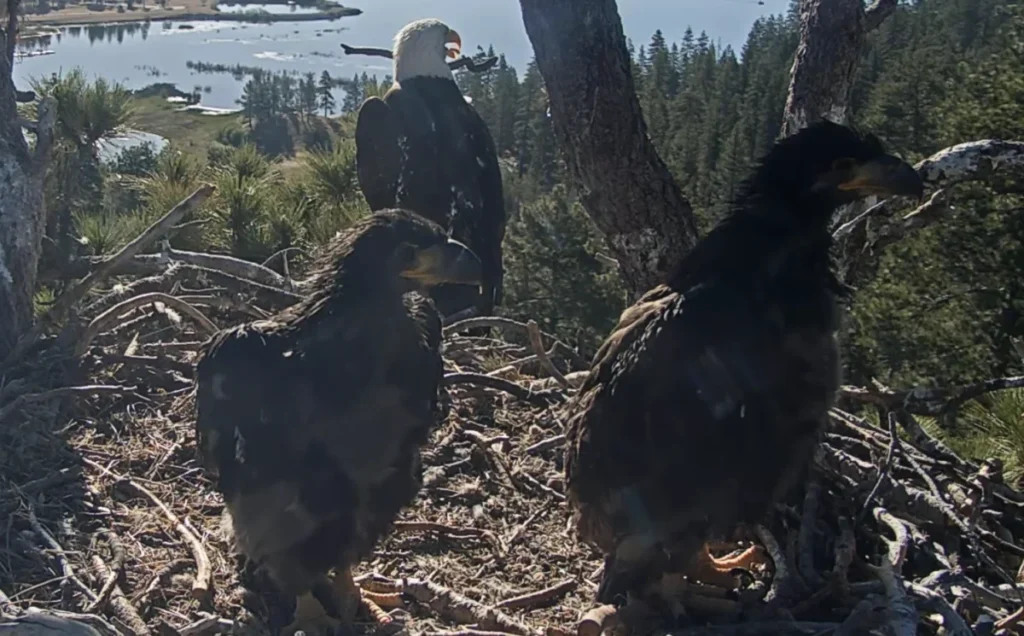
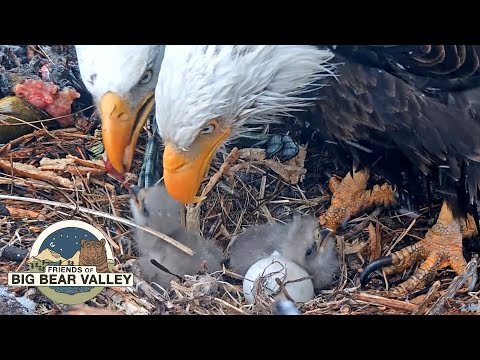
The high-altitude nest in the San Bernardino National Forest has become a theater of rapid biological development as Sandy and Luna, the two bald eagle chicks belonging to the famous pair Jackie and Shadow, enter a transformative phase of their young lives. Since hatching in early April, the eaglets have transitioned from helpless, down-covered hatchlings into increasingly robust raptors. Currently at approximately six weeks of age, the pair has begun exhibiting specialized behaviors—specifically vigorous wing-flapping and instinctual "stomping"—that are essential precursors to their eventual departure from the nest. These milestones represent a critical juncture in a nesting season that has captivated a global audience via 24-hour livestreaming provided by the non-profit organization Friends of Big Bear Valley (FOBBV).
As the eaglets grow, their physical appearance has shifted dramatically from the grey, fuzzy down of their first weeks to the dark, mottled brown juvenile plumage that will define them for the next several years. However, it is their behavioral evolution that currently draws the most attention from biologists and enthusiasts alike. Observers have noted frequent sessions of "wing-ercising," where the chicks stand at the edge of the nest and beat their wings with increasing intensity. While these movements may appear uncoordinated to the casual observer, they serve a dual physiological purpose: the strengthening of the massive pectoral muscles required for flight and the development of spatial awareness. According to FOBBV, this practice allows the chicks to gauge their own wingspan, a necessary skill to avoid collisions with their sibling or the high-altitude pine branches that surround their home.
The Biological Significance of "Stomping" and Developmental Milestones
Beyond the visible effort of flapping, a more subtle but equally vital behavior has emerged: a rhythmic stomping and pouncing within the nest bowl. This activity is far more than mere play; it is a manifestation of deeply ingrained predatory instincts. Bald eagles are apex raptors that rely on the strength and precision of their talons to secure prey. The stomping behavior mimics the action of "pinning" a fish or small mammal to the ground, a technique they will eventually use to survive in the wild.
Furthermore, this behavior assists in the physical recalibration of the birds’ bodies. At six weeks old, eaglets are notably "top-heavy," as their internal organs and feathers develop faster than their coordination. Stomping helps the chicks find their center of gravity and strengthens their legs as they grow longer. While this developmental phase occasionally results in the chicks accidentally stepping on one another’s toes, it is a necessary step toward the grace and power they will exhibit as adults.
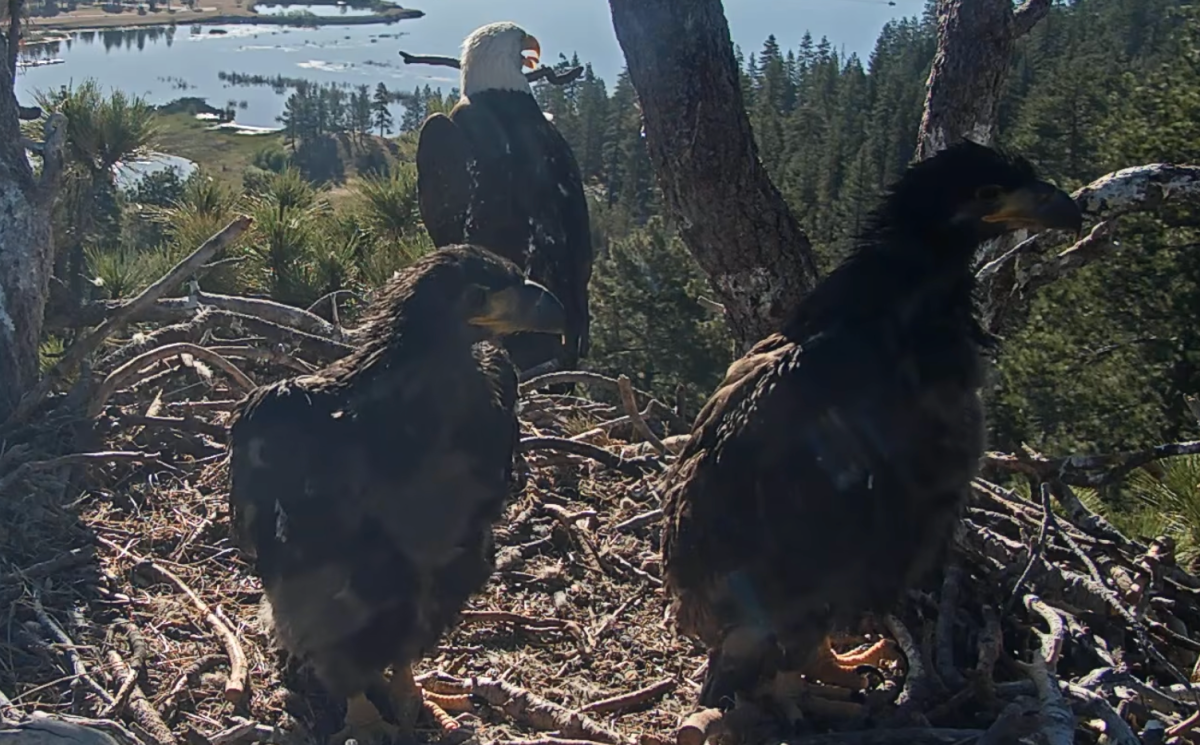
The timeline for these developments is consistent with the standard growth patterns of Haliaeetus leucocephalus. Bald eagle chicks typically remain in the nest for a period of 10 to 14 weeks. This suggests that Sandy and Luna are roughly halfway through their residency in the Big Bear nest. Their predecessors, Sunny and Gizmo, fledged at approximately 13 weeks of age during the 2025 season, providing a historical benchmark for what viewers can expect in the coming month.
A Chronology of the 2026 Nesting Season
The success of Sandy and Luna follows a period of significant tension and environmental challenge for Jackie and Shadow. The 2026 season began with a setback in January when the pair’s initial clutch of eggs was predated by ravens, a common threat in the San Bernardino National Forest. Despite this loss, the pair demonstrated the resilience for which they are known, successfully laying a second clutch of eggs shortly thereafter.
The current timeline of the 2026 brood is as follows:
- April 4, 9:33 p.m. PDT: Chick 1 (Sandy) successfully hatches after an arduous incubation period.
- April 5, 8:30 a.m. PDT: Chick 2 (Luna) hatches, less than 12 hours after its sibling.
- Late April: The chicks begin "branching" and exhibiting increased mobility within the nest structure.
- May 1: Following a public naming process that saw thousands of submissions, FOBBV officially announces the names Sandy and Luna.
- Mid-May: The onset of intense wing-flapping and "pinning" behavior as the chicks reach the six-week mark.
This successful hatching was particularly noteworthy given the statistical challenges facing bald eagles. Biologists note that only about 50 percent of bald eagle eggs successfully hatch in the wild, hampered by factors such as fluctuating temperatures, predation, and parental experience. Jackie and Shadow, who have been a bonded pair since 2018, have consistently beaten these odds, though their journey has not been without tragedy.
Historical Context and Parental Legacy
Jackie and Shadow have become a focal point for avian conservation due to their documented history of triumphs and losses. Since they began nesting together in the Big Bear Valley, they have successfully raised chicks in 2019, 2022, and 2025. However, the 2023 and 2024 seasons saw failed clutches where eggs did not hatch, illustrating the precarious nature of high-altitude nesting.

The 2025 season remains a particularly poignant chapter in their history. In March of that year, a severe late-season snowstorm blanketed the nest in two feet of snow while Jackie and Shadow were caring for three newly hatched chicks. Despite the parents’ best efforts to shield their brood from the sub-freezing temperatures and high winds, one chick perished during the storm. The two survivors, later named Sunny and Gizmo, went on to fledge successfully, but the event served as a stark reminder of the environmental pressures these birds face. The survival of Sandy and Luna thus far in 2026 represents a more stable season, though the risks remain present until the birds are fully independent.
Environmental Risks and the Challenges of Fledging
While Sandy and Luna are currently safe under the watchful eyes of Jackie and Shadow, the most dangerous phase of their lives is rapidly approaching. The transition from the nest to the air—known as fledging—is a high-stakes period where mortality rates are significantly elevated. Data from various wildlife agencies suggest that only about 70 percent of bald eagles survive their first year.
The threats to fledgling eagles are multifaceted:
- Predation: Even as they grow larger, young eagles are vulnerable to other large raptors, including Great Horned Owls and larger hawks, as well as terrestrial predators if they land on the ground prematurely.
- Weather Extremes: High-altitude environments like Big Bear Valley are subject to sudden shifts in weather. Strong gusts of wind can knock an inexperienced flyer into trees or onto the forest floor.
- Human Impact: One of the most significant threats to young eagles is human infrastructure. Fledglings often scavenge for food and may be drawn to roadkill, leading to fatal collisions with vehicles. Additionally, lead poisoning from consuming carcasses containing lead shot remains a chronic threat to the species.
Because FOBBV maintains a policy of non-interference and does not tag the eagles with GPS trackers, the exact fate of Jackie and Shadow’s offspring once they leave the valley remains largely unknown. However, anecdotal evidence and sightings of un-tagged juveniles suggest that Big Bear fledglings have traveled as far north as British Columbia and as far south as Baja California, indicating the expansive range these birds cover once they master the thermals of the San Bernardino Mountains.
Conservation Implications and Community Support
The immense popularity of the Big Bear bald eagle cam has translated into tangible conservation efforts. The Friends of Big Bear Valley and other environmental stakeholders are currently engaged in a significant fundraising campaign, aiming to raise $10 million to protect the eagles’ foraging areas. The "Save Moon Camp" initiative seeks to prevent development in critical habitats surrounding the lake where Jackie and Shadow hunt for fish to feed their growing brood.
The presence of the eagles is also a vital indicator of the local ecosystem’s health. As apex predators, bald eagles require a robust food chain and a clean environment to thrive. Their continued success in the San Bernardino National Forest suggests a degree of ecological resilience, but also highlights the need for continued vigilance against habitat fragmentation and climate-driven weather volatility.
As Sandy and Luna continue their "wing-ercising" and stomping routines, they are doing more than just growing; they are preparing to carry on a lineage that has become a symbol of wildlife recovery in North America. For the millions of viewers watching the livestream, these awkward, stomping chicks represent the raw, unscripted reality of nature—a process of trial, error, and instinct that has remained unchanged for millennia. The coming weeks will be the ultimate test for the pair as they prepare to take their first flight and join the wild population of the American West.