

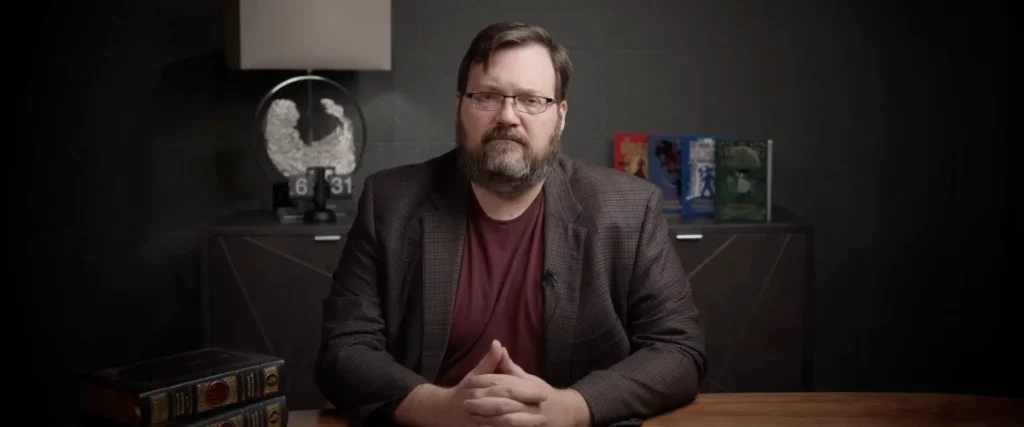
Late last year, acclaimed fantasy novelist Brandon Sanderson delivered a pivotal address titled “The Hidden Cost of AI Art” at Dragonsteel Nexus, the annual conference orchestrated by his burgeoning media company, Dragonsteel Entertainment. The event, a significant gathering for fans of his expansive Cosmere universe and a prominent platform within the fantasy genre, served as the backdrop for a nuanced exploration of generative artificial intelligence’s impact on creative fields. Sanderson, known not only for his prolific writing output but also for his innovative approaches to publishing and direct engagement with his fanbase, positioned his critique of AI art not as a technophobic rejection, but as a deep inquiry into the fundamental nature of artistic creation.
The Author’s Evolving Stance on Generative AI
Sanderson began his address by acknowledging the undeniable fascination surrounding large language models (LLMs) and generative AI, even as he expressed profound unease regarding their trajectory in relation to writing and art. "The surge of large language models and generative AI raises questions that are fascinating," he stated early in his remarks, "and even if I dislike how the movement is going in relation to writing and art, I want to learn from the experience of what’s happening." This introspective approach set the tone for a discussion that sought to move beyond surface-level objections to uncover a deeper, more personal understanding of his discomfort.
While unequivocally stating his disapproval of AI-generated art—a feeling he described as his "stomach turn[ing]"—Sanderson embarked on an intellectual journey to pinpoint the precise reasons for this visceral reaction. He systematically reviewed and ultimately dismissed several common arguments against AI art. These often include concerns about copyright infringement due to training data, the potential for job displacement among human artists, the perceived lack of "soul" or originality in AI output, and the ethical implications of automating creative processes. By setting aside these widely debated points, Sanderson aimed to distil the core issue to something more intrinsic to the human experience of art.
The Transformative Power of Creation: Sanderson’s Core Argument
Sanderson’s ultimate conclusion rested on a deeply personal insight derived from his own struggles as an aspiring writer. Recounting the arduous process of writing his first, ultimately unsuccessful, book manuscripts, he underscored what he believes to be the essential value of art: its capacity to transform the artist. "Maybe someday the language models will be able to write books better than I can," Sanderson conceded. "But here’s the thing: Using those models in such a way absolutely misses the point, because it looks at art only as a product."
He elaborated on the profound personal satisfaction derived from the act of creation itself, independent of the final commercial viability of the product. "Why did I write [my first manuscript]?… It was for the satisfaction of having written a novel, feeling the accomplishment, and learning how to do it. I tell you right now, if you’ve never finished a project on this level, it’s one of the most sweet, beautiful, and transcendent moments. I was holding that manuscript, thinking to myself, ‘I did it. I did it.’" This perspective highlights the intrinsic, process-oriented value of art, contrasting it sharply with a product-centric view that generative AI models seemingly promote. For Sanderson, the journey of creation, with its inherent challenges, failures, and ultimate triumphs, is indispensable to the meaning and purpose of art.
Art as Deep Human Communication: An Expanded Perspective
Building upon Sanderson’s insights, a complementary perspective views art as an act of profound human communication. This understanding posits that an artist utilizes a tangible medium—be it a prose manuscript, a painted canvas, a musical composition, or a sculpted form—to transmit a complex internal cognitive state from their mind to that of their audience. This process is akin to a form of "telepathy," enabling a unique and deeply human exchange of ideas, emotions, and experiences that transcends mere information transfer. It is through this intricate dance of expression and reception that art fosters empathy, connection, and shared understanding across individuals and cultures.
From this viewpoint, the concept of engaging with a book authored by an LLM or experiencing a film generated solely from a prompt becomes inherently paradoxical, if not fundamentally anti-human. If art’s essence lies in the communication of a human consciousness, then output lacking such an origin cannot genuinely fulfill this function. It risks becoming a sophisticated simulation, offering a superficial resemblance to true artistic engagement without the underlying depth and authenticity of human intent. This perspective aligns with Sanderson’s concern that AI-generated content reduces art solely to its product, stripping away the communicative bridge between human minds.
The Rise of Generative AI and the Creative Industries
The rapid ascent of generative AI tools, particularly since 2022 with the widespread availability of models like Stable Diffusion, Midjourney, DALL-E, and advanced LLMs from companies like OpenAI and Anthropic, has indeed sent reverberations throughout the creative industries. These technologies allow users to generate highly sophisticated images, texts, and even music from simple text prompts, democratizing the creation of digital content but also igniting contentious debates.
For visual artists, the advent of AI image generators has been particularly disruptive. Concept artists, illustrators, and graphic designers have voiced concerns over job security, the devaluation of their skills, and the ethical implications of AI models trained on vast datasets of existing artwork, often without artists’ consent or compensation. A survey conducted in late 2023 by Artstation, a major platform for digital artists, revealed that over 80% of its users expressed strong negative sentiment towards AI-generated art, citing concerns over copyright infringement and the erosion of artistic integrity. Similarly, within the writing community, the emergence of LLMs capable of generating coherent narratives and articles has prompted fears among novelists, journalists, and content creators about plagiarism, intellectual property rights, and the potential for a flood of low-quality, AI-produced content.
Legal and Ethical Quandaries
The "Hidden Cost of AI Art" extends beyond the philosophical to encompass significant legal and ethical challenges. A central issue is the sourcing of training data. Many generative AI models are trained on massive datasets scraped from the internet, which often include copyrighted works without explicit permission from creators. This practice has led to numerous lawsuits, with artists and copyright holders alleging infringement and demanding compensation or control over their works’ use in AI training. Organizations like the Copyright Alliance and various artists’ guilds have been vocal in advocating for stronger protections and clear ethical guidelines.
Furthermore, the legal framework for AI-generated content remains largely undefined. Questions persist regarding who owns the copyright to AI-generated works, if anyone, and how to attribute authorship when human input might be minimal. The U.S. Copyright Office has stated that human authorship is a prerequisite for copyright protection, raising complex questions about the legal status of purely AI-generated creations. These unresolved issues contribute to an atmosphere of uncertainty and vulnerability for human creators, adding to the "hidden cost" in terms of potential economic harm and legal complexity.
Challenging Nihilistic Passivity: The Power of Human Agency
A particularly striking element of Sanderson’s talk, and one that resonates deeply with the broader anxieties surrounding technological advancement, was his powerful conclusion. If art is indeed a profoundly human endeavor, he argued, then its definition and meaning ultimately rest with humanity itself. "That’s the great thing about art — we define it, and we give it meaning," he asserted. "The machines can spit out manuscript after manuscript after manuscript. They can pile them to the pillars of heaven itself. But all we have to do is say ‘no.’"
This statement serves as a potent counter-narrative to a growing trend of "nihilistic passivity" observed in much of the contemporary commentary on AI. This trend, often characterized by a weary acceptance of grim scenarios where AI inevitably disrupts or destroys cherished human domains, frequently leaves readers with a sense of helplessness. Such narratives, common in recent essays and analyses, lay out dire predictions about AI’s impact on society, only to conclude without offering pathways for human intervention or resistance. The author of the original article aptly described this as a "cat dropping a dead bird on the doorstep" – a presentation of a problem without a call to action.
Sanderson’s message, by contrast, is one of profound empowerment and agency. He reframes the challenge posed by AI not as an unassailable force but as a choice presented to humanity. In the realms that matter most—the definition of creativity, the value of human expression, and the fundamental shape of our cultural existence—it is not the whims of tech magnates like Sam Altman of OpenAI or Dario Amodei of Anthropic that dictate our future. Instead, it is the collective will and decision-making capacity of individuals and communities.
This call to action is particularly relevant in an era where technological determinism often overshadows human choice. Sanderson reminds his audience, and by extension the broader creative community, that the future of art is not preordained by algorithmic capabilities but is rather a canvas upon which humanity continues to paint its own values and aspirations. The simple act of saying "no" to AI-generated art, or "yes" to human-created art, is presented as a powerful assertion of sovereignty over our cultural landscape. It signifies a refusal to allow technological advancements to unilaterally redefine what is considered meaningful or valuable in human expression.
The Broader Implications for Human Creativity
Sanderson’s address, and the subsequent discussions it has fueled, underscores a critical juncture for human creativity. The "hidden cost" he identifies is not merely economic or legal, but existential. It questions whether society risks losing the very essence of human artistic endeavor—the struggle, the personal growth, the unique communicative bond—in pursuit of efficiency and limitless output. If the primary value of art becomes its instantaneous generation and consumption, detached from the human journey of its making, then a profound shift in cultural priorities may be underway.
The challenge, therefore, lies not in rejecting technology outright, but in thoughtfully integrating it in ways that augment, rather than diminish, human creative potential and experience. This involves advocating for ethical AI development, supporting human artists, establishing clear legal frameworks for intellectual property, and fostering a cultural environment that values the process of creation as much as its product. Brandon Sanderson’s "The Hidden Cost of AI Art" serves as a timely and important reminder that in the face of unprecedented technological change, the power to define, defend, and cherish human art ultimately remains in human hands. The choice, as he articulates, is ours to make.