


The landscape of global education is undergoing a fundamental shift as institutions move past the initial novelty of generative artificial intelligence toward a structured, integrated approach to digital transformation. In response to this evolution, Microsoft has unveiled a comprehensive redesign of its Education AI Toolkit, specifically engineered to provide primary schools, districts, and universities with the practical guidance necessary to transition from small-scale pilots to broad, impactful implementation. This update arrives at a critical juncture for the sector, as educators grapple with the dual challenges of harnessing AI’s pedagogical potential while ensuring data privacy, security, and ethical use.
The redesigned toolkit is built upon the feedback of thousands of education leaders worldwide who have spent the last eighteen months experimenting with early-stage AI applications. These institutions are no longer merely asking what AI can do; they are asking how it can be scaled across entire departments and districts. From primary schools building custom chatbots to support neurodivergent learners to large-scale universities piloting sophisticated study assistants, the demand for a standardized roadmap has never been higher. The updated Microsoft Education AI Toolkit addresses these needs through a streamlined five-section layout—Overview, AI Navigators, Plan, Implement, and Research—optimized for landscape orientation to facilitate easier navigation during collaborative planning sessions.
Three Pillars of Educational Transformation
To provide a cohesive strategy for diverse institutions, the toolkit organizes AI implementation around three core themes: Student Success, Institutional Innovation, and Simplify and Secure IT. These pillars represent a holistic approach that balances the needs of learners, administrators, and technical staff simultaneously.

Under the banner of Student Success, the focus is on personalized learning and workforce readiness. AI-powered tools are being deployed to provide tutoring-style support, automated assessments, and near-instant feedback, allowing educators to address learning gaps in real-time. Beyond the classroom, these tools are designed to prepare students for a rapidly changing job market by integrating skills-based pathways and industry-recognized certifications into the curriculum.
Institutional Innovation addresses the operational side of education. By leveraging AI-powered insights and automation, schools are improving administrative efficiency and modernizing infrastructure. This shift is intended to reduce the "drudgery" of manual data entry and scheduling, thereby freeing up faculty and staff to focus on high-touch student interactions.
The final pillar, Simplify and Secure IT, addresses the most significant barrier to AI adoption: safety. The toolkit emphasizes the use of Microsoft Security Copilot for advanced threat detection and provides rigorous governance guidance to protect sensitive student data. This ensures that as institutions adopt more powerful AI systems, they do so within a framework of privacy and trust.
The Evolution from Snapshots to AI Sparks
A significant highlight of the updated toolkit is the introduction of "AI Sparks," a concept designed to bridge the gap between individual experimentation and systemic innovation. Previously, the toolkit utilized "AI Snapshots," which focused on how an individual practitioner—such as a single teacher or a lone IT specialist—might use AI to enhance their specific workflow. While effective for personal productivity, Snapshots often failed to trigger broader institutional change.

In contrast, AI Sparks focus on team-level and department-level implementations. For example, while a Snapshot might help one teacher use Microsoft 365 Copilot to draft a lesson plan, a Spark demonstrates how an entire district-wide literacy team can utilize Learning Accelerators, such as Reading Coach and Reading Progress, to accelerate early literacy across all K-3 classrooms simultaneously. In a higher education context, a Spark might involve an IT department using Microsoft Copilot Studio analytics to identify recurring helpdesk issues across a campus and proactively updating resources to reduce the volume of support tickets. This transition from individual use to institutional capacity building marks a maturing of the AI conversation in education, focusing on lasting, coordinated change.
Agentic AI: The Frontier of Institutional Autonomy
The toolkit also introduces the concept of "Agentic AI," representing a move from simple assistance to greater autonomy in administrative and instructional workflows. Agentic AI refers to systems capable of automating multi-step tasks—such as routing complex student inquiries or managing intricate administrative approvals—based on specific institutional design and governance rules.
Microsoft highlights two distinct paths for schools entering the agentic space. The first is through Copilot Studio, which offers a no-code environment for rapid agent creation, allowing non-technical staff to build functional AI assistants. The second is through Microsoft Azure AI Foundry, which provides a more sophisticated platform for custom, high-scale solutions. A notable case study included in the toolkit is the University of Leicester, which implemented an AI-powered digital coach. This system successfully reduced staff workload by handling routine inquiries while providing students with 24/7 access to vital university information, illustrating the tangible benefits of moving toward agentic models.
Chronology and Context: The Rapid Rise of Educational AI
The release of this updated toolkit follows a period of unprecedented technological acceleration. Following the public release of advanced large language models in late 2022, the 2023 academic year was largely defined by "pilot fatigue" and concerns over academic integrity. By early 2024, however, the narrative shifted toward "responsible AI," with organizations like UNESCO and various national education ministries calling for frameworks that prioritize ethics and equity.

Microsoft’s timeline reflects this shift. The initial toolkit was launched as a response to the immediate need for basic AI literacy. The Fall 2025 update, which includes the integration of Code.org’s "Hour of AI," signals a move toward long-term curriculum integration. Building on the global success of the "Hour of Code," this initiative aims to demystify AI for students through engaging platforms like Minecraft Education, specifically the "Generation AI" lesson. By targeting foundational AI literacy at the primary and secondary levels, the toolkit seeks to ensure that the next generation of learners is not just consumers of AI, but informed architects of it.
Action-Ready Frameworks and Research Integration
To move from theory to practice, the toolkit now includes "action-ready checklists." These are designed to turn abstract guidance into assignable tasks for leadership committees. These checklists cover the entire lifecycle of AI adoption, from the initial assessment of institutional readiness to the final stages of sustainable implementation. By providing a structured roadmap, Microsoft aims to help institutions avoid common pitfalls, such as fragmented adoption or "shadow AI" (the use of unapproved AI tools by staff).
Furthermore, the Research section of the toolkit has been significantly strengthened. Recognizing that education boards and stakeholders require evidence-based justification for technology investments, the updated resources are organized to help teams find peer-reviewed studies and outcome data quickly. This section is particularly valuable for addressing faculty concerns and validating implementation strategies with current research that highlights real-world academic and operational outcomes.
Community and Networking: Microsoft Elevate
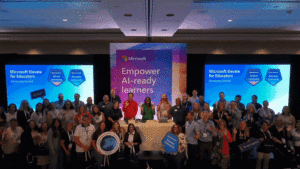
A final component of the updated strategy is the expansion of Microsoft Elevate for Educators. This framework merges the success of the Microsoft Showcase Schools and the Microsoft Innovative Educator Expert (MIEE) programs into a unified network. By fostering a global community, Microsoft is encouraging a "crowdsourced" approach to innovation. Educators and leaders can share their own AI experiences, collaborate on best practices, and earn recognition for their contributions to the field. This peer-to-peer connection is essential for scaling AI, as it allows institutions in different regions to learn from each other’s successes and failures.

Analysis of Implications
The release of the redesigned Microsoft Education AI Toolkit suggests that the "wild west" phase of AI in education is coming to a close, replaced by a period of rigorous institutionalization. For Microsoft, this move consolidates its position as a primary infrastructure provider for the education sector, moving beyond software sales to become a strategic partner in digital governance.
The broader implications for the education sector are profound. By providing the tools to scale AI responsibly, Microsoft is effectively lowering the barrier to entry for smaller districts and institutions that may lack the resources to develop their own governance frameworks. However, this also places a significant responsibility on education leaders to ensure that the "systemic change" promoted by these tools does not exacerbate the digital divide. As AI becomes more deeply embedded in institutional operations—from admissions to grading—the need for transparency and human oversight remains paramount.
Ultimately, the updated toolkit represents a call to action for education leaders to move beyond the "if" of AI and focus on the "how." By centering the journey on student success, institutional innovation, and security, the framework provides a blueprint for a future where AI serves as a catalyst for more equitable and efficient educational systems. The success of this initiative will be measured not by the number of chatbots deployed, but by the measurable improvements in learning outcomes and institutional resilience in an increasingly automated world.