


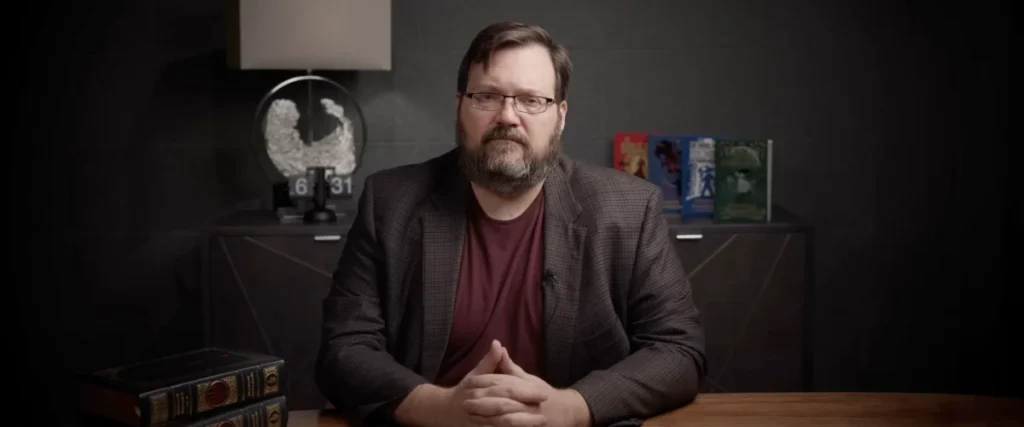
The annual Dragonsteel Nexus conference, a cornerstone event organized by Brandon Sanderson’s burgeoning media company, served as the platform for a pivotal address late last year. Titled "The Hidden Cost of AI Art," Sanderson’s talk delved into the complex and often contentious intersection of artificial intelligence and creative expression, offering a nuanced perspective that has resonated widely within the literary and broader artistic communities. Sanderson, a prolific author celebrated for his expansive Cosmere universe and innovative storytelling, opened his discussion by acknowledging the revolutionary yet unsettling nature of current technological advancements. "The surge of large language models and generative AI raises questions that are fascinating," he stated, "and even if I dislike how the movement is going in relation to writing and art, I want to learn from the experience of what’s happening." This initial statement set the tone for a discourse that, while critical, was rooted in a genuine desire for understanding rather than outright rejection of the technology itself.
Sanderson’s personal aversion to AI-generated art was unmistakable; he confessed that "my stomach turns" at the prospect. Yet, rather than simply voicing disapproval, he embarked on an intellectual journey to pinpoint the precise reasons behind this visceral reaction, systematically examining and ultimately setting aside several common objections that often dominate public discourse. While the specific objections he dismissed were not detailed in the original report, typical arguments against AI art often revolve around issues of copyright infringement, the displacement of human artists, the perceived lack of "soul" or originality, and the ethical implications of data scraping. By moving beyond these often-cited concerns, Sanderson aimed to uncover a more fundamental, perhaps overlooked, aspect of art’s inherent value.
The Transformative Power of Creation: Sanderson’s Core Thesis
Sanderson ultimately anchored his argument in a deeply personal reflection on the act of creation itself. Recalling his early struggles with numerous failed book manuscripts before achieving professional success, he illuminated what he identifies as the singular, irreplaceable value of art: its profound capacity to transform the artist. This internal metamorphosis, he contended, is the true "hidden cost" that AI art bypasses.
He elaborated on this transformative process with poignant clarity: "Maybe someday the language models will be able to write books better than I can. But here’s the thing: Using those models in such a way absolutely misses the point, because it looks at art only as a product." For Sanderson, the essence of artistic endeavor transcends the mere production of a finished piece. It encompasses the struggle, the learning, the perseverance, and ultimately, the profound sense of accomplishment derived from bringing a complex vision to fruition. "Why did I write [my first manuscript]?" he mused. "It was for the satisfaction of having written a novel, feeling the accomplishment, and learning how to do it. I tell you right now, if you’ve never finished a project on this level, it’s one of the most sweet, beautiful, and transcendent moments. I was holding that manuscript, thinking to myself, ‘I did it. I did it.’" This powerful testimony underscores a critical distinction: AI excels at generating output, but it cannot experience the journey of creation, nor can it undergo the personal growth that defines the human artistic experience.
Art as Telepathy: A Complementary Perspective
Adding another layer to this critical examination, an observer and fellow writer offered a complementary perspective, framing art as an act of profound human communication. This view posits that art functions as a form of "telepathy," where the artist employs a tangible medium—be it prose on a page, paint on a canvas, or notes in a melody—to transmit intricate internal cognitive states from their mind directly to that of their audience. This act is described as one of the most beautiful and fundamentally human endeavors.
From this vantage point, the concept of engaging with a book authored by a language model or experiencing a film generated solely from a prompt becomes inherently paradoxical, if not "anti-human." Such creations, devoid of a human consciousness from which to originate complex internal states, are likened to "the heroin needle providing a quixotic simulation of love." The authenticity of the communication is lost, replaced by an imitation that lacks the genuine human connection and shared experience that define true art. This perspective reinforces Sanderson’s argument by highlighting that if art is fundamentally about human expression and connection, then AI, by its very nature, is incapable of participating in this core function.
Chronology of the AI Art Debate in Creative Industries
The debate surrounding AI art did not emerge in a vacuum but intensified significantly in the period leading up to and following Sanderson’s talk in late 2023. The year witnessed an unprecedented acceleration in generative AI capabilities, particularly with the widespread availability of tools like Midjourney, Stable Diffusion, and advanced large language models such as OpenAI’s GPT series and Anthropic’s Claude.
- Early 2022: Initial widespread public awareness of AI image generators sparks curiosity and nascent concerns among artists.
- Mid-2022: Generative AI tools become more accessible, leading to a surge in AI-created content. Artists begin to voice concerns about intellectual property rights and the ethical sourcing of training data.
- Late 2022: Legal challenges emerge. Lawsuits are filed against AI companies (e.g., Stability AI, Midjourney, DeviantArt) by artists alleging copyright infringement, claiming their works were used to train AI models without consent or compensation. The Writers Guild of America (WGA) and other unions begin incorporating AI clauses into contract negotiations.
- Early 2023: The debate broadens to include generative text models. Authors express apprehension about AI-generated books flooding markets and the potential devaluation of human authorship. Calls for stronger copyright protections and ethical guidelines intensify.
- Mid-2023: Major industry bodies, including the Authors Guild and various visual arts organizations, issue statements and recommendations advocating for human-centric AI policies and artist protections. Public demonstrations and online campaigns against unethical AI practices gain momentum.
- Late 2023 (Time of Sanderson’s Talk): The discourse shifts from mere concern to active resistance and the formulation of principles. Sanderson’s address at Dragonsteel Nexus fits into this evolving landscape, offering a philosophical anchor for those seeking to define the boundaries of human creativity against technological encroachment.
Broader Impact and Implications for Creative Sectors
Sanderson’s address, delivered by a figure of his stature, carries significant weight across various creative industries. His emphasis on the intrinsic value of the artistic process and human agency has resonated deeply within communities grappling with the rapid advancements of AI.
- Literary World: In the publishing industry, Sanderson’s voice is particularly influential. His success, including multiple record-breaking Kickstarter campaigns and a devoted global readership, lends authority to his pronouncements. The proliferation of AI-generated content poses significant threats, from concerns about copyright infringement on authors’ works used for training data to the potential flooding of marketplaces with low-quality, AI-produced books that could devalue genuine human authorship. Sanderson’s argument provides a philosophical defense against viewing books merely as "products" to be generated, underscoring the irreplaceable human element.
- Visual Arts: Similar concerns plague the visual arts. Artists worry about the diminished market value of human-created art, the ethical sourcing of training data, and the legal ambiguities surrounding AI-generated imagery. Sanderson’s focus on the artist’s journey is a powerful affirmation of the unique human skill, vision, and effort that AI cannot replicate.
- Music and Film: While Sanderson’s talk centered on writing and art, the implications extend to music and film. AI is increasingly capable of generating musical compositions, voiceovers, and even rudimentary video content. The debate in these sectors mirrors the literary and visual arts: what constitutes true artistry when machines can simulate creative output? How do we ensure fair compensation and recognition for human creators?
- Ethical and Legal Landscape: The ongoing legal battles against AI companies highlight the urgent need for clearer legislative frameworks regarding intellectual property in the age of generative AI. Governments and international bodies are under pressure to define what constitutes "authorship" and "originality" for AI-generated works, and how to protect human creators whose existing works are used without consent. Sanderson’s call to "define it" suggests a proactive stance in shaping these legal and ethical boundaries.
The Call to Agency: Defining Art and Saying "No"
What truly distinguished Sanderson’s talk was its powerful conclusion: an emphatic assertion of human agency in defining art itself. "That’s the great thing about art — we define it, and we give it meaning," he declared. This statement serves as a potent counter-narrative to the increasingly common "nihilistic passivity" observed in much of the AI commentary.
This prevalent trend, as noted by the original article’s author, often features essays that lay out dire scenarios of AI’s destructive potential, then offer little in the way of resistance or a path forward, leaving readers with a sense of weary resignation. Sanderson explicitly challenges this meekness. His message is one of empowerment: "The machines can spit out manuscript after manuscript after manuscript. They can pile them to the pillars of heaven itself. But all we have to do is say ‘no.’"
This "no" is not a Luddite rejection of technology, but rather a profound affirmation of human sovereignty over cultural values and definitions. It suggests that while AI can generate endless content, humanity retains the ultimate authority to determine what qualifies as "art," what holds meaning, and what experiences are truly valuable. In areas that matter most to human flourishing and cultural identity, Sanderson contends, it is "us, not the whims of Sam Altman or Dario Amodei," who ultimately shape our existence. This resonates with broader societal discussions about technological determinism versus human choice, reminding us that the future of art and creativity remains, fundamentally, in human hands.
Correction Regarding Anthropic’s Opus 4.6 LLM Report
In a recent podcast episode titled "AI Reality Check," the following statement was made: "If you go back and look at the release notes for Anthropic’s earlier, less powerful Opus 4.6 LLM, they say the following: their researchers used Opus to find, quote, ‘over 500 exploitable zero-day vulnerabilities, some of which are decades old.’ And let’s stop for a moment because that note, which was hidden in the system card for Opus 4.6, is almost word for word what Anthropic said about Mythos."
This wording contained inaccuracies and has been clarified. The reference was to a report published by Anthropic concerning Opus 4.6, released concurrently with the model. While accurately described as "release notes" or "supplementary release notes," it was not technically the "system card" for Opus 4.6.
The specific statements within Anthropic’s report were: "Opus 4.6 found high-severity vulnerabilities, some that had gone undetected for decades." In a separate section, the report also stated: "So far, we’ve found and validated more than 500 high-severity vulnerabilities." Both the title of the report and its conclusion referred to these vulnerabilities as "0-day."
However, the precise quote provided in the podcast — "over 500 exploitable zero-day vulnerabilities, some of which are decades old" — does not appear verbatim within Anthropic’s official report. This specific phrasing was, in fact, a summary of the report’s findings as presented in a tweet by Daniel Sinclair. While the summary accurately conveyed the essence of the report’s claims regarding the number and nature of vulnerabilities discovered by Opus 4.6, the podcast’s wording inadvertently implied that this exact quote originated directly from the Anthropic report itself, which it did not.
The correction is issued to ensure factual precision. We extend our gratitude to the AI researcher who identified these discrepancies. Concerns or notes can always be directed to [email protected].