


The rapid proliferation of artificial intelligence across secondary and higher education institutions has triggered a fundamental reassessment of how students engage with course material, forcing educators to move past the initial panic of unauthorized software usage and toward a strategic evaluation of pedagogical design. As global statistics indicate that an overwhelming majority of students are independently integrating artificial intelligence into their study habits, school administrators and policymakers are grappling with a critical dichotomy: whether these computational tools merely supply instant answers or actively foster cognitive engagement and critical thinking. In response to this shifting educational landscape, Microsoft has introduced "Study and Learn," a specialized agent integrated within the Microsoft 365 Copilot ecosystem. Designed specifically to anchor artificial intelligence in established learning-science principles, the tool aims to guide students through complex problem-solving processes rather than short-circuiting their academic efforts with pre-packaged solutions.
The urgency behind deploying education-focused artificial intelligence tools is underscored by recent data from Microsoft’s 2026 global education research initiative. According to the findings, 92 percent of enrolled students globally acknowledge utilizing artificial intelligence for school-related tasks, while more than half of institutional leaders report that their schools are actively implementing or scaling enterprise artificial intelligence strategies. Students frequently turn to these technologies to synthesize dense reading materials, overcome academic roadblocks during independent study, and brainstorm project topics. Furthermore, approximately one-third of surveyed learners explicitly rely on these systems to customize their study methodologies to align with individual learning styles.
Despite these high adoption rates among students, many educational institutions have historically responded with restrictive measures, choosing to limit or completely block access to artificial intelligence applications on campus networks. However, education experts note that heavy-handed restrictions on school-managed devices rarely deter students, who simply migrate their usage to personal smartphones and home computers. Consequently, blocking institutional access often backfires by stripping educators and administrators of any meaningful oversight, leaving learners navigating powerful technological tools entirely without guardrails, academic supervision, or ethical guidance.
This regulatory disconnect is further exacerbated by a substantial communication gap between institutional policy and daily classroom reality. Data from the 2026 Microsoft special report reveals that while four out of five education leaders believe their institutions provide clear artificial intelligence guidance, only about half of surveyed students and teachers report receiving any guidance at all. The training deficit is even more pronounced: 77 percent of students and 53 percent of educators state they have received zero formal training in artificial intelligence usage, despite overwhelming demand, with 66 percent of educators and 52 percent of students requesting structured training on a quarterly basis.
Chronologically, the integration of generative artificial intelligence in classrooms has evolved through distinct phases over the past several years. The initial phase, spanning from late 2022 through 2023, was characterized by widespread disruption, academic integrity concerns, and reactionary blanket bans following the public release of consumer-facing large language models. By 2024 and 2025, institutions transitioned into an exploratory phase, recognizing the inevitability of the technology and attempting to draft preliminary governance frameworks and ethical use policies. Now, entering 2026, the educational technology sector has entered a critical consolidation phase, where software developers and school districts are shifting focus toward purpose-built, secure educational ecosystems that prioritize active learning, institutional privacy controls, and data protection compliance.
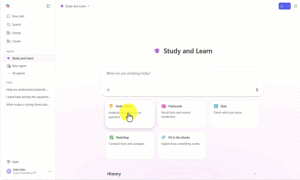
Within this evolving timeline, the introduction of Microsoft’s Study and Learn agent represents a concerted effort to address the shortcomings of generalized conversational models. Unlike consumer-facing chat interfaces that prioritize speed and direct answers, Study and Learn is architected to function as a digital tutor that mirrors effective instructional techniques. For instance, when a student prepares for a biology examination, the agent can dynamically generate customized flashcard sets directly from the user’s uploaded lecture notes. When tackling advanced calculus homework, the system avoids providing the final solution, instead offering step-by-step scaffolding questions designed to prompt the student to perform the core mathematical reasoning. Similarly, when drafting analytical essays in history, the agent evaluates the student’s developing thesis and responds with targeted counter-arguments and probing questions to sharpen their critical perspective. Crucially, the platform operates entirely within the student’s localized Microsoft 365 document environment, drawing exclusively from authorized textbooks, classroom slides, and PDF readings while providing precise citations back to the original source material.
The underlying architecture of Study and Learn is deliberately rooted in cognitive science rather than purely computational objectives. By incorporating evidence-based practices such as retrieval practice, spaced repetition, and cognitive scaffolding, the tool actively discourages passive consumption. Educational researchers emphasize that when students are forced to articulate their reasoning and work through guided prompts, neural pathways associated with long-term retention and conceptual mastery are significantly strengthened.
Reactions from educational practitioners on the ground reflect cautious optimism regarding this technological pivot. Shane Tooley, Assistant Principal of Curriculum at St. Peter Claver College in Australia, noted a marked evolution in student behavior following the implementation of structured enterprise artificial intelligence tools. According to Tooley, students are no longer merely looking for shortcuts or finished answers; instead, they are learning how to formulate sophisticated, multi-layered prompts that enhance their engagement with the curriculum—a behavioral shift that educators view as a major pedagogical victory.
Implementing Study and Learn within an educational setting requires deliberate coordination between instructional leaders and technical administrators. The agent is available through eligible Microsoft 365 Education licensing tiers, specifically A1, A3, and A5. However, deployment is contingent upon a primary administrative prerequisite: Copilot Chat must be explicitly enabled by an institutional IT administrator. For primary and secondary education environments, Microsoft has engineered Copilot Chat to be disabled by default, requiring administrators to activate age-gating controls specifically tailored for learners aged 13 to 17. The tool remains entirely inaccessible for students under the age of 13, establishing a strict compliance framework designed to protect younger minors.
This technical dependency creates a necessary bridge between pedagogical vision and technical execution. While curriculum directors and teachers establish the academic priorities and learning outcomes, institutional chief technology officers and IT departments hold the administrative controls. Experts advise school leadership teams to leverage empirical data, such as the comprehensive findings in the AI in Education report, to facilitate collaborative discussions regarding safe deployment, privacy safeguards, and enterprise-grade data protection standards.
The broader implications of successfully integrating learning-first artificial intelligence extend far beyond the immediate academic term, connecting directly to the future economic viability and workforce readiness of today’s students. According to labor market research cited from the LinkedIn Work Change Report, approximately 70 percent of the core skills required across the global workforce are undergoing significant transformation, largely catalyzed by the rapid integration of artificial intelligence technologies. Furthermore, the volume of job postings explicitly requiring artificial intelligence literacy experienced a staggering sixfold increase within a single year.
Students themselves are acutely aware of this macroeconomic transition. Institutional surveys reveal that 79 percent of students believe that mastering the effective and responsible use of artificial intelligence is essential for their future career prospects, a sentiment echoed by 87 percent of educators and institutional leaders. By granting students controlled access to pedagogically sound, learning-first artificial intelligence experiences during their formative academic years, schools can successfully bridge the gap between theoretical knowledge and practical workplace competencies.
As educational institutions worldwide continue to navigate the complexities of the digital age, the fundamental question facing administrators is no longer whether artificial intelligence will occupy a space in the classroom, but rather what philosophy will govern its application. By shifting away from unchecked consumer applications and toward enterprise-grade, learning-science-backed solutions like Study and Learn, schools possess a viable mechanism to ensure that technological innovation enhances, rather than diminishes, human intellect and critical inquiry.