


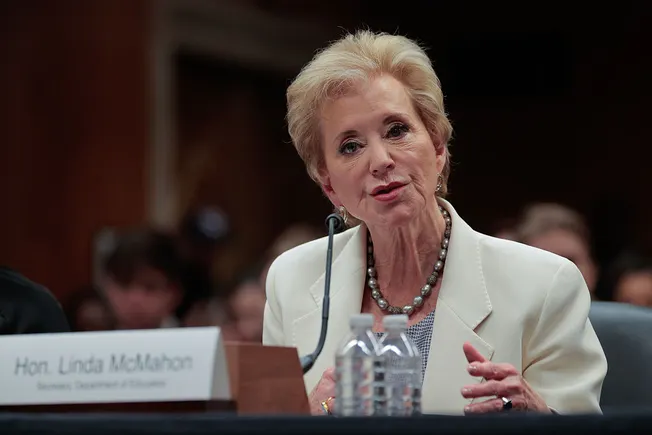
Democratic leaders on the Senate Appropriations Committee have launched a formal inquiry into the United States Department of Education, accusing the federal agency of systematically subverting congressional intent through a controversial funding practice known as "frontloading." In a strongly worded letter addressed to U.S. Secretary of Education Linda McMahon, lawmakers highlighted that the agency’s strategic shift in distributing discretionary awards has resulted in approximately $630 million in appropriated federal resources being withheld across roughly 35 vital grant programs.
The dispute centers on how the Education Department allocates multiyear funding. Rather than following the traditional model of dispersing funds across annual budget periods to maximize the breadth of educational outreach, the agency has increasingly opted to bundle multiyear funding into single, massive lump sums awarded to a drastically reduced pool of recipients. According to congressional estimates, this methodology has artificially restricted the number of educational entities able to secure critical federal backing, leaving hundreds of local school districts, research institutions, and community-based programs without anticipated federal support.
Chronology and Escalation of Congressional Scrutiny
The friction between Capitol Hill and the Department of Education represents the latest flashpoint in an ongoing battle over federal oversight, executive authority, and educational policy priorities. The timeline of this dispute underscores a rapidly deteriorating relationship between federal lawmakers and executive branch administrators:
- Early 2025: The Department of Education begins shifting internal administrative guidance regarding discretionary grant distribution, favoring concentrated multiyear investments over broader annual funding allocations.
- August 2025: The agency proposes a sweeping new administrative rule that would grant the federal government broad authority to abruptly terminate, discontinue, or withhold discretionary funding—including provisions allowing terminations simply "for convenience" and via retroactive reviews of original applications.
- Fall 2025: Legal challenges mount from civil rights and education advocacy groups regarding executive cancellations of prior grants tied to diversity, equity, and inclusion (DEI) practices, resulting in federal court rulings that invalidate several administration directives.
- October 13, 2025: U.S. Senators Patty Murray (D-Wash.) and Tammy Baldwin (D-Wis.) dispatch a formal oversight letter to Secretary Linda McMahon, detailing the $630 million freeze and accusing the agency of using frontloading to bypass bipartisan congressional appropriations.
- October 14, 2025: The Department of Education defends its policy through a public statement released by Ellen Keast, communications director for the undersecretary, emphasizing a mandate to return educational control to states and prioritize high-quality grantees.
Anatomy of the Funding Freeze and Programmatic Impact
In their October 13 correspondence, Senators Murray and Baldwin—serving respectively as the vice chair of the Senate Appropriations Committee and the ranking member of the Appropriations Subcommittee on Labor, Health and Human Services, Education, and Related Agencies—detailed the profound real-world consequences of the Department of Education’s frontloading policy.
Had the agency adhered to traditional annual funding distributions, the federal government would have been capable of issuing more than 1,000 additional grants this fiscal year alone. These grants underwrite some of the most critical foundational pillars of the American educational ecosystem, including evidence-based student literacy initiatives, comprehensive student mental health support systems, foundational education research, and targeted programs aimed at recruiting and preparing the next generation of classroom educators.
A prime illustration of this policy shift highlighted by the committee involves the Innovative Approaches to Literacy program. Although Congress earmarked $30 million for the initiative within the fiscal year 2026 appropriations framework—with the explicit expectation that the department would issue up to 35 separate awards—the agency ultimately finalized only four new awards. The remaining balance of roughly $13 million was held back to fund future budget periods for those four select entities, effectively locking out dozens of other qualified school districts and community literacy groups from accessing federal assistance.
Lawmakers argue that this calculated bottlenecking violates the spirit and letter of bipartisan congressional appropriations, deliberately shrinking the footprint of federal investments in public education.
Defense and Rationale from the Department of Education
The Department of Education has forcefully defended its administrative approach, framing the policy as a necessary correction designed to maximize fiscal efficiency and refocus federal priorities on measurable academic outcomes.
Responding to the allegations, Ellen Keast, communications director for the undersecretary at the Department of Education, questioned the motivations behind the congressional inquiry in an email statement.
"The better question is why would an Administration dedicated to improving literacy outcomes and supporting child care for low-income student parents continue the failed approach of previous Administrations?" Keast wrote. "Yes, we are returning education to the states and have furthered that effort by funding the highest-quality grantees that will help kids learn to read and support parents in college."
From the administration’s perspective, concentrating financial resources into top-tier programs ensures that taxpayer dollars are not diluted across a high volume of lower-performing or redundant initiatives. By reducing administrative overhead and channeling larger sums directly to elite grantees, proponents argue the department can better enforce accountability and drive targeted results in foundational academic metrics.
Broader Policy Context: DEI Controversies and Rulemaking Battles
The dispute over grant frontloading does not occur in a vacuum; it is deeply intertwined with a broader, contentious effort by the administration to reshape the federal footprint in education. Over the past year, the Department of Education has faced intense scrutiny—and numerous courtroom defeats—over its handling of federal grants, particularly concerning the retroactive conditioning or cancellation of funding based on ideological compliance.
Several federal courts have intervened in recent months to block administrative directives that targeted grant recipients utilizing diversity, equity, and inclusion (DEI) frameworks. In multiple instances, federal judges have ruled that abrupt funding cuts and retroactive enforcement mechanisms are unlawful, forcing the department to reinstate or backpedal on previously canceled mental health and teacher training grants.
Compounding these legal setbacks, the department has pursued aggressive rulemaking designed to codify its expansive authority over discretionary funds. The proposed rule introduced in August would institutionalize mechanisms allowing the government to terminate grants "for convenience" or re-evaluate past applications to ensure absolute alignment with evolving executive branch policies.
Democratic lawmakers warn that the combination of grant frontloading and the proposed termination rules creates a precarious vulnerability for public education funding. Because frontloaded grants lump multiyear funding into upfront allocations, any subsequent invocation of the proposed "for convenience" termination rules could wipe out substantial portions of bipartisan appropriations approved by Congress.
"This means the Department could easily terminate all these frontloaded funds, effectively terminating a large swath of FY2026 funds that Congress appropriated on a bipartisan basis," Murray and Baldwin wrote in their letter.
Future Implications for Federal Education Policy
As the standoff between the Senate Appropriations Committee and the Department of Education deepens, the implications extend far beyond a bureaucratic disagreement over accounting methods. The outcome of this conflict will likely establish critical legal and administrative precedents regarding the limits of executive power over congressionally mandated spending.
If the Department of Education successfully implements its proposed rules and maintains its frontloading strategy, future executive administrations will possess unprecedented unilateral leverage to reshape, defund, or redirect federal education programs without explicit legislative authorization. Conversely, a concerted pushback from Capitol Hill—backed by potential legislative riders, continued litigation, and aggressive budgetary oversight—could rein in executive discretion and reaffirm Congress’s constitutional power of the purse.
For local school districts, state education agencies, and nonprofit organizations reliant on federal discretionary grants, the ongoing uncertainty creates significant operational hurdles. As federal policy shifts dynamically with each political cycle, educational institutions find themselves increasingly caught in the crossfire of a fundamental ideological debate over the federal government’s role in shaping America’s classrooms.