



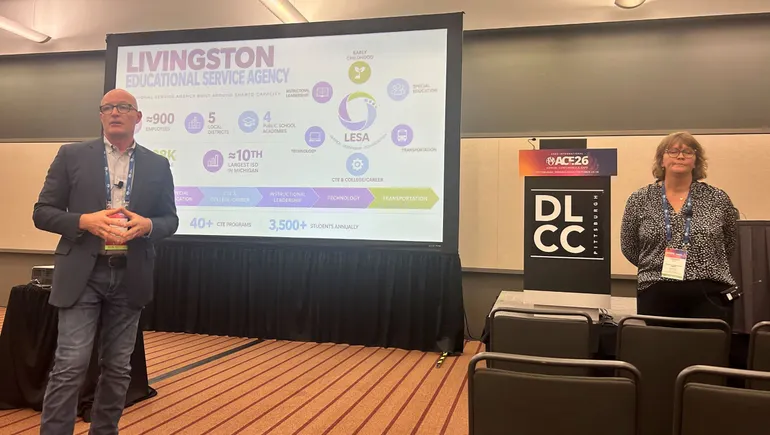
PITTSBURGH — In the complex ecosystem of modern public education finance, the traditional image of budget development is often one of isolation. School district finance offices typically operate behind closed doors, sequestered with spreadsheets, historical trend lines, and calculator tapes, emerging only once a year to present a finished fiscal blueprint to the school board. Yet, for the approximately 28,000 students served by Michigan’s Livingston Educational Service Agency (Livingston ESA), that insular model has been thoroughly dismantled and replaced by a collaborative, cross-departmental framework.
Administrators at Livingston ESA argue that fiscal health is not merely a mathematical exercise, but a cultural one. By prioritizing robust relationships across departments and embedding transparency deep within its leadership cabinet, the agency has redefined how public funds are allocated, forecasted, and monitored.
This innovative approach took center stage on a Wednesday morning in Pittsburgh, where Livingston ESA Deputy Superintendent Stephanie Weese and Superintendent Michael Hubert addressed education finance professionals during a high-profile presentation at the Association of School Business Officials International (ASBOI) 2026 Annual Conference & Expo. As school districts nationwide grapple with post-pandemic fiscal cliffs, expiring federal relief funds, and rising operational costs, the Livingston ESA model offers a compelling blueprint for organizational resilience.
Main Facts: Redefining the Fiscal Workflow
At the core of Livingston ESA’s budgeting philosophy is the elimination of departmental silos. Rather than leaving spending decisions entirely to the finance department, the agency integrates the budget-building process into the regular operations of its entire leadership cabinet.
According to Weese, this strategy has allowed the district to craft exceptionally accurate budgets for upcoming academic years. This precision is not born of advanced predictive algorithms alone, but from continuous, granular communication. By actively consulting department heads to evaluate what is working, what is failing, and where resources are genuinely needed, Livingston ESA moves beyond passive trend analysis into proactive fiscal stewardship.
The agency’s leadership team convenes twice a month. Significantly, the district’s budget director attends every meeting, ensuring that financial updates are delivered in real time rather than quarterly or annually. This constant loop of communication guarantees that programmatic decisions and fiscal realities are always evaluated in tandem.
Chronology and Operational Routine: The Twice-Monthly Rhythm
The transformation of Livingston ESA’s budgeting process is anchored in a highly structured, relational meeting cadence designed by Superintendent Hubert and his leadership team. The chronology of these sessions is meticulously calibrated to build trust, foster mutual respect, and maintain absolute operational clarity.
Before a single operational or financial metric is discussed, the leadership team engages in structured check-ins and exchanges of appreciation. Hubert reviews brief pre-check-in forms submitted by each cabinet member prior to the meeting. This preparatory step allows the superintendent to gauge the emotional and operational temperature of the district, identifying friction points, emerging challenges, or structural bottlenecks that require immediate collective attention.
Once the meeting officially commences, the team utilizes a communication framework Hubert describes as "connecting the dots." Each cabinet member is permitted a maximum of three short, key updates regarding their respective departments.
This brevity is intentional. By preventing long-winded, monolithic presentations, the model ensures that all leaders absorb high-level operational context regarding what is happening across the entire agency. While routine during stable financial periods, this shared situational awareness pays immense dividends during times of stress. If the district were to face sudden economic downturns or revenue shortfalls necessitating immediate spending reductions, the leadership team already possesses the cross-departmental familiarity and trust required to navigate difficult, high-stakes decisions collaboratively.
Supporting Data and Practical Exercises: Stress-Testing the Budget
Livingston ESA’s commitment to transparency extends beyond casual updates into active, rigorous financial simulations. Although the district has not recently faced severe budgetary contractions, Superintendent Hubert insists that leadership teams must regularly practice the mechanics of fiscal reduction before an actual crisis hits.
To cultivate these critical skills, the cabinet periodically engages in collective cost-cutting exercises. During these simulations, individual leaders are tasked with closely examining their respective department budgets to identify potential savings.
However, this exercise has not been without its operational friction. Weese noted that one notable drawback of the simulation was that it occasionally "didn’t feel real" to all participants. Leaders whose departments were entirely funded through external restricted grants frequently pushed back, arguing that they bore no obligation to make cuts when other, unrestrictive departments could absorb reductions more easily.
To bridge these gaps and maintain strategic alignment, the district implemented a traffic-light indicator system for all financial projections. When the budget director presents the agency’s financial outlook for the upcoming year, each projection is categorized using a distinct color code:
- Green Light: Signifies steady, stable, or increased funding, indicating a healthy fiscal posture.
- Yellow Light: Signals caution, warning the leadership team to exercise restraint and carefully evaluate the addition of any new expenses.
- Red Light: Acts as an urgent alarm, prompting the cabinet to proactively deliberate and implement strategic budget cuts.
This red, yellow, and green framework is not reserved solely for annual projections; it is actively applied during mid-year budget reviews. If mid-year financial adjustments reveal unexpected surplus funds, cabinet members are invited to propose additional line items and programmatic enhancements for their respective departments. Superintendent Hubert then evaluates these proposals using the same color-coded risk assessment methodology.
Weese acknowledges that this participatory model is labor-intensive and requires significant advance planning. Nevertheless, she emphasizes that the investment of time yields massive returns in institutional buy-in. "They all had the opportunity to add their wants, their needs, and we then talked about it as an entire cabinet," Weese stated, highlighting how inclusive deliberation transforms a top-down administrative mandate into a shared institutional mission.
Official Responses and Industry Context
The presentation in Pittsburgh drew significant attention from attendees at the ASBOI 2026 Annual Conference & Expo, reflecting widespread anxiety across the K-12 education sector regarding financial sustainability. With the expiration of the federal Elementary and Secondary School Emergency Relief (ESSER) funds, public school districts nationwide are navigating unprecedented fiscal cliffs.
Industry analysts and school business officials have increasingly pointed out that traditional budgeting models—often characterized by adversarial negotiations between program directors and finance officers—are poorly suited for an era of declining revenues and shifting enrollment trends. When departments view the budget as a zero-sum game where they must fiercely protect their turf, institutional transparency breaks down, leading to reactive cuts, low morale, and misallocated resources.
Superintendent Hubert emphasized that relational trust is the indispensable foundation upon which all fiscal accuracy rests. "How we build the trust is by respecting each other and engaging and listening to who they are, how they’re engaging in their work, [and] what’s going on," Hubert noted during the session. By validating the daily realities of educators and administrative leaders, Livingston ESA ensures that financial figures on a spreadsheet represent real human priorities and educational outcomes.
Broader Impact and Implications for School Districts
The practices showcased by Livingston ESA carry profound implications for educational governance and administrative leadership across the United States. As public scrutiny of school district spending intensifies, governing boards and local taxpayers are demanding higher levels of fiscal accountability and operational transparency.
By shifting the budgeting paradigm from an administrative chore managed by a select few into an ongoing, collaborative dialogue shared by all cabinet members, Livingston ESA demonstrates that internal transparency directly correlates with external financial health. When department heads understand the financial mechanics of the entire agency, they become better stewards of public funds, more creative problem-solvers, and more effective advocates for student success.
Furthermore, the integration of structured check-ins, transparent indicators, and hands-on simulation exercises provides a replicable framework for other educational service agencies, local school districts, and municipal government bodies alike. In an environment defined by economic volatility, Livingston ESA’s success underscores a fundamental truth: robust fiscal health begins not with calculators and spreadsheets, but with listening, respect, and shared responsibility.