



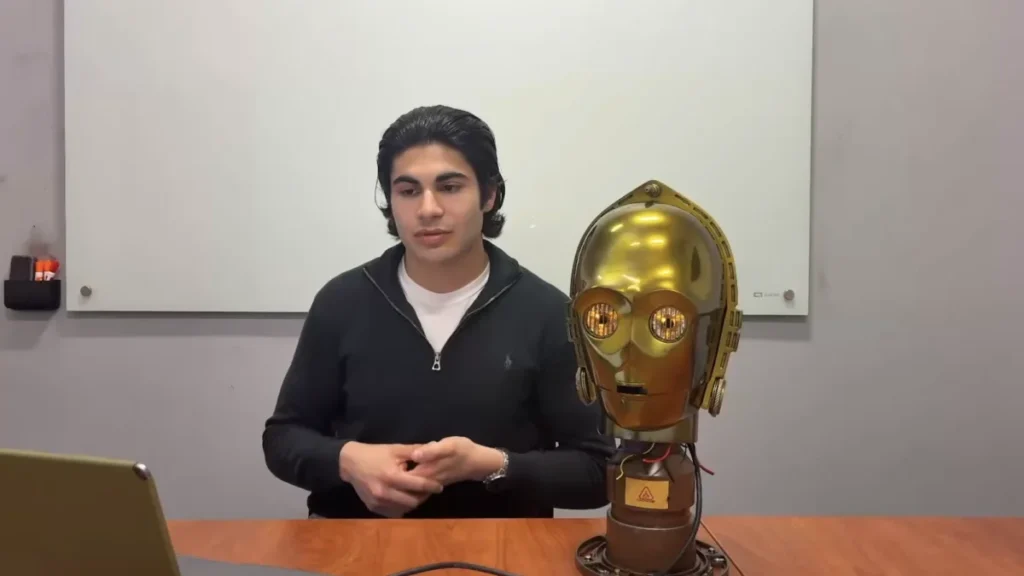
The boundary between science fiction and tangible reality continues to blur as hobbyist robotics and accessible artificial intelligence reach new heights of sophistication. Sam Potozkin, a business analyst at Chapman University and a dedicated robotics enthusiast based in Orange County, California, has recently unveiled a meticulously crafted, conversational replica of the iconic Star Wars protocol droid, C-3PO. Unlike previous iterations of movie prop replicas, which often rely on pre-recorded lines or remote control, Potozkin’s creation leverages modern "Edge AI" to engage in real-time, autonomous dialogue. The project represents a significant milestone in the maker movement, demonstrating that the computational power required for complex humanoid interaction is now available in consumer-grade, credit-card-sized hardware.
The Vision: Bridging the Gap Between Prop and Persona
For decades, Star Wars fans have sought to recreate the galaxy’s most famous worrywart, but the technical hurdles of voice recognition, natural language processing, and authentic sound design often relegated these projects to static statues or simple soundboard-driven toys. Potozkin’s objective was fundamentally different: he aimed to create a "conversation buddy" that possessed the specific personality traits of the droid—politeness, anxiety, and a vast, if occasionally pedantic, knowledge base.
The project was born from a desire to see if modern large language models (LLMs) could be effectively "embodied" within a physical form without relying on the massive server farms owned by tech giants like Google or OpenAI. By housing the entire intelligence of the droid within the head itself, Potozkin has addressed one of the most significant challenges in modern robotics: latency and privacy. The result is a droid head that can parse human speech, formulate a character-accurate response, and speak back with the distinctive timbre of actor Anthony Daniels, all within seconds.
The Engineering Process: Additive Manufacturing and Aesthetic Precision
The physical construction of the C-3PO head began with high-resolution 3D printing. Using digital files modeled after the original 1977 film assets, Potozkin printed the head in multiple sections using a hollow plastic substrate. While 3D printing allows for high geometric accuracy, the resulting "print lines"—tiny ridges left by the nozzle—are a common detractor from cinematic realism.
To achieve the "protocol droid" finish, Potozkin engaged in an intensive post-processing phase. This involved dozens of hours of manual labor, beginning with coarse-grit sanding to level the surface, followed by progressively finer grits to achieve a glass-like smoothness. This was followed by the application of high-build primers to fill any remaining micro-fissures. The final aesthetic was achieved through a multi-stage painting process: a base coat of reflective silver to provide depth, followed by several layers of a specific gold-toned metallic spray. The crowning touch was a high-gloss clear coat, which not only protects the finish from oxidation and fingerprints but also provides the specular highlights seen under the twin suns of Tatooine.
Hardware Architecture: The Power of the Raspberry Pi 5
The "brain" of the C-3PO unit is the Raspberry Pi 5, the latest iteration of the popular single-board computer. Released in late 2023, the Pi 5 offers a significant leap in performance over its predecessors, featuring a 64-bit quad-core Arm Cortex-A76 processor running at 2.4GHz. This increase in clock speed and architectural efficiency is what allows the droid to handle the heavy computational load of local AI.
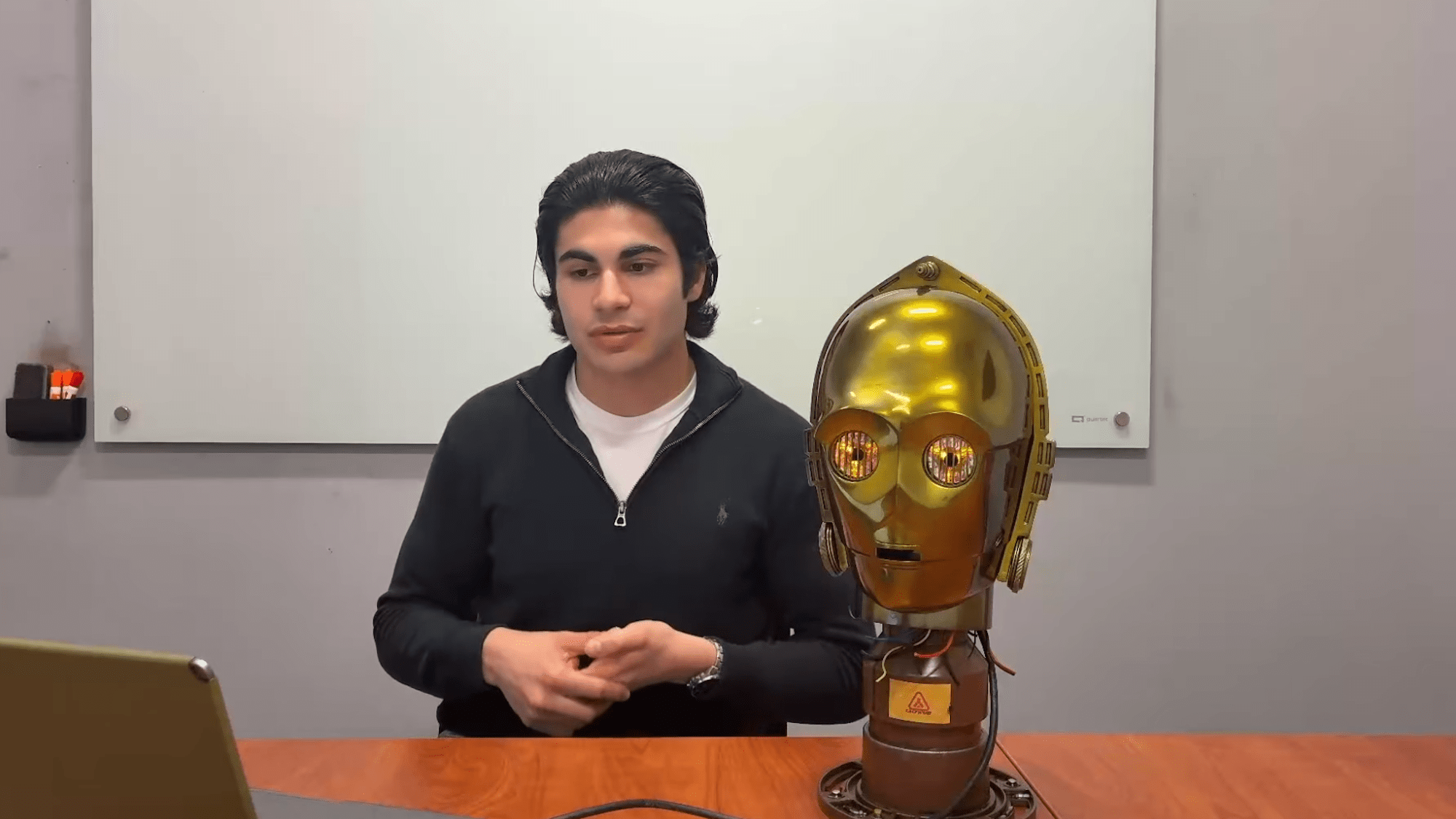
In many AI applications, the device acts merely as a terminal, sending audio data to a cloud server and waiting for a response. Potozkin avoided this "tethered" approach. By running the AI models locally on the Raspberry Pi 5, the droid remains functional even without an internet connection. This local processing also eliminates the "uncanny valley" of conversational delays, as the data does not need to travel to a data center and back. The hardware setup includes a high-sensitivity microphone hidden within the head’s structure to capture human input and a custom cooling solution to prevent the processor from throttling during intense linguistic computations.
The Software Stack: Integrating Speech, Logic, and Personality
The intelligence of the droid is built on a sophisticated three-part software pipeline. The first stage utilizes a speech-to-text (STT) engine, likely a variant of OpenAI’s Whisper or a similar open-source model optimized for edge devices. This engine listens for human vocalizations, filters out background noise, and converts the audio into a text string.
The second stage is the Large Language Model (LLM) core. Potozkin programmed the AI with a specific "system prompt"—a set of instructions that tells the AI to behave as C-3PO. This includes directives to use formal British English, reference "Master Luke" or the "Maker," and maintain a temperament that is helpful yet perpetually concerned about the odds of survival. The LLM processes the input text and generates a response that fits these parameters.
The final stage is the text-to-speech (TTS) synthesis. To achieve the iconic voice, Potozkin utilized a voice-cloning algorithm trained on audio samples of the droid from the Star Wars films. This ensures that the output is not a generic robotic voice but one that carries the specific pitch, cadence, and "mechanical" undertones associated with the character.
Acoustic Innovation: The Mechanical Exciter
One of the most technically creative aspects of Potozkin’s build is the audio output method. Standard speakers work by vibrating a paper or plastic cone to move air. However, a speaker grille would have ruined the seamless aesthetic of the gold-plated head. Instead, Potozkin utilized a "mechanical exciter."
An exciter is essentially a speaker without a frame or cone. When attached to a solid surface—in this case, the internal wall of the 3D-printed plastic head—it turns that entire surface into a sounding board. By vibrating the plastic of the head itself, the sound appears to emanate from the droid’s entire "body" rather than a specific point. This method also imparts a subtle, natural metallic resonance to the voice, further enhancing the illusion that the listener is speaking to a mechanical being.
Chronology of Development and Open Source Contribution
The development of the C-3PO head spanned several months, categorized by the following milestones:

- Phase 1: Design and Print (Month 1): Sourcing 3D models and completing the multi-day printing process.
- Phase 2: Finishing (Month 2): Intensive sanding, priming, and painting to achieve the signature gold sheen.
- Phase 3: Logic Integration (Month 3): Configuring the Raspberry Pi 5 and testing various LLMs for speed and personality accuracy.
- Phase 4: Audio Engineering (Month 4): Installing the mechanical exciter and fine-tuning the voice synthesis models.
- Phase 5: Public Release (Current): Documenting the process and uploading the code to the public.
In a move praised by the global maker community, Potozkin has made his entire project open-source. He has hosted the computer code, 3D print files, and a detailed technical white paper on GitHub. This transparency allows other enthusiasts to build upon his work, potentially adding motor-driven eyes, neck articulation, or even integrating the head onto a full-scale bipedal body.
Broader Implications: The Rise of Embodied AI
Potozkin’s project is more than a tribute to a beloved film character; it is a proof-of-concept for the future of "Embodied AI." As LLMs become more efficient, we are moving toward a world where household objects—from appliances to companion robots—can interact with humans in natural, context-aware ways.
Industry analysts suggest that the democratization of these technologies is shifting power away from centralized tech giants. When a single individual can build a conversational agent in their garage using a $100 computer and free software, the potential for personalized, private, and specialized AI becomes limitless. Potozkin’s C-3PO serves as a precursor to a new generation of smart devices that don’t just "process commands" but "understand" the nuances of human personality.
Conclusion: A New Era for The Workshop
The project was recently featured in Popular Science’s "The Workshop" series, which highlights ingenious DIY projects that push the boundaries of hobbyist engineering. While Potozkin admits that his C-3PO is currently "limited to one form of communication," the accuracy of that communication is a testament to the rapid advancement of consumer technology.
As the maker community continues to experiment with the Raspberry Pi 5 and localized AI models, the dream of a fully functional R2-D2 or a bipedal C-3PO moves closer to reality. For now, Potozkin’s gold-plated companion stands as a shining example of what can be achieved when cinematic inspiration meets the cutting edge of modern computing. The "Golden Rod" may still be waiting for a body, but his mind is already well-ahead of his time.