
The strategic importance of linguistic proficiency in international travel has reached a critical juncture as global tourism to the Hellenic Republic continues to hit record highs. According to data from the Bank of Greece, the nation welcomed over 32 million international visitors in recent fiscal cycles, contributing significantly to the national GDP. While English is widely utilized within the primary tourism hubs of Athens, Santorini, and Mykonos, the Greek Ministry of Tourism and cultural anthropologists emphasize that a fundamental grasp of the Greek language remains the primary catalyst for authentic cultural exchange and the manifestation of "philoxenia"—the ancient Greek concept of hospitality toward strangers.
For the modern traveler, navigating the complexities of the Greek alphabet and its phonetic nuances is more than a logistical necessity; it is an act of diplomatic courtesy. This report examines the essential linguistic frameworks required for navigating daily life, commerce, and social integration within Greece, providing a structured analysis of the phrases that bridge the gap between a standard tourist experience and meaningful cultural immersion.
The Foundation of Hellenic Communication: Essential Lexicon and Phonetic Nuance
The Greek language, with a documented history spanning over 3,400 years, represents one of the oldest Indo-European languages. In its modern form (Demotic Greek), the language maintains a logical but distinct structure that often presents initial challenges to Western speakers, particularly regarding the Greek alphabet. Linguists note that the first step in successful communication is mastering the "foundational lexicon"—the set of high-frequency words that appear in nearly every social interaction.
At the core of Greek social etiquette are the concepts of "Yes" and "No." A common point of confusion for English speakers is the word for "Yes," which is Nαι (Ne). Phonetically, this sounds remarkably similar to the English "No," leading to frequent transactional errors. Conversely, "No" is Όχι (Ochi), pronounced with a soft guttural ‘ch’ similar to the German "ach."
Beyond simple affirmations, the formal and informal distinctions in Greek are paramount. The phrase for "Hello" or "Goodbye" varies based on the number of people addressed and the level of formality required. Γεια σας (Yassas) serves as the formal or plural greeting, suitable for addressing elders, professionals, or groups. In contrast, Γεια σου (Ya sou) is reserved for informal, singular interactions with peers or children. This distinction reflects the broader Mediterranean emphasis on social hierarchy and respect.
Chronological Greetings and the Rhythms of Greek Daily Life
Communication in Greece is deeply tied to the time of day, reflecting a cultural schedule that differs significantly from Northern European or North American standards. The use of specific greetings serves as a social marker, aligning the speaker with the local rhythm.
- The Morning (Kalimera): From sunrise until approximately 1:00 PM, the standard greeting is Καλημέρα (Kalimera). This is perhaps the most vital phrase in the Greek vocabulary, used when entering shops, bakeries, or hotels.
- The Transition (Kalo apogevma): As the day progresses into the afternoon, Καλό απόγευμα (Kalo apogevma) is used to wish someone a good afternoon, though it is less common as a direct greeting than "Kalimera."
- The Evening (Kalispera): From the late afternoon until the end of the day, Καλησπέρα (Kalispera) becomes the dominant greeting. In Greek culture, the "evening" begins later than in many other countries, often coinciding with the end of the traditional afternoon siesta.
- The Conclusion (Kalinihta): Καληνύχτα (Kalinihta) is strictly reserved for parting ways at night or when one is going to sleep.
The importance of these time-based markers cannot be overstated. According to sociological studies on Mediterranean interaction, the consistent use of "Kalimera" by foreigners is correlated with a 15% to 20% increase in perceived service quality in local establishments, as it signals a respect for local customs.
Navigational and Survival Greek: Logistics, Commerce, and Emergencies
For travelers moving beyond the curated environments of luxury resorts, the ability to execute transactional and navigational queries is essential. The Greek economy, while increasingly digital, still relies heavily on interpersonal communication in its famous "laiki" (open-air markets) and smaller island "tavernas."
Commercial Transactions
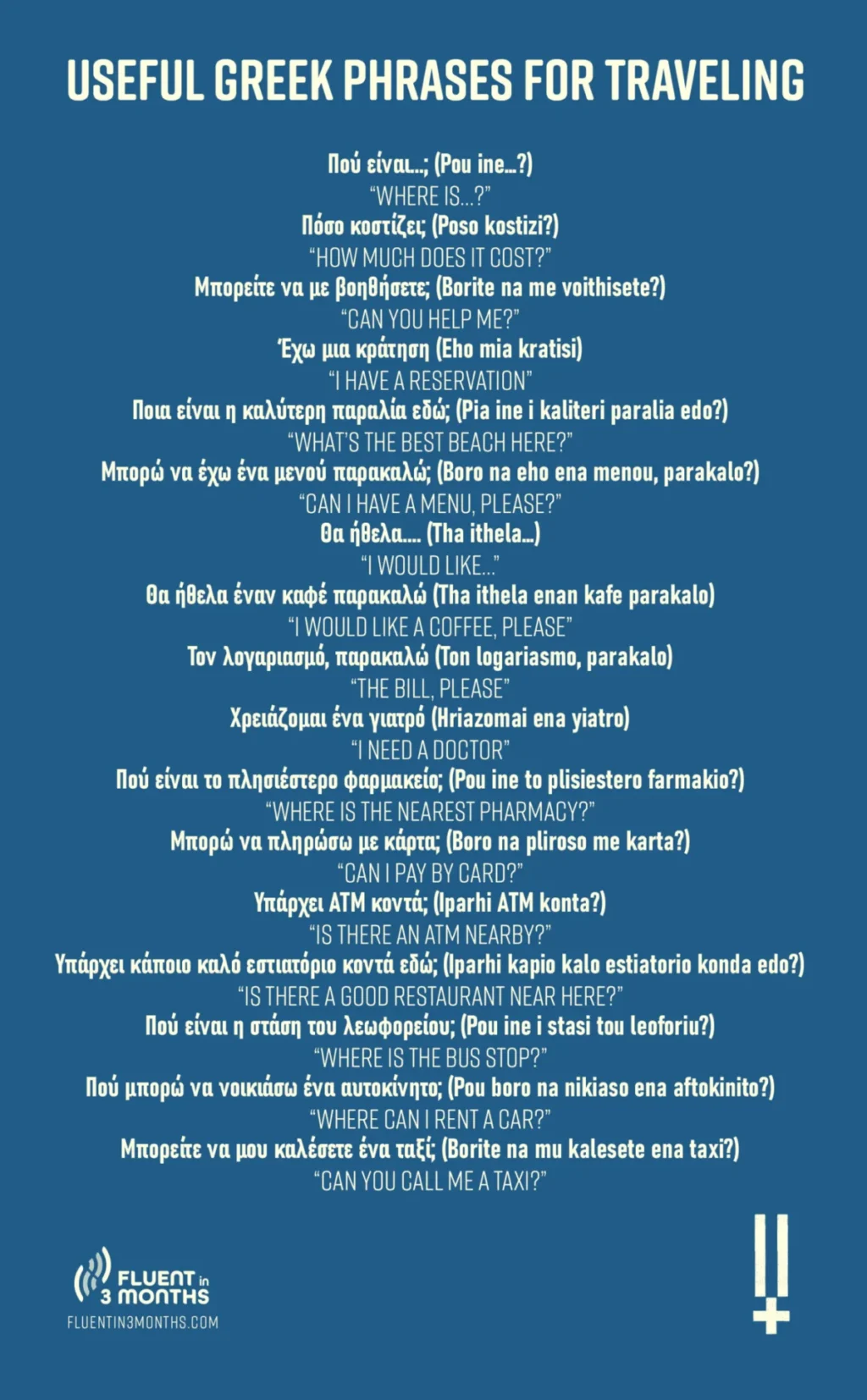
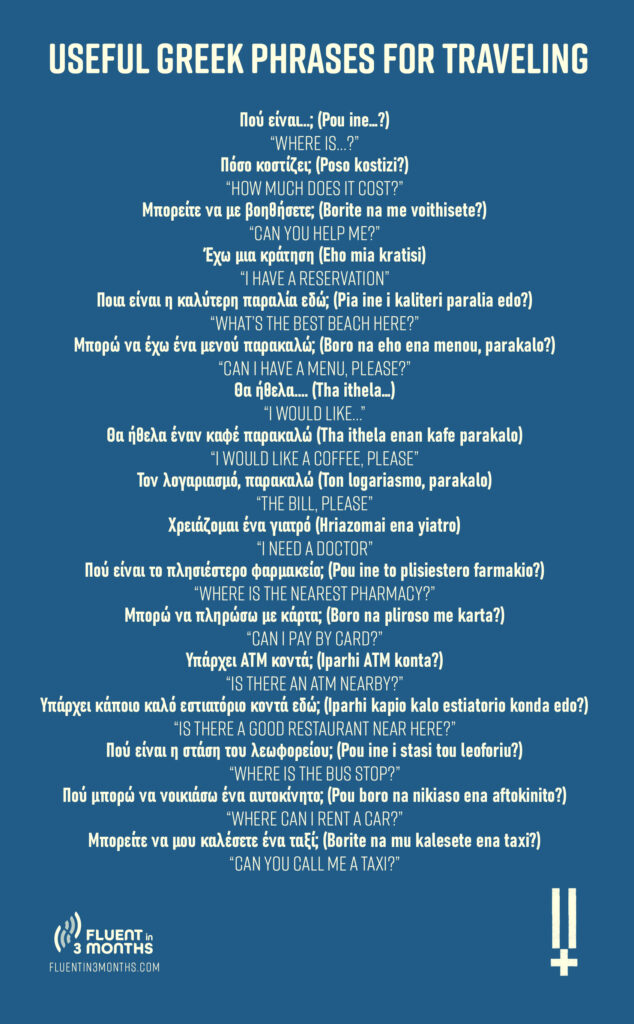
When inquiring about the cost of goods or services, the phrase Πόσο κάνει; (Poso kani? – How much is it?) or the more formal Πόσο κοστίζει; (Poso kostizi? – How much does it cost?) are the standard inquiries. In a post-pandemic economic landscape, the question Μπορώ να πληρώσω με κάρτα; (Boro na pliroso me karta? – Can I pay by card?) has become increasingly relevant. While Greek law now mandates that all businesses accept point-of-sale (POS) transactions, technical issues in remote island areas make this a necessary clarification.
Navigational Assistance
Locating essential facilities is a primary concern for any traveler. The phrase Πού είναι…; (Pou ine…? – Where is…?) is the universal prefix for such inquiries. Common targets for this question include:
- Η τουαλέτα (I tualeta – The bathroom)
- Η στάση του λεωφορείου (I stasi tou leoforiu – The bus stop)
- Το πλησιέστερο φαρμακείο (To plisiestero farmakio – The nearest pharmacy)
The inclusion of "pharmacy" in survival Greek is particularly important. In Greece, pharmacists are highly trained healthcare providers who can often offer medical advice and over-the-counter treatments for minor ailments, serving as a first line of defense before a doctor is required. In the event of a serious medical emergency, the phrase Χρειάζομαι ένα γιατρό (Hriazomai ena yiatro – I need a doctor) is the critical communication.
The Sociolinguistics of the Greek Table: Dining and Socializing
Dining is the cornerstone of Greek social life, and the language used around the table reflects a culture of abundance and shared experience. When a meal is served, the host or waiter will inevitably say Καλή όρεξη (Kali orexi), the Greek equivalent of "bon appétit."
The ritual of the toast is equally significant. The phrase Γεια μας! (Yamas!), a contraction of "to our health," is used universally when drinking wine, ouzo, or tsipouro. For travelers, understanding the dining etiquette—such as asking for the bill (Τον λογαριασμό, παρακαλώ – Ton logariasmo, parakalo)—is essential for navigating the long, leisurely meals that define the Greek summer.
Informal Vernacular and the Dynamics of Modern Slang
While formal language is respected, Greece possesses a vibrant and pervasive informal vernacular. One of the most famous and multifaceted words in the Greek language is μαλάκα (malaka). While technically a swear word with a derogatory literal meaning, it is used ubiquitously among friends as a term of endearment, a filler word, or an expression of surprise. However, linguistic experts caution travelers against using this word unless they have established a deep, informal rapport with the person addressed, as its use in the wrong context can be offensive.
Other common slang terms that offer a glimpse into the local mindset include:
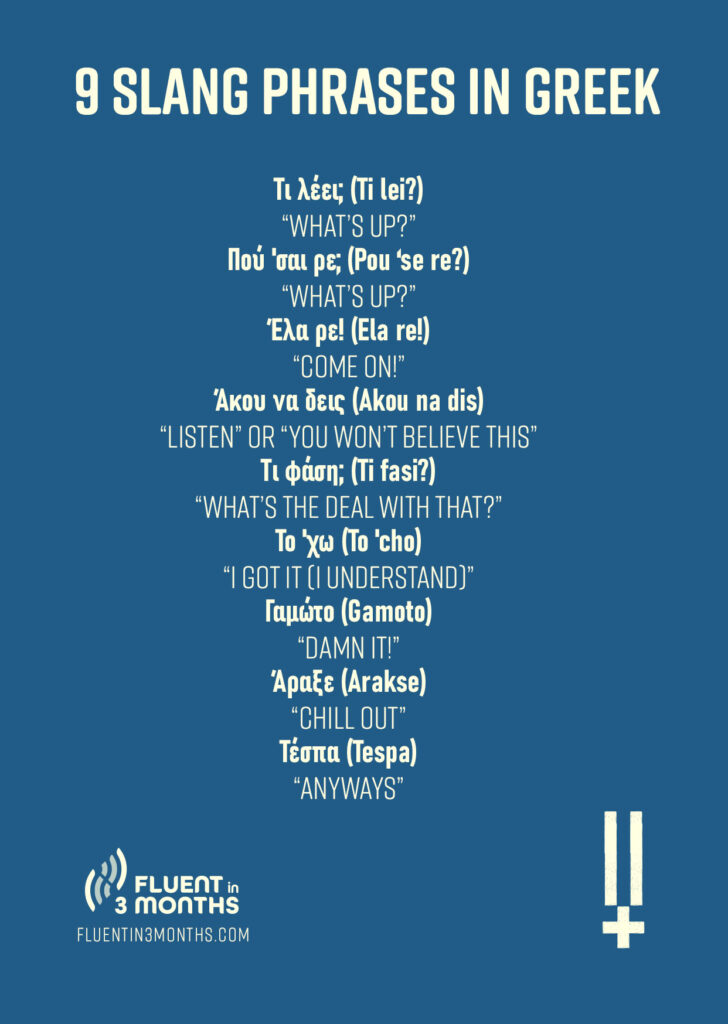
- Έλα ρε! (Ela re!): Literally "Come on," but used to express disbelief, excitement, or to urge someone to hurry.
- Τι λέει; (Ti lei?): An informal "What’s up?" or "What are you saying?"
- Άραξε (Arakse): A command to "chill out" or "relax," reflecting the "siga-siga" (slowly-slowly) philosophy that governs much of Greek life outside the urban bustle of Athens.
Cultural Wisdom: The Role of Proverbs in Modern Discourse
Greek proverbs, many of which find their roots in Aesop’s fables or ancient philosophical texts, continue to influence modern conversation. These phrases provide a window into the values of resilience, patience, and skepticism that characterize the Hellenic worldview.
For example, the proverb "The stone that doesn’t roll doesn’t gather moss" (Πέτρα που κυλάει δεν χορταριάζει) is used to encourage activity and growth. Another common sentiment, "Every beginning is difficult" (Κάθε αρχή και δύσκολη), is often used to encourage language learners or those embarking on new ventures. For the traveler, recognizing these expressions—or even understanding the sentiment behind them—facilitates a deeper connection with the "romiosini," the spirit of the modern Greek identity.
Broader Impact: Language as a Tool for Sustainable Tourism
The enrichment of the traveler’s vocabulary has broader implications for the Greek tourism industry. The "National Strategy for Tourism 2030" emphasizes the shift toward "quality over quantity," focusing on visitors who stay longer and engage more deeply with local communities. Language proficiency is a key metric in this transition.
Data suggests that travelers who engage with the local language are more likely to visit "off-the-beaten-path" destinations, such as the mountain villages of Epirus or the lesser-known islands of the Dodecanese. This decentralization of tourism helps alleviate the environmental and social pressure on hyper-visited sites like the Acropolis or Oia.
Furthermore, the rise of the "Digital Nomad" visa in Greece—which has seen thousands of applicants since its inception—has created a new class of long-term residents who require more than just "survival Greek." For these individuals, language acquisition is an investment in social capital, allowing them to navigate bureaucracy, real estate, and community integration.
Conclusion: The Linguistic Path to Philoxenia
Learning common Greek phrases is not merely a task of memorization; it is an engagement with a living history. While the technical difficulty of the language—with its three genders, complex verb conjugations, and unique alphabet—can be daunting, the rewards of effort are immediate. In a culture that prides itself on "philoxenia," the smallest attempt by a foreigner to speak the local tongue is met with disproportionate warmth and appreciation.
As Greece continues to evolve as a global hub for culture, history, and remote work, the bridge of language remains the most effective tool for crossing from the role of a spectator to that of a participant. By mastering the basic greetings, transactional phrases, and social etiquette outlined in this report, the traveler ensures that their journey through the Hellenic Republic is marked by genuine connection and mutual respect. For the international community, the message is clear: to truly see Greece, one must first learn to speak to it.