



The Greek language, one of the oldest recorded living languages in the world with a history spanning over 3,400 years of written records, remains a cornerstone of Western civilization and a vital tool for the millions of international visitors who descend upon the Hellenic Republic annually. As tourism in Greece reaches record-breaking levels—with the Greek National Tourism Organization (GNTO) reporting over 32 million international arrivals in 2023—the importance of basic linguistic competency has moved beyond mere courtesy into a strategic necessity for travelers. While English is widely spoken in major urban centers like Athens and Thessaloniki, as well as on high-traffic islands such as Mykonos and Santorini, a fundamental grasp of the Greek vernacular is essential for navigating rural territories, engaging in authentic cultural exchanges, and honoring the local tradition of "philoxenia"—the ancient Greek concept of hospitality toward strangers.
The Socio-Linguistic Landscape of Modern Greece
Modern Greek, or Demotic Greek, serves as the official language of Greece and Cyprus. For the international traveler, the primary challenge often lies not only in the vocabulary but in the Greek alphabet, which serves as the basis for the Latin and Cyrillic scripts. Industry experts suggest that the "psychological barrier" of a non-Latin script often prevents travelers from attempting to learn the language. However, linguistic data indicates that even a "survival kit" of 50 to 100 phrases can significantly alter the quality of a traveler’s interactions.
The evolution of the language from the Koine Greek of the Hellenistic period to the modern tongue has retained a high degree of mutual intelligibility with ancient roots, yet the social application of the language is governed by strict codes of formality. In Greek society, the distinction between formal and informal address is a critical component of social etiquette, reflecting the level of familiarity and respect between interlocutors.
Fundamental Greetings and the Etiquette of Address
The foundation of any linguistic interaction in Greece begins with the greeting. Unlike many Western languages where a single "hello" suffices, Greek utilizes specific variations based on the time of day and the social standing of the participants.
The most versatile greeting is Yassas (Γεια σας), which serves as a formal or plural "hello." This is the standard greeting for addressing elders, professionals, or groups of people. In contrast, Ya sou (Γεια σου) is the informal singular version used among friends, peers, and children. Misusing these can occasionally lead to social friction, though Greeks are notoriously forgiving of foreigners attempting the language.
Temporal greetings are equally significant:
- Kalimera (Καλημέρα): "Good morning." This is typically used from sunrise until midday. It is perhaps the most frequently heard phrase in Greek villages.
- Kalispera (Καλησπέρα): "Good evening." This transition occurs in the late afternoon, usually after 5:00 PM, and remains appropriate until the end of the day.
- Kalinihta (Καληνύχτα): "Good night." This is strictly used as a parting phrase when someone is retiring for the evening.
For those arriving or departing, the phrases Kalos irthes (Καλώς ήρθες – singular welcome) and Kalos irthate (Καλώς ήρθατε – plural/formal welcome) are the standard for hospitality. When departing, Adio (Αντίο) serves as a formal "goodbye," while the more casual Ta leme (Τα λέμε) translates to "see you later" or "we’ll talk soon."
Essential Lexicon for Daily Transactions
Navigating the Greek marketplace and hospitality sector requires a specific set of logistical phrases. Statistical surveys from travel agencies indicate that "price" and "location" are the two most common categories of inquiry for non-Greek speakers.
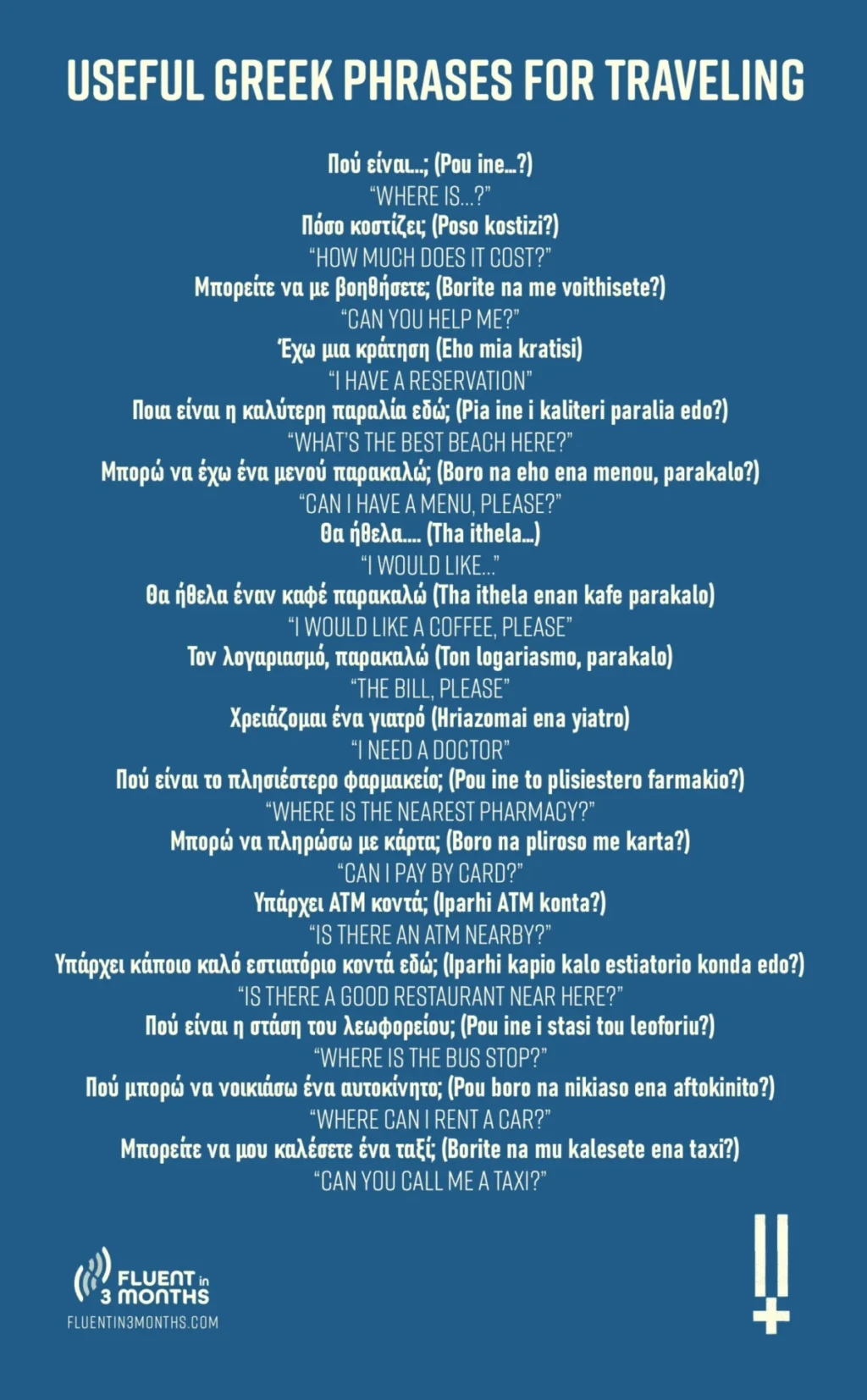
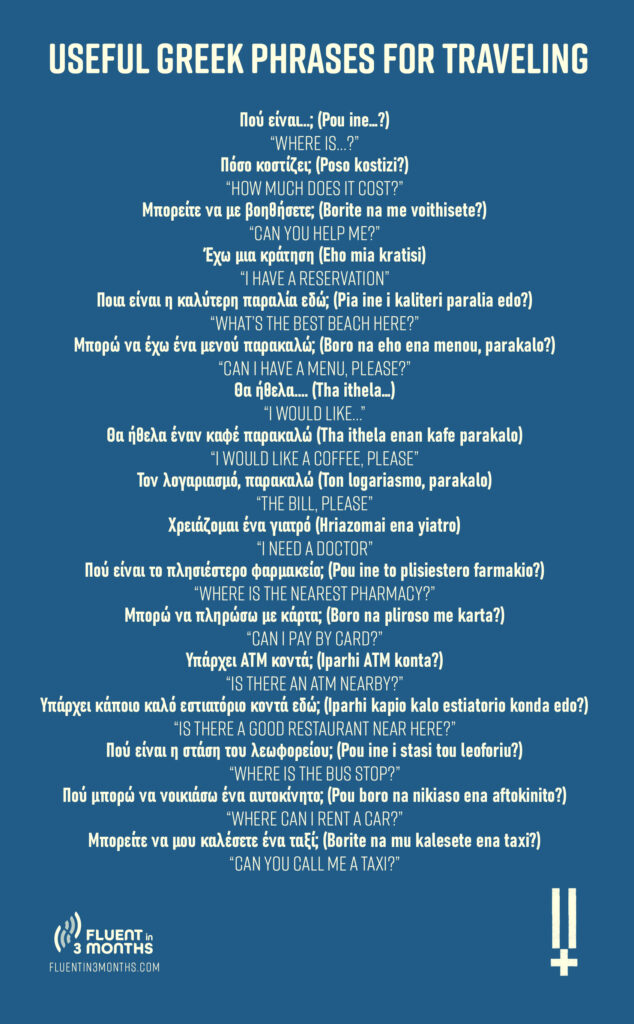
The phrase Poso kani? (Πόσο κάνει;) translates to "How much is it?" and is indispensable in the "Laiki" (open-air markets) where price tags may not always be present. In formal dining settings, requesting the bill is done through the phrase Ton logariasmo, parakalo (Τον λογαριασμό, παρακαλώ).
Other critical logistical phrases include:
- Pou ine i tualeta? (Πού είναι η τουαλέτα;): "Where is the bathroom?"
- Milate anglika? (Μιλάτε αγγλικά;): "Do you speak English?"
- Den katalaveno (Δεν καταλαβαίνω): "I don’t understand."
- Borite na epanalavete? (Μπορείτε να επαναλάβετε;): "Could you repeat that?"
The affirmative and negative in Greek are famously confusing for English speakers. Ne (Ναι) means "Yes," while Ochi (Όχι) means "No." The phonetic similarity of Ne to the English "Nay" or "No" is a frequent point of confusion for first-time visitors.
Survival Greek: Emergency and Infrastructure Phrases
For travelers moving outside the primary tourist corridors, the ability to communicate needs regarding health and transportation is a safety priority. While the Greek healthcare system provides services to tourists, the initial communication of a problem can expedite care.
Emergency and medical phrases include:
- Hriazomai ena yiatro (Χρειάζομαι ένα γιατρό): "I need a doctor."
- Pou ine to plisiestero farmakio? (Πού είναι το πλησιέστερο φαρμακείο;): "Where is the nearest pharmacy?" In Greece, pharmacists are highly trained and can often provide over-the-counter advice for minor ailments.
- Borite na me voithisete? (Μπορείτε να με βοηθήσετε;): "Can you help me?"
Regarding transportation and finance, visitors should be aware of:
- Pou ine i stasi tou leoforiu? (Πού είναι η στάση του λεωφορείου;): "Where is the bus stop?"
- Iparhi ATM konta? (Υπάρχει ΑΤΜ κοντά;): "Is there an ATM nearby?"
- Boro na pliroso me karta? (Μπορώ να πληρώσω με κάρτα;): "Can I pay by card?" Despite the increasing digitization of the Greek economy, cash remains preferred in some smaller villages and tavernas.
The Cultural Significance of Slang and Informal Vernacular
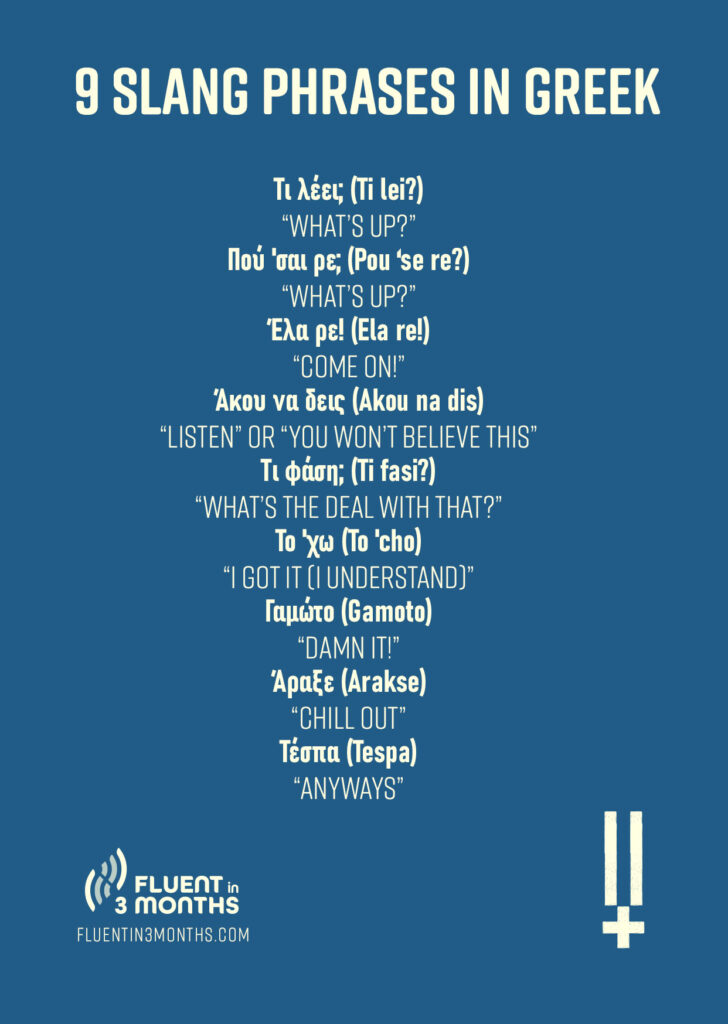
To truly understand the rhythm of modern Greek life, one must acknowledge the informal "slang" that permeates daily conversation. The most pervasive word in the Greek language is arguably Malaka (μαλάκα). While technically a swear word with a literal meaning involving self-indulgence, its usage in modern Greece has evolved into a versatile term of endearment, frustration, or punctuation among friends. It is a linguistic marker of "in-group" status, though travelers are advised to use it with extreme caution and only in highly informal settings with close acquaintances.
Other common informalities include:
- Ela re! (Έλα ρε!): Literally "Come on," but used to express disbelief or excitement, similar to "No way!"
- Ti fasi? (Τι φάση;): "What’s the deal?" or "What’s going on?"
- Arakse (Άραξε): "Chill out" or "Relax."
- Tespa (Τέσπα): A shortened version of telos panton, meaning "anyways."
Proverbial Wisdom and the Greek Identity
The Greek language is rich with proverbs (parimies) that provide a window into the national psyche. These phrases often combine ancient stoicism with the practical realities of Mediterranean life. Comprehending these offers a deeper level of cultural immersion than simple vocabulary lists.
- "The stone that doesn’t roll doesn’t gather moss" (Πέτρα που δεν κυλάει, δεν χορταριάζει): Similar to the English version, this emphasizes the importance of activity and progress.
- "Better to have your eye out than your name out" (Καλύτερα να σου βγει το μάτι, παρά το όνομα): This highlights the extreme importance of reputation and honor (philotimo) in Greek culture.
- "Every beginning is difficult" (Κάθε αρχή και δύσκολη): A common encouragement for those starting a new venture, including language learning.
- "The many words are poverty" (Τα πολλά λόγια είναι φτώχεια): A call for directness and action over excessive talking.
- "In the end, the priest’s son becomes a deacon" (Στο τέλος ο γιος του παπά γίνεται διάκος): A metaphorical way of saying that things eventually fall into their natural order or that children often follow in their parents’ footsteps.
Broader Impact and Linguistic Diplomacy
The initiative to learn Greek, even at a rudimentary level, has documented economic and social benefits. According to surveys conducted by the Hellenic Chamber of Hotels, tourists who utilize basic Greek phrases report higher levels of satisfaction with their service and a more profound sense of connection to the destination. From a diplomatic perspective, the preservation and promotion of the Greek language are central to the country’s "soft power" strategy.
The Ministry of Education and Religious Affairs has seen a steady increase in the enrollment of "Greek as a Second Language" programs, both in-person and via digital platforms. This trend suggests a growing global interest in not just visiting Greece, but understanding the linguistic framework that shaped Western philosophy, science, and democratic thought.
For the modern traveler, learning the Greek phrases outlined above is more than a tool for convenience; it is a gesture of respect toward a culture that has contributed immeasurably to the global heritage. Whether it is a simple Efcharisto (Thank you) at a seaside cafe or a formal Ti kanete? (How are you?) to a shopkeeper in a mountain village, these words serve as the bridge between being a mere spectator and becoming a welcomed guest in the Hellenic world.