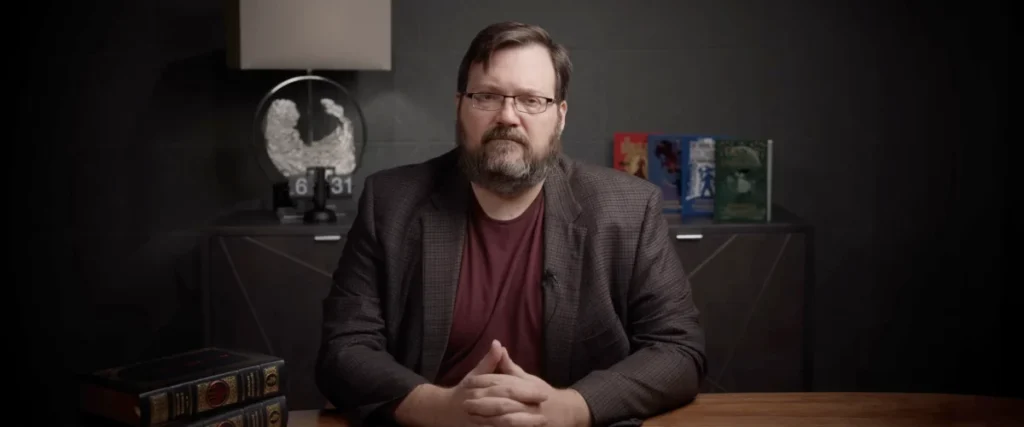
Late last year, acclaimed fantasy novelist Brandon Sanderson delivered a thought-provoking address titled "The Hidden Cost of AI Art" at Dragonsteel Nexus, the annual conference organized by his media company. The speech, which quickly garnered widespread attention across creative and technological communities, offered a nuanced critique of generative artificial intelligence’s rapidly expanding role in artistic production, moving beyond common objections to focus on the intrinsic value of the creative process itself for the human artist.
Sanderson’s Core Argument: The Artist’s Transformation, Not Just the Product
Sanderson initiated his discourse by acknowledging the captivating nature of large language models (LLMs) and generative AI, stating, "The surge of large language models and generative AI raises questions that are fascinating, and even if I dislike how the movement is going in relation to writing and art, I want to learn from the experience of what’s happening." While making his personal disapproval of AI-generated art unequivocally clear—describing how "my stomach turns" at the prospect—he sought a deeper understanding of this aversion, systematically examining and ultimately setting aside conventional criticisms such as copyright infringement, potential job displacement, or the question of AI’s "creativity."
Instead, Sanderson pivoted to a profoundly personal perspective, drawing from his own early struggles with failed book manuscripts. He identified the pivotal, often overlooked, value of art: its capacity to fundamentally change and develop the artist who undertakes its creation. "Maybe someday the language models will be able to write books better than I can," Sanderson conceded. "But here’s the thing: Using those models in such a way absolutely misses the point, because it looks at art only as a product." He elaborated on the immense satisfaction derived from the arduous journey of creation, recalling the transcendent moment of completing his first novel: "Why did I write [my first manuscript]? It was for the satisfaction of having written a novel, feeling the accomplishment, and learning how to do it. I tell you right now, if you’ve never finished a project on this level, it’s one of the most sweet, beautiful, and transcendent moments. I was holding that manuscript, thinking to myself, ‘I did it. I did it.’" This sentiment underscores a philosophical distinction between art as a tangible output and art as an experience that shapes the human spirit and intellect.
Complementary Perspectives: Art as Deep Human Communication
Echoing and expanding upon Sanderson’s focus on the human element, another prominent voice in the discourse has characterized art as an act of profound human communication. This perspective posits that art functions as a form of "telepathy," where an artist utilizes a tangible medium—be it prose, paint, or sculpture—to transmit a complex internal cognitive state from their consciousness directly to that of their audience. This intimate transfer of human experience and emotion, this viewpoint suggests, is among the most beautiful and fundamentally human endeavors.
From this standpoint, the concept of engaging with a book authored by a language model or a film generated solely by a prompt becomes inherently problematic, if not "anti-human." Such creations, lacking the originating human consciousness, are likened to "the heroin needle providing a quixotic simulation of love," offering an imitation of connection without the genuine human spark. Both Sanderson’s emphasis on the artist’s transformative journey and this broader view of art as human telepathy converge on the idea that the essential quality of art is inextricably linked to its human origin and the process of its creation and reception.
A Call to Agency: Humanity’s Power to Define Art
Perhaps the most impactful aspect of Sanderson’s address was his rousing conclusion, which served as a powerful antidote to what some observers perceive as a growing "nihilistic passivity" in contemporary AI commentary. This trend often sees authors or commentators presenting grim scenarios of AI’s destructive potential against sacred human domains, then simply leaving the dire prediction hanging without offering a path forward.
Sanderson, however, offered a defiant message of agency. If art is intrinsically human, he argued, then its definition and meaning ultimately rest with humanity. "That’s the great thing about art – we define it, and we give it meaning," he declared. "The machines can spit out manuscript after manuscript after manuscript. They can pile them to the pillars of heaven itself. But all we have to do is say ‘no.’" This statement challenges the notion of technological determinism, reminding audiences that human values, choices, and collective will ultimately shape the future of creative expression, rather than the unbridled advancements driven by tech leaders. It asserts that the power to discern, value, and protect human art remains firmly within human hands.
The Evolving Landscape: Generative AI and the Creative Industries
Sanderson’s remarks arrive amidst a tumultuous period for creative industries grappling with the rapid evolution and deployment of generative AI technologies. The past few years have witnessed an unprecedented surge in AI capabilities, from text-to-image models like DALL-E, Midjourney, and Stable Diffusion to sophisticated large language models such as OpenAI’s ChatGPT and Anthropic’s Claude. These tools have democratized content creation to an extent, allowing individuals with minimal technical or artistic skill to generate complex images, prose, and even music with simple text prompts.
This technological explosion has triggered a multifaceted debate across various sectors:
- Visual Arts: Artists and illustrators have voiced significant concerns regarding copyright infringement, as many AI models are trained on vast datasets of existing artwork without explicit consent or compensation for the original creators. Organizations like the Artists’ Rights Alliance have actively campaigned for stronger protections. Reports from industry surveys, such as those conducted by ArtStation or DeviantArt, indicate that over 70% of professional artists express concern about AI’s impact on their livelihoods and the ethical implications of training data.
- Literature and Publishing: Writers’ guilds and authors, including Sanderson himself, have grappled with the implications of AI-generated prose. Concerns range from the devaluation of human writing to the potential for AI to flood the market with low-quality content, making it harder for human authors to stand out. The Science Fiction and Fantasy Writers of America (SFWA) has actively engaged in discussions about AI policy, while publishers are slowly beginning to implement guidelines for AI submission disclosure.
- Music and Film: Similar debates are unfolding in the music industry regarding AI-generated compositions and voice synthesis, and in film concerning AI-driven scriptwriting, visual effects, and even synthetic actors. Major studios and unions are in early stages of negotiation and policy formulation.
Ethical, Legal, and Economic Implications
The "hidden cost" that Sanderson alluded to extends beyond the individual artist’s journey to encompass broader societal implications:
- Copyright and Fair Use: The legal framework for AI-generated content is nascent and highly contested. Lawsuits against AI companies regarding the unauthorized use of copyrighted material for training data are ongoing, challenging long-held interpretations of fair use and intellectual property. The ability to definitively prove human authorship versus AI generation is becoming increasingly complex.
- Economic Disruption: While some argue AI tools can enhance productivity, a significant fear among creatives is widespread job displacement. A study by Goldman Sachs in 2023 estimated that generative AI could automate up to 300 million full-time jobs globally, with creative professions being among those most susceptible. The gig economy, already precarious for many artists, faces unprecedented challenges.
- Authenticity and Value Perception: As AI-generated content becomes indistinguishable from human-created work, questions arise about the perceived value of art. Will audiences continue to value the human touch, or will efficiency and volume become paramount? Sanderson’s argument directly addresses this, advocating for a re-emphasis on the intrinsic human value.
- The "Prompt Engineer" vs. "Artist" Debate: The rise of "prompt engineers" who craft instructions for AI has sparked debate about who truly deserves credit or compensation in the AI art pipeline. This blurs traditional lines of authorship and creative input.
The Dragonsteel Nexus: A Platform for Critical Dialogue
Dragonsteel Nexus, held annually, serves as a significant gathering for fans of Brandon Sanderson’s "Cosmere" literary universe and speculative fiction in general. It attracts thousands of readers, writers, and artists, making it a fitting, and indeed impactful, venue for Sanderson to deliver such a pivotal address. His influence within the fantasy genre, coupled with his reputation for transparency and thoughtful engagement with his audience, lent considerable weight to his message. The conference provided a concentrated audience of creatives and consumers deeply invested in the future of storytelling, making it an ideal platform to initiate a crucial dialogue about the human element in an increasingly automated creative landscape.
Correction Regarding AI Vulnerability Reporting
Separately, and in the interest of factual accuracy, a clarification was issued concerning a previous podcast episode discussing AI’s capabilities in identifying software vulnerabilities. During an "AI Reality Check" episode, a statement was made regarding Anthropic’s earlier Opus 4.6 LLM: "If you go back and look at the release notes for Anthropic’s earlier, less powerful opus 4.6 LLM, they say the following: their researchers used Opus to find, quote, ‘over 500 exploitable zero-day vulnerabilities, some of which are decades old.’ And let’s stop for a moment because that note, which was hidden in the system card for opus 4.6, is almost word for word what anthropic said about Mythos."
This statement contained some imprecise wording. The information referred to originated from a report published by Anthropic on the same day Opus 4.6 was released, which could be accurately described as release notes or supplementary release notes, rather than specifically the system card for Opus 4.6. The report stated: "Opus 4.6 found high-severity vulnerabilities, some that had gone undetected for decades," and in another section, "So far, we’ve found and validated more than 500 high-severity vulnerabilities." Both the title and conclusion of this report referred to these as "0-day" vulnerabilities.
However, the specific quote provided in the podcast, "over 500 exploitable zero-day vulnerabilities, some of which are decades old," did not appear verbatim in Anthropic’s official report. It was, in fact, a summary derived from a tweet by an individual discussing the report. While the summary was considered accurate in conveying the essence of Anthropic’s findings, the podcast’s wording inadvertently implied it was a direct quote from the official report, which it was not. This clarification underscores the critical importance of precise sourcing and attribution in the rapidly evolving and often complex discourse surrounding AI capabilities and their reporting.
Navigating the Future of Creativity
The discussions sparked by Brandon Sanderson’s "The Hidden Cost of AI Art" and the ongoing debates within creative industries highlight a critical juncture for society. As generative AI continues its rapid advancement, the challenge is not merely to adapt to new technologies but to actively define the boundaries and preserve the essence of human creativity. Sanderson’s call to agency serves as a potent reminder that the future of art, its meaning, and its value, remain fundamentally within the purview of human choice and collective determination. The dialogue around AI in art is far from settled, and its resolution will profoundly shape how future generations create, consume, and understand the very nature of artistic expression.