

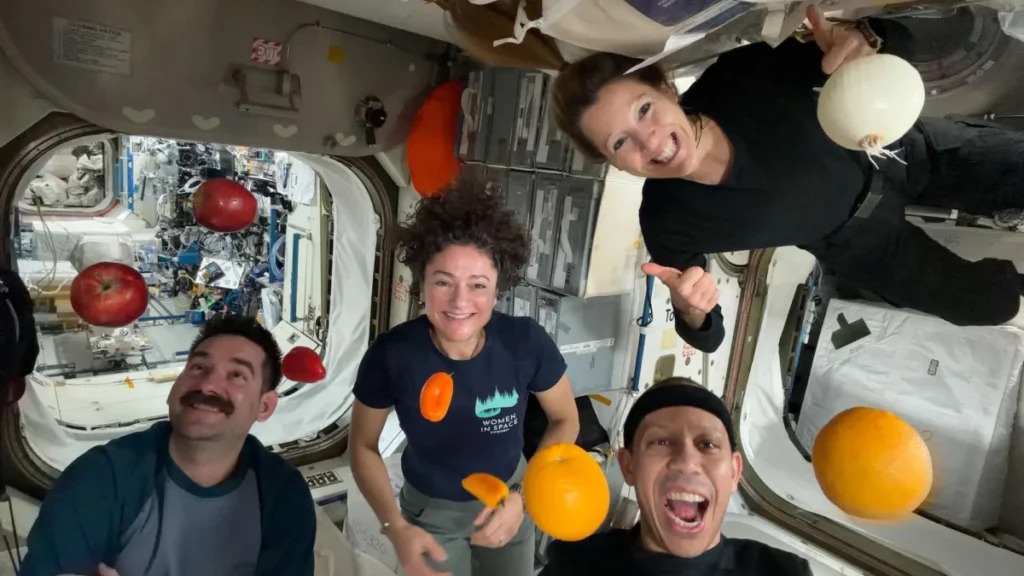
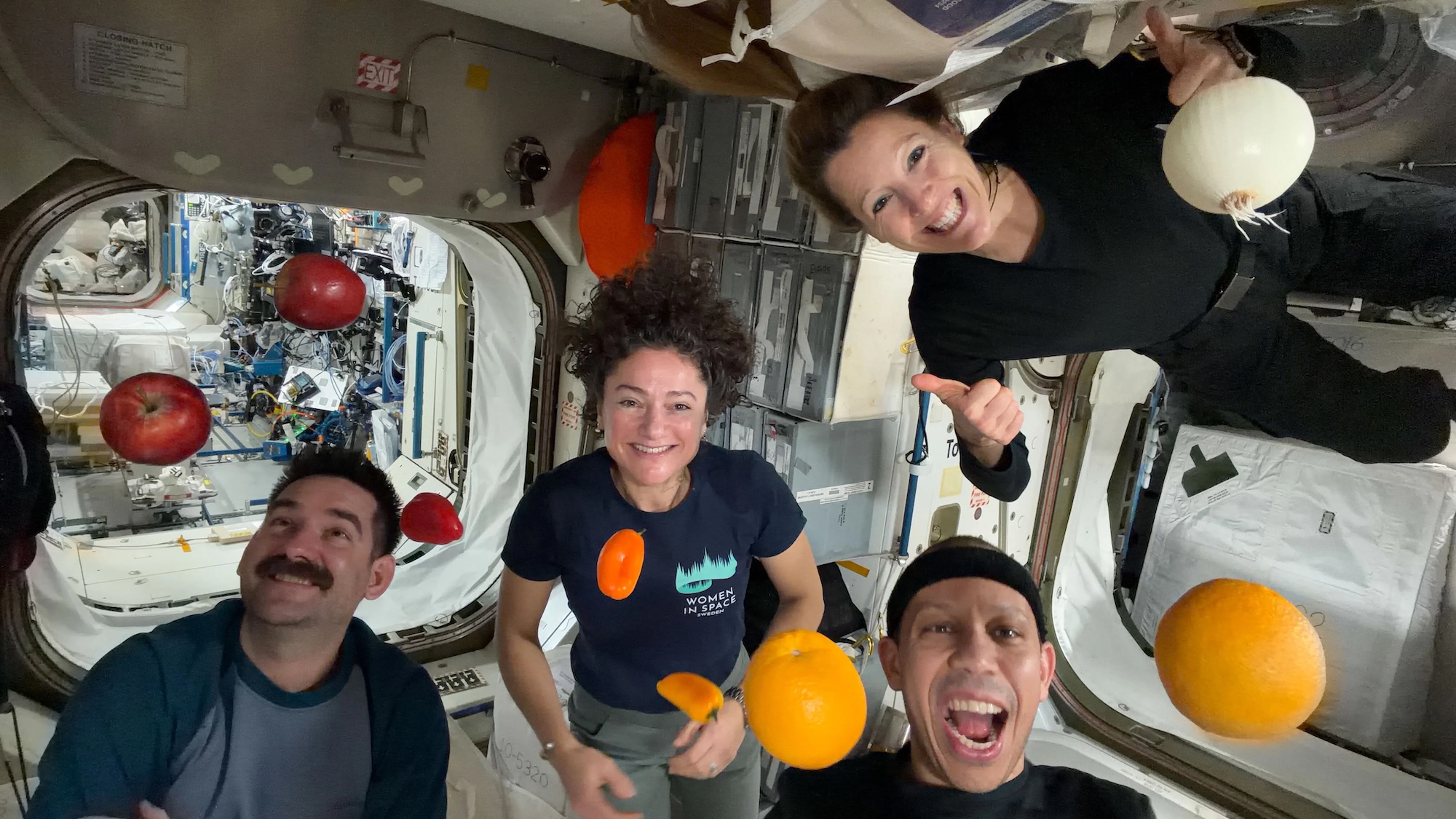
The arrival of a resupply spacecraft at the International Space Station (ISS) remains one of the most critical logistical feats in modern aerospace, bridging the gap between Earth’s resources and the harsh isolation of low-Earth orbit. In a recently highlighted mission, the crew of the ISS welcomed a Northrop Grumman Cygnus spacecraft, which delivered a diverse manifest of cargo ranging from essential life-support hardware to a rare luxury in orbit: fresh produce. A photograph released by NASA on May 14 captures the crew—including Jack Hathaway, Jessica Meir, Chris Williams, and Sophie Adenot—surrounded by floating oranges, apples, peppers, and a solitary onion. This delivery, while visually whimsical, represents a sophisticated intersection of nutritional science, psychological well-being, and advanced orbital logistics.
The cargo arrived via the Cygnus XL spacecraft as part of a scheduled Commercial Resupply Services (CRS) mission. While the primary objective of such missions is often the delivery of high-tech laboratory equipment and fuel, the inclusion of "fresh food" has become a staple of modern station management. For the astronauts living 250 miles above the planet, these items are more than just snacks; they are vital links to Earth that provide essential vitamins and a necessary boost to morale.
The Evolution of Space Nutrition: From Tubes to Tortillas
The history of space food is a testament to the rapid advancement of food science and engineering. During the early Mercury and Gemini missions, astronauts were relegated to eating semi-liquid pastes squeezed from aluminum tubes or dehydrated cubes coated in gelatin to prevent crumbs. By the Apollo era, the menu expanded slightly to include "wet packs" and freeze-dried meals, but the experience remained largely utilitarian.
The modern ISS era, however, has revolutionized the orbital dining experience. Because the ISS is regularly serviced by a fleet of cargo vessels—including the SpaceX Dragon, the Northrop Grumman Cygnus, and the Russian Progress—long-term storage is no longer the only option. While most space food remains shelf-stable for up to 18 months, resupply missions allow for the delivery of "bonus food" and fresh items that do not require the rigorous processing of standard space rations.
One of the most significant shifts in space nutrition has been the adoption of the tortilla as a primary bread substitute. Unlike traditional bread, which produces crumbs that can float into sensitive electronics or be inhaled by crew members, tortillas are virtually crumb-free and serve as a versatile vessel for everything from peanut butter to beef brisket. During the recent Artemis II lunar fly-by simulations and current ISS rotations, tortillas have remained the most requested item, underscoring their status as the "perfect" space food.
A Detailed Manifest: More Than Just Groceries
While the fresh produce captured the public’s imagination, the Cygnus spacecraft carried over 2,300 pounds of research hardware and scientific equipment, representing the core mission of the ISS as a premier microgravity laboratory. The cargo manifest for this mission was particularly heavy on biomedical research and life-support upgrades.
Stem Cell Research and Cancer Treatment
A significant portion of the scientific payload was dedicated to blood stem cell research. In the microgravity environment of the ISS, cells grow differently than they do on Earth. Without the constant pull of gravity, cells can form three-dimensional structures that more closely mimic the way they grow inside the human body. Researchers are utilizing this unique environment to study the progression of blood-based cancers and to test the efficacy of new treatments. This research could potentially lead to breakthroughs in how we treat leukemia and other hematopoietic disorders, as microgravity allows for a clearer observation of cellular interactions that are often masked by gravity-induced sedimentation on Earth.
Astronaut Gut Health and the Microbiome
Another critical area of study delivered in this shipment focuses on the human microbiome. Long-duration spaceflight is known to alter the balance of bacteria in the human gut, which can impact the immune system and overall health. The new research materials will allow the crew to conduct experiments on how to maintain and strengthen gut health during missions that last six months or longer. This is particularly relevant as NASA prepares for future missions to Mars, where astronauts will be away from Earth’s microbial environment for years at a time.
European Space Agency (ESA) Exercise Upgrades
Physical health in microgravity requires constant vigilance. Without the resistance provided by gravity, astronauts can lose significant bone density and muscle mass. To combat this, the ESA sent a new exercise machine in the Cygnus delivery. This hardware is designed to be more compact and efficient than previous models, providing the high-intensity resistance training necessary to keep the crew’s musculoskeletal systems intact during their stay.
Life Support and Maintenance
Beyond the science, the mission delivered essential maintenance components. This included replacement nitrogen and oxygen tanks specifically designed for the station’s Extravehicular Activity (EVA) suits. These tanks are critical for spacewalks, ensuring that astronauts have a reliable supply of breathable air while performing repairs on the exterior of the station.
The Chronology of the Mission
The delivery process is a choreographed sequence of events that begins months before launch. The timeline for this specific resupply mission followed a rigorous schedule:
- Pre-Launch Integration: Scientific experiments and fresh produce are packed into the Cygnus pressurized module. Fresh items are "late-load" additions, placed into the craft just hours before launch to maximize their freshness upon arrival.
- Launch and Transit: The spacecraft is launched atop a rocket (typically an Antares or Falcon 9), entering a pursuit orbit to rendezvous with the ISS.
- Berthing and Capture: On April 19, the ISS crew utilized the station’s robotic arm, Canadarm2, to "grapple" the incoming Cygnus vehicle. This delicate operation requires precise coordination between the crew on board and mission control centers in Houston and Dulles.
- Unloading and Integration: Over the following weeks, the crew systematically unloads the 2,300 pounds of cargo. The fresh food is typically consumed first, while the scientific hardware is integrated into the various laboratory modules.
- Disposal Phase: Unlike the SpaceX Dragon, which returns to Earth, the Cygnus is designed to stay attached to the ISS for several months before being released. It is then filled with several thousand pounds of station trash and commanded to de-orbit, where it safely burns up in Earth’s atmosphere.
Official Perspectives and Implications
NASA officials and nutritionists have frequently emphasized that the "human element" of spaceflight cannot be ignored. While a pepper or an orange may seem minor in the context of a multi-billion dollar space station, the sensory experience of fresh food is a powerful psychological tool.
"Fresh fruits and vegetables are always a high-priority item for the crew," noted a NASA spokesperson during a mission briefing. "The crunch of a fresh apple or the smell of an orange provides a sensory connection to Earth that freeze-dried food simply cannot replicate. It’s a vital component of maintaining the mental health of our astronauts during long-duration stays."
From a technical standpoint, the successful delivery of stem cell research equipment underscores the ISS’s transition into a more mature phase of scientific utility. The station is increasingly being used as a platform for "translational medicine"—research that has direct applications for patients on Earth. The implications of this are far-reaching; by using the ISS as a laboratory, pharmaceutical companies and academic institutions can accelerate the development of drugs and therapies in ways that are impossible on the ground.
Looking Toward the Future: The Gateway and Mars
The lessons learned from ISS resupply missions are currently being applied to the planning of the Lunar Gateway—a small space station that will orbit the Moon as part of the Artemis program. Because the Gateway will be much further from Earth, resupply missions will be less frequent and more complex.
Understanding how to preserve fresh food longer, how to manage a closed-loop microbiome, and how to conduct autonomous science will be the pillars of deep-space exploration. The "conspicuous onion" seen in the April 19 photograph is a symbol of this transition. It represents the ongoing effort to make space not just a place where humans can survive, but a place where they can live and work effectively for years at a time.
As NASA and its international partners look toward the 2030s and a potential crewed mission to Mars, the logistics of the ISS remain the ultimate proving ground. Every pound of hardware, every stem cell culture, and every orange delivered by the Cygnus spacecraft provides the data needed to ensure that when humans finally step onto the Red Planet, they do so with the nutritional and physical health required to succeed. For now, the four smiling astronauts on the ISS serve as a reminder that even in the cold vacuum of space, a fresh meal and a new scientific challenge are the keys to pushing the boundaries of the final frontier.