

The Greek language, a cornerstone of Western civilization with a documented history spanning over 3,400 years, maintains a contemporary vibrancy through its deeply embedded systems of endearment and interpersonal affection. Unlike many North Germanic or Anglophone linguistic traditions that may reserve specific terms of affection for private or highly intimate settings, Modern Greek utilizes a broad spectrum of "endearment vocabulary" to navigate social hierarchies, reinforce familial bonds, and establish immediate rapport among peers. This linguistic phenomenon is not merely a matter of slang but is rooted in the morphological structure of the language and the historical evolution of Hellenic social values.
The Morphological Framework of Greek Affection
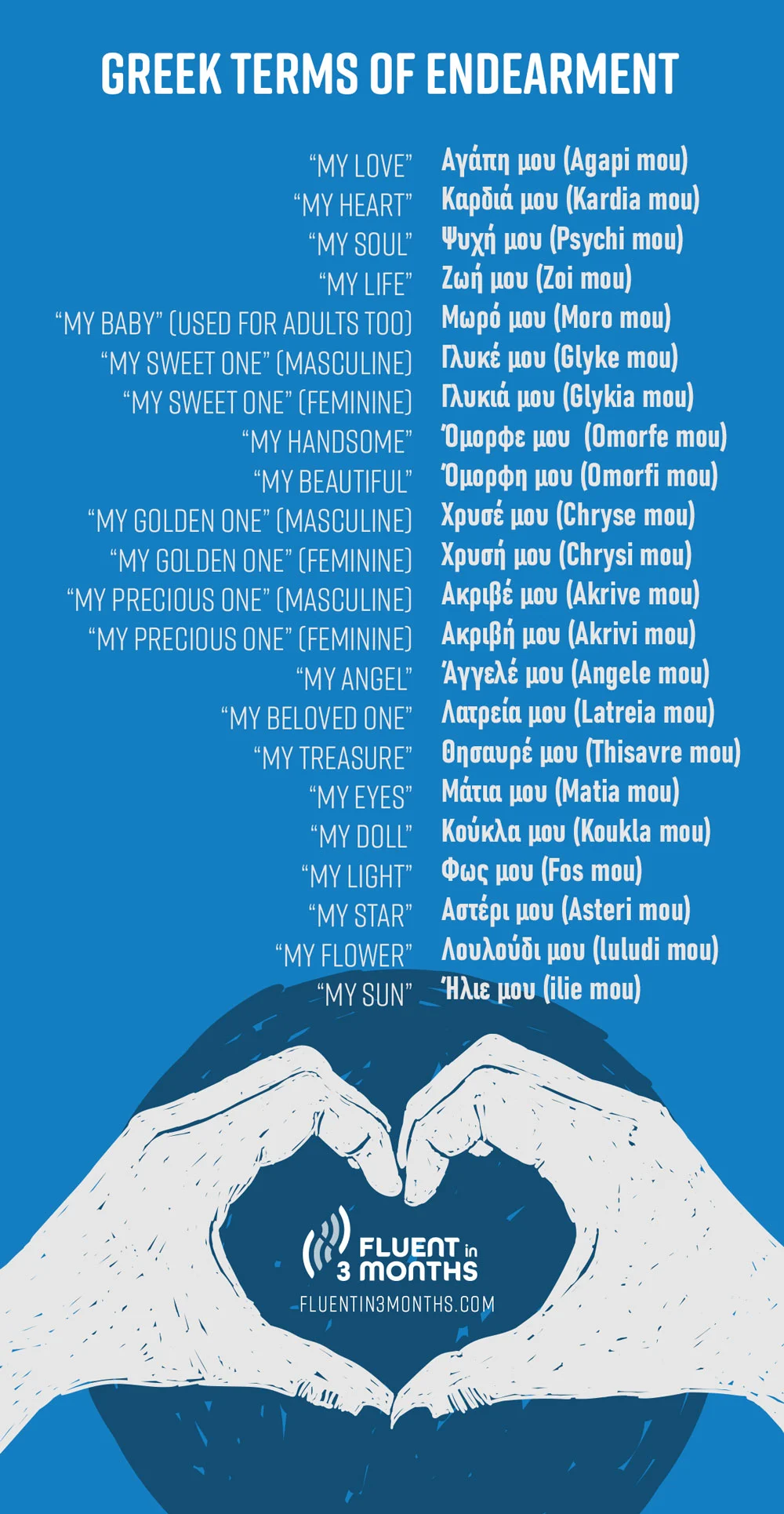
At the heart of Greek endearment lies a sophisticated system of diminutive suffixes and possessive pronouns that transform standard nouns into vessels of intimacy. The most prevalent of these is the use of the post-nominal possessive pronoun "mou" (μου), meaning "my." In Greek syntax, the placement of "mou" after a noun—such as in "agapi mou" (my love) or "kardia mou" (my heart)—serves to personalize the sentiment, signaling a direct emotional connection between the speaker and the recipient.
Linguistic analysis reveals that the Greek language employs a "diminutive" system that is among the most productive in the Indo-European family. By adding suffixes such as -aki (-άκι), -oula (-ούλα), -oulis (-ούλης), or -itsa (-ίτσα), speakers can alter the perceived size, age, or "sweetness" of a subject. For instance, the name "Yiorgos" becomes "Yiorgaki," effectively signaling a shift from formal recognition to affectionate familiarity. This morphological flexibility allows for a nuanced gradation of intimacy that is often difficult to replicate in English without the use of excessive adjectives.
Categorization of Endearment by Social Context
The application of endearment terms in Greece and Cyprus is strictly categorized by the nature of the relationship, though the boundaries remain more fluid than in many Western European cultures.
Romantic and Intimate Partners
In romantic discourse, the term "Agapi mou" (Αγάπη μου) remains the standard bearer, representing a broad, unconditional love. However, more intense or poetic terms are frequently utilized to denote specific facets of a relationship. "Psychi mou" (Ψυχή μου), translated as "my soul," and "Zoi mou" (Ζωή μου), "my life," represent a level of devotion that borders on the spiritual. Data from sociolinguistic surveys suggest that these terms are often used by couples to reinforce a sense of shared identity. Other common romantic descriptors include "Moro mou" (Μωρό μου), which translates to "my baby," a term that has transcended its literal meaning to become a standard address for adults in romantic partnerships.
Familial Bonds and the "Storge" Tradition
Greek culture is historically characterized by "storge"—the innate, instinctual love between family members. This is reflected in the transformation of formal titles into affectionate nicknames. The transition from "Mitera" (mother) to "Manoula" (mommy) or "Pateras" (father) to "Bampaka" (daddy) is a standard linguistic progression within the Greek household. The addition of the diminutive suffix to children’s names or terms like "Paidi mou" (my child) serves as a constant reinforcement of the familial hierarchy and the protective nature of the Greek domestic unit.
Platonic and Social Endearment
In the public sphere, Greeks frequently use endearments to soften social interactions. It is common for friends to address one another as "Koukla mou" (my doll) or "Glyke mou" (my sweet one). Even in semi-formal service environments, such as a local bakery or "taverna," a proprietor may address a regular customer with a term of endearment to establish a "philoxenia"—the ancient Greek concept of hospitality and friendship toward strangers.
The Philosophical Roots: The Eight Types of Love
The modern usage of these terms is inextricably linked to the ancient Greek philosophical classification of love. To understand why a Greek speaker chooses "agapi" over "eros," one must look at the historical context of these definitions:
- Eros: Sexual or passionate love. In modern contexts, this is rarely used as a direct term of address, remaining instead a descriptor of physical attraction.
- Philia: Shared experience and friendship. This provides the basis for terms used among peers and colleagues.
- Storge: Familial love, as seen in the nicknames for parents and children.
- Agape: Universal or unconditional love. This is the root of "agapi mou," the most common endearment.
- Ludus: Playful or uncommitted love, often reflected in the "moro mou" (my baby) slang used in early dating.
- Pragma: Long-standing, patient love, often seen in the way elderly couples address each other as "matia mou" (my eyes).
- Philautia: Self-love, which in a modern psychological context, is discussed as a necessary component of mental health.
- Mania: Obsessive love, which serves as a linguistic warning against unhealthy attachment.
Chronology of Linguistic Evolution
The evolution of these terms follows the broader history of the Greek language. During the Byzantine era, the language began to shift from the rigid structures of Attic Greek toward a more vernacular form. The use of diminutives expanded significantly during the Ottoman period as a way to maintain cultural and familial intimacy within local communities.
In the 20th century, the "Language Question" (Glossiko Zitima)—the conflict between the formal "Katharevousa" and the popular "Demotic" Greek—was eventually resolved in favor of the Demotic. This resolution codified the use of many endearment terms that were previously considered too "low-brow" for formal literature but were essential to the daily lives of the citizenry. Today, these terms are standard in Greek media, music, and literature, representing a unified national identity.
Sociolinguistic Analysis and Global Impact
The prevalence of endearment in Greek communication has significant implications for language learners and the global Hellenic diaspora. According to data from various language learning platforms, Greek remains a popular "heritage language," with millions of descendants in the United States, Australia, Canada, and Germany seeking to reconnect with their roots. For these learners, mastering terms of endearment is often prioritized over complex grammar, as these words provide the "emotional keys" to communicating with older generations.
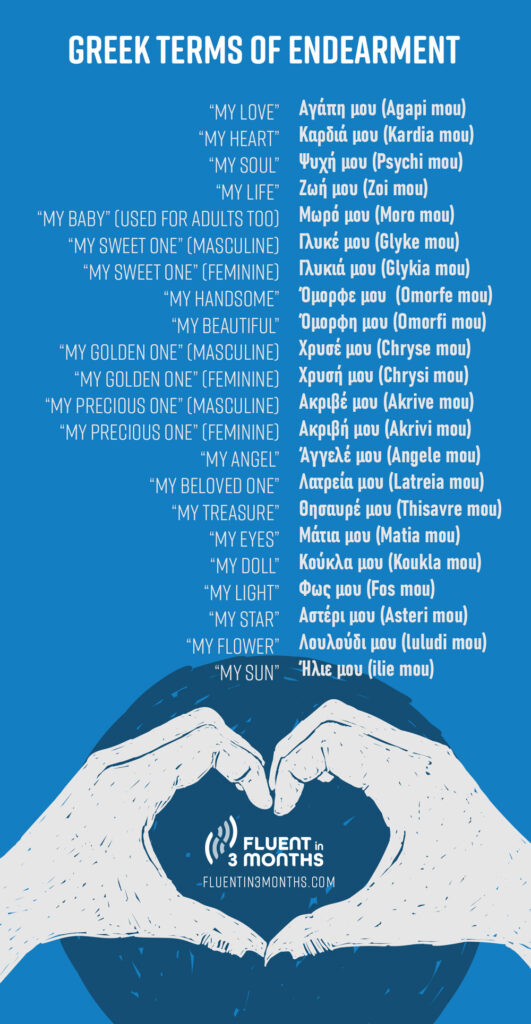
Psychologically, the frequent use of endearments in Greek culture is associated with high "Collectivism" scores on the Hofstede cultural dimensions scale. Unlike "Individualistic" cultures that prioritize personal space and formal boundaries, Greek culture prioritizes "In-group" cohesion. Terms like "Kardia mou" (my heart) act as verbal signals that the listener is part of the speaker’s inner circle, thereby reducing social anxiety and fostering trust.
Official Reactions and Educational Perspectives
Educators at the Center for the Greek Language (KEG) in Thessaloniki emphasize that while textbooks focus on formal grammar, the "pragmatics" of the language—how it is actually used in social settings—is where the true mastery of Greek lies. Linguistic experts argue that the inability of automated translation services to accurately capture the nuance of Greek diminutives highlights the complexity of the system. For instance, translating "Yiorgaki" simply as "Little George" fails to convey the warmth, age-appropriateness, and social context inherent in the original Greek.
Furthermore, the Greek Ministry of Culture has often highlighted the "intangible cultural heritage" of the Greek language. The way Greeks express affection is viewed as a vital part of the nation’s "soft power," contributing to its reputation as a warm, welcoming, and emotionally expressive society. This is particularly evident in the tourism sector, where the linguistic warmth of the locals is frequently cited in traveler surveys as a primary reason for high return rates to the country.
Implications for Modern Communication
In the digital age, the usage of endearment terms has adapted to new formats. Social media platforms and instant messaging have seen the rise of "Greeklish" (Greek written with Latin characters), where terms like "agapi mou" are frequently shortened or accompanied by specific emojis to maintain their emotional weight in a fast-paced environment. Despite the shift in medium, the underlying frequency of these terms has not diminished, suggesting that the cultural need for linguistic intimacy remains a constant in the Hellenic world.
As global communication becomes increasingly standardized, the persistence of the Greek system of endearment serves as a testament to the language’s ability to preserve its unique emotional landscape. For the speaker, these words are a bridge to the past; for the listener, they are a reaffirmation of their value within a community. Whether used between partners, family members, or friends, these terms remain the "heartbeat" of the Greek language, ensuring that every interaction is infused with a sense of belonging and "philotimo"—the uniquely Greek virtue of honor, hospitality, and love for one’s fellow man.