


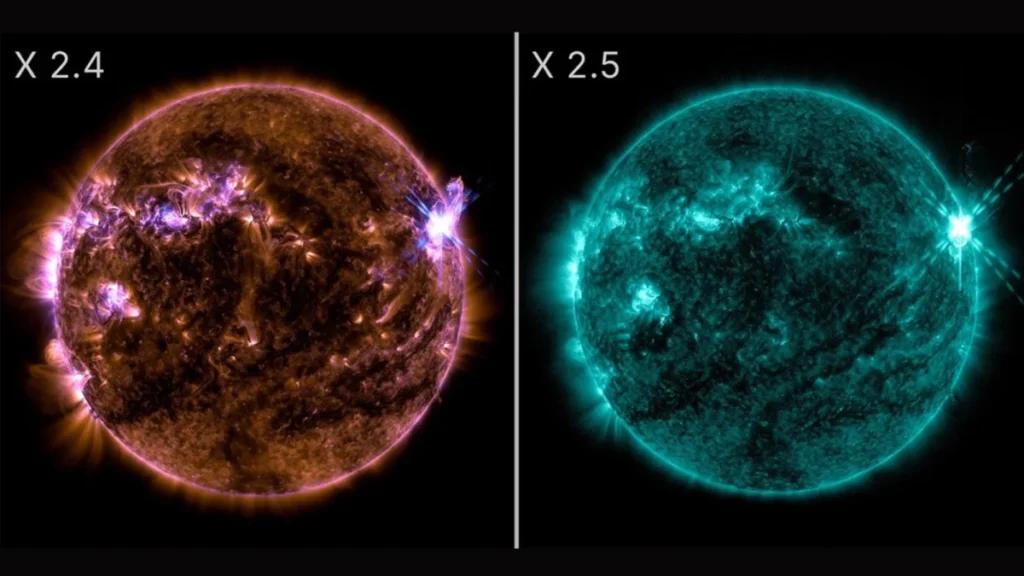
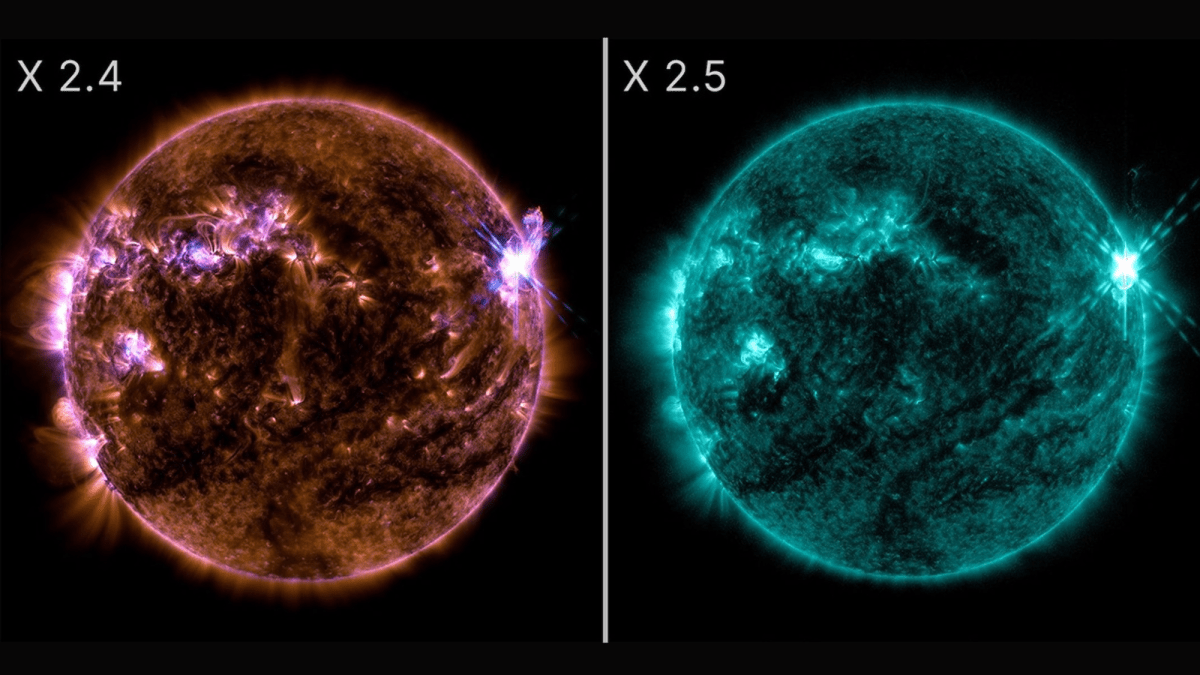
The sun emitted two powerful X-class solar flares in rapid succession between April 23 and April 24, 2026, marking a significant period of heliophysical activity that has triggered localized radio blackouts and heightened monitoring of the Earth’s magnetosphere. According to data released by NASA’s Solar Dynamics Observatory (SDO), the first event, classified as an X2.4 flare, peaked at 9:07 p.m. EDT on April 23. This was followed less than eight hours later by a second, slightly more intense X2.5 flare, which reached its maximum at 4:13 a.m. EDT on April 24. While these events represent the highest tier of solar activity, they occur within the broader context of Solar Cycle 25, a period during which the sun has demonstrated sustained electromagnetic volatility.
The Mechanics of X-Class Solar Eruptions
Solar flares are massive bursts of electromagnetic radiation originating from the sun’s surface, typically triggered by the sudden release of magnetic energy associated with sunspots. These flares travel at the speed of light, reaching Earth in roughly eight minutes. Scientists classify these eruptions using a letter-based scale—A, B, C, M, and X—where each letter represents a tenfold increase in energy output.
An X-class flare is the most intense category. Within this category, a numerical suffix provides further detail regarding the flare’s strength. For example, an X2 flare is twice as intense as an X1, and an X3 is three times as intense. The recent X2.4 and X2.5 flares, while significant enough to disrupt modern technology, fall on the lower end of the X-class spectrum. For comparison, the most powerful flare ever recorded, occurring in November 2003, was estimated to be at least X40, a level so high it saturated the sensors of the monitoring satellites at the time.
The SDO captured the April 2026 events using its Atmospheric Imaging Assembly (AIA), which monitors the sun in several wavelengths of extreme ultraviolet light. The images provided by NASA highlight the extremely hot plasma within the flares, colorized in gold, blue, and teal to distinguish different temperatures and magnetic structures. These visuals allow heliophysicists to track the movement of solar material and predict whether a flare is accompanied by a Coronal Mass Ejection (CME)—a massive cloud of charged particles that travels more slowly than a flare but can cause much more significant geomagnetic disturbances upon reaching Earth.
Chronology of the April 23-24 Solar Events
The sequence of events began late in the evening of April 23, 2026. Solar forecasters at the National Oceanic and Atmospheric Administration (NOAA) Space Weather Prediction Center (SWPC) had been monitoring a complex sunspot region that showed signs of magnetic instability.
- April 23, 9:07 p.m. EDT: The sun released an X2.4 flare. This eruption caused an immediate R3 (Strong) radio blackout on the sun-lit side of the Earth, primarily affecting the Pacific Ocean and parts of East Asia. High-frequency (HF) radio signals used by aviators and maritime operators experienced degradation or total loss for approximately 30 to 60 minutes.
- April 24, 1:00 a.m. – 3:00 a.m. EDT: Solar activity remained at a high baseline, with several smaller M-class flares detected as the magnetic fields in the active region continued to reconfigure.
- April 24, 4:13 a.m. EDT: A second major eruption occurred, measuring X2.5. This flare targeted a similar geographical footprint on Earth due to the planet’s rotation, further disrupting communication systems over Australia and Southeast Asia.
NASA officials confirmed that the SDO’s continuous monitoring was vital in providing real-time data to satellite operators. "The double eruption highlights the unpredictable nature of the sun as we move through the peak of Solar Cycle 25," noted a spokesperson for NASA’s Heliophysics Division. "While the flares themselves have subsided, we are now analyzing the data to determine the trajectory of any associated plasma clouds."
Contextualizing Solar Cycle 25 and the Solar Maximum
The sun operates on a roughly 11-year cycle characterized by the waxing and waning of magnetic activity. This cycle is driven by the sun’s internal dynamo, which causes the magnetic poles to flip at the cycle’s peak. In October 2024, NASA and NOAA officially announced that the sun had reached the "solar maximum" phase of Solar Cycle 25.
Although the sun has technically moved past the initial onset of the maximum, the period of peak activity is not a single point in time but rather a plateau that can last for two years or more. During this window, the frequency of sunspots, solar flares, and CMEs increases dramatically. Solar Cycle 25 has proven to be more active than originally predicted by many models in the late 2010s, with X-class flares occurring with greater frequency than seen in the previous cycle (Cycle 24).
The persistence of these flares in April 2026 suggests that the sun remains in a highly volatile state. Scientists use these events to refine their "space weather" forecasting models, which are increasingly important as humanity becomes more dependent on satellite-based infrastructure and transpolar aviation.
Terrestrial Impacts: Communication, Navigation, and Auroras
The primary concern following X-class flares is their impact on the Earth’s ionosphere. When the burst of X-rays and extreme ultraviolet radiation hits the upper atmosphere, it increases the ionization of the D-layer. This interferes with the path of high-frequency radio waves, which are normally reflected off the ionosphere to allow for long-distance communication.
Beyond radio blackouts, the broader implications of solar activity include:
- Global Positioning Systems (GPS): Fluctuations in the ionosphere can cause "signal scintillation," leading to errors in GPS positioning. For precision industries like autonomous shipping or agricultural drone operations, even a few meters of deviation can be problematic.
- Satellite Operations: High-energy particles can damage solar panels on satellites and interfere with sensitive electronics. Furthermore, the heating of the atmosphere caused by solar radiation increases "atmospheric drag," which can cause satellites in low-Earth orbit to lose altitude.
- Power Grids: If the flares are followed by a CME that strikes Earth’s magnetic field, it can induce currents in long-distance power lines. In extreme cases, like the 1989 Quebec blackout, these currents can trip circuit breakers or damage transformers.
- The Aurora Borealis and Australis: On a more positive note, the interaction of solar particles with the atmosphere often results in spectacular light displays. Following the April 24 flare, auroras were reported at lower latitudes than usual, providing a visual testament to the sun’s power.
Historical Comparisons and Future Outlook
While the X2.4 and X2.5 flares are powerful by contemporary standards, they remain significantly smaller than historical "super-flares." The most famous of these is the Carrington Event of 1859. If a flare of that magnitude—estimated to be much larger than an X10—were to occur today, the resulting geomagnetic storm could cause trillions of dollars in damage to global infrastructure.
In 2003, during the "Halloween Storms," an X17 flare and a subsequent X40 flare caused satellite failures and prompted airlines to reroute flights away from the poles to avoid radiation exposure for crews and passengers. The April 2026 events, by contrast, are considered "manageable" by modern space weather standards, though they serve as a reminder of our vulnerability.
As Solar Cycle 25 continues, NASA and international partners like the European Space Agency (ESA) are looking toward the future of solar observation. Missions like the Parker Solar Probe, which "touches" the sun’s corona, and the Solar Orbiter are providing unprecedented data that will eventually allow for better "lead times" in space weather forecasting.
For now, the NOAA Space Weather Prediction Center continues to issue alerts as the active sunspot regions rotate across the solar disk. While the immediate threat from the April 23-24 flares has passed, the sun’s current state suggests that more X-class events are likely in the coming months. Stakeholders in the telecommunications, energy, and aerospace sectors remain on high alert, utilizing the data from the Solar Dynamics Observatory to safeguard the technological systems that underpin modern civilization.